
EP253: The European Perspective: Capability Without Visibility
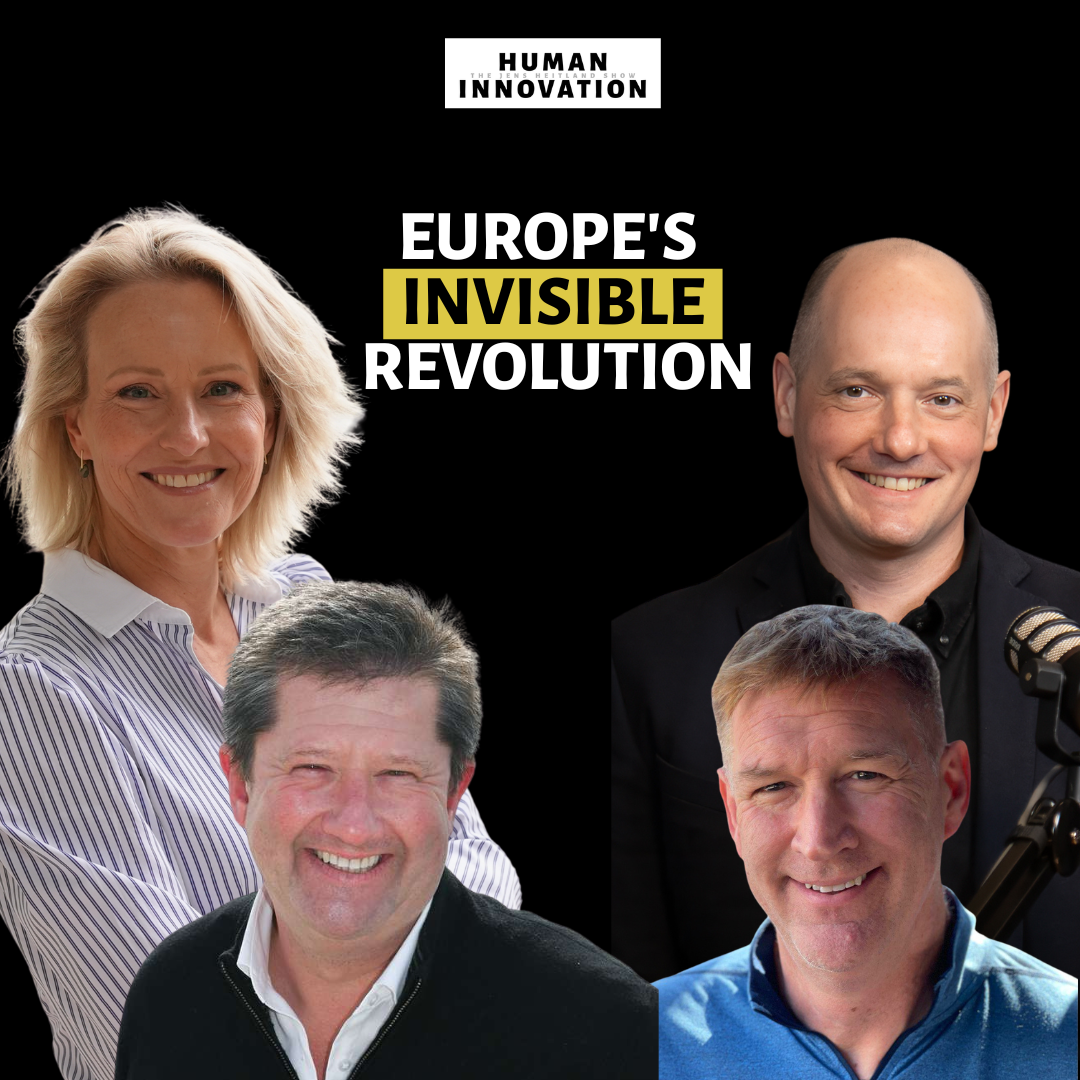
A panel of European business leaders: Annette Van Berge Henegouwen, Stephen Brooks, Stewart Guenther, and Jens Heitland, discuss AI sovereignty, open-source models, defense investment, and why European entrepreneurs remain invisible as they build critical infrastructure.
Youtube Podcasts
Europe is moving. The question is whether it is moving fast enough.
This episode brought together four people who have spent significant time working inside European and international organisations: Stewart from the US, Stephen from the UK, Anette from the Netherlands, and me. The format was simple. Six themes, one week of European news, and the kind of conversation that does not tend to happen in polished panel settings.
Across very different stories, the same patterns kept surfacing.
The biggest technology story of the week was the Europa AI consortium getting funded by the European Commission to build an open-source frontier model in 24 European languages. The reaction in the room was cautious optimism. Stewart pointed out the difference between a regulatory instinct and an ecosystem-building instinct, and why only one of those tends to produce lasting value. Anette framed it as much a geopolitical move as a technological one. If you have nothing to fall back on, you have no leverage in any conversation. Stephen raised the question directly: can Europe break the US-China AI duopoly, and is a state-sponsored model the right instrument to do so?
My own concern was more specific. The gap between open-source models and frontier models remains significant. Anthropic recently pulled Fable and Mythos. That event matters because it shows that organisations that have built their AI strategies around a single model or a single provider are exposed. For European companies in particular, where technology adoption within large organisations has historically been slow, the lesson is not about which model to choose. It is about building systems that allow you to swap models as the landscape shifts.
The success story of the week made that point from a different angle. Conduct, a London-based company founded by engineers who came out of Palantir, raised 51 million in a Series A to help organisations structure their data so AI can actually work with it. The problem they are solving is not glamorous. Most organisations have data spread across isolated systems that cannot communicate with each other, and a language model cannot do much with it. What Conduct builds is the infrastructure layer that makes AI usable at enterprise scale.
The interesting part was not just the funding. It was how quietly it happened. Three engineers building something genuinely critical, pulling tier-one global investors, and largely invisible in the European business conversation. European entrepreneurs tend not to beat the drum, and the culture has historically penalised those who do. The result is that the same stories, the same models, the same names keep circulating, while a significant amount of real work goes unnoticed.
The transformation and change theme brought in the KNDS story. Germany took a 40 per cent stake in the largest tank manufacturer in Europe and cleared the way for a roughly 20 billion euro IPO. The conversation about drones and modern warfare was a detour that proved relevant. Five years ago, drone warfare was not part of the conversation. Now, drones built by small, non-defence companies are reshaping how conflict actually works. The speed of iteration is extraordinary, and the capital required is minimal compared to legacy hardware. Applied beyond defence, the advantage increasingly goes to organisations that can test and adapt quickly rather than those that can outspend over long cycles.
The entrepreneurial thinking section of the conversation kept returning to a structural challenge inside European organisations. There is a difference between sandboxing innovation and actually implementing it. The sandbox gives organisations a sense of movement without exposure. The friction comes when something leaves the sandbox and starts affecting real processes, real teams, and real decision structures. That is the moment when most organisations stop, and those that do not tend to separate from everyone else.
The fuckup of the week was the cancellation of the Franco-German FCAS sixth-generation fighter program because Airbus and Dassault could not agree on who would lead it. Years of development. Significant investment. Real technical capability has been built up across the collaboration. And it collapsed not because the technology was wrong, but because the governance issues were never resolved. Stewart's read was that this might free up capital and attention for smaller, faster, more innovation-oriented defence companies across Europe. The more immediate lesson for organisations is this: knowledge built across a collaboration does not have to disappear when the collaboration ends. The relationships, the technical understanding, and the process knowledge all have value that can be redirected. The question is whether the people involved have the structure and the mandate to do that.
What connected all six themes, across AI policy, startup funding, defence investment, and a failed fighter program, was the same underlying dynamic. Europe is not short on capability. It is short on the communication and governance structures that turn capability into visible, compounding progress. That gap is not new. The speed at which the external environment is now forcing a response is.
Human Innovation with Jens Heitland is produced by Heitland Media Group.*
Guest Links
Stewart Guenther: https://www.linkedin.com/in/smguenther/
Annette Van Berge Henegouwen: https://www.annettevanbergehenegouwen.com/
Stephen Brooks: https://www.linkedin.com/in/stephenabrooks1/
Website:https://www.jensheitland.com/
Business: https://www.heitlandmediagroup.com/
LinkedIn:https://www.linkedin.com/in/jensheitland/
Facebook:https://www.facebook.com/JensHeitlandofficial/
Instagram:https://www.instagram.com/jensheitland/
TikTok:https://www.tiktok.com/@jensheitland
X/Twitter:https://twitter.com/jensheitland
Newsletter:https://www.jensheitland.com/newsletter
YouTube:https://www.youtube.com/@jens-heitland
Subscribe and listen to The Jens Heitland Show Podcast here:
YT:https://www.youtube.com/channel/UCjuSGi1feauCNSER3IKuGWg
Web:https://www.jensheitland.com/podcasthome
Apple:https://podcasts.apple.com/us/podcast/the-jens-heitland-show-human-innovation/id1545043872?uo=4
Spotify:https://open.spotify.com/show/7H0GWMGVALyXnnmstYA1NL
Transcript
[00:00:00] Jens: Hello, and welcome back to the Human Innovation Podcast. This episode is a special episode which is called The European Perspective, and I have three guests with me. Stuart from the US, Stephen from the UK, and Anette from the Netherlands. And together, what we are going to set out to do is talk about European business perspectives and actual topics that happened in the last seven days. And we do this in a way so that executives that are living and working in Europe can benefit from our perspectives. And what we're going to do is we take six different themes. We talk about technology, we talk about the success story, we talk about transformation and change, then deep dive in one specific industry. We talk about entrepreneurial thinking, and then we talk about the fuckup of the week. So let's get started.
Welcome Stuart, welcome Anette, and welcome Steven. are you all doing?
[00:01:02] Stephen Brooks: Well, thank you. Thanks for having us, Jens
[00:01:05] Stewart Guenther: Yeah, abso
[00:01:06] Annette van Berge Henegouwen: Great to be here
[00:01:06] Jens: Let's,
Start with, with the first topic, technology. So a lot of things happen in technology worldwide, but as well a lot of things are happening in technology in Europe. And sometimes we're overwhelmed with the news that are coming from the US if we talk about AI and technology, there's a lot going on in Silicon Valley where Stuart has grown up. But we focus today on the European market and what's happened in Europe in technology. this week happened something in the European AI movement, and I think what was super interesting for those that have not heard that, so there was, um, a consortium of different companies chosen, which was called Europa from the European government that got the goal or that got the funding, is maybe a better way of saying that, to an open source AI model, artificial intelligence model for Europe. I think that's super exciting because I'm deeply in AI and a lot of others are into AI as well. Let's start with Stuart. What is your perspective in the, the, the win of, of the Europa Consortium and building an open source model for Europe?
[00:02:29] Stewart Guenther: So this, first of all, this is a, a very broad topic that has a lot of facets to it. So let's focus first on the aspect of European ownership, European sovereignty as it relates to AI. We are nor- we are already seeing within the startup world of the last forty years, companies and the sovereignties to which they report to have a tremendous influence on business and business activity regardless of where they are in the world. it
Makes perfect sense that Europe is looking both on an ecotomic-- on an economic level to try and create a carve-out of AI for economic value as well as business value unique and centric to Europe. This also means it's going to have significantly more influence and be influenced by the theses and the mission sets of the different governments as well as that community.
So from a spirit perspective of let's get something unique to us where we can affect the weightings, we can encourage a local ecosystem, we can encourage secondary and tertiary effects from this core activity makes perfect sense. Word of caution, though. The other piece to it is we're used to seeing high speed changes within technology and adoption curves. have still not-- We have nothing even close to the speed of adoption of AI and the breadth with which this technology is going across different function areas, across different industries, across different processes. So as much as it's important for us to focus on what can we build for Europe within Europe, we are gonna be in a constant race just for technology itself innovating. So are we looking to create a solution which puts the brakes on certain things, or are we looking to create a solution which creates a ring fence? Very normal, very strategic mechanisms from the past technology waves. That's gonna be proven increasingly difficult. So how do we have a flexible approach as opposed to a hard line approach is what I would strongly encourage
[00:04:26] Jens: Nette, thoughts Stuart's points and on the topic
[00:04:32] Annette van Berge Henegouwen: On the topic, I, I would look at it from more from a strategic point of view, and that's actually that, um, Europe is lagging behind in an independence, uh, independency in actually energy, in infrastructure, in digital and innovation. And this is actually Europe making a choice, not just giving out options like the Draghi report, but actually making a choice.
So it's making a shift from just talking, regulating, to actually doing something. And yes, of course, the challenges are enormous, but it's a start, and if you don't start, you will not succeed
[00:05:09] Jens: Yeah, I agree
[00:05:09] Stewart Guenther: bringing up there, Aneta, is, is really important, and that is if this is a sh- truly a shift from a regulatory approach to an ecosystem development approach, this is gonna have lasting benefit. If this is a way to try and actually extend that ring fence to enable that regulatory approach, it, it will not matter if they're successful.
The technology's gonna find ways around it
[00:05:30] Jens: Steven
[00:05:31] Stephen Brooks: so, well, so have a think about this then. Can Europe actually break that US-China AI du- duopoly? Um, they're betting the entire bank on a brand-new frontier model right now, and it's a bold move. Uh, but open source state-sponsored AI historically struggles to match the raw speed of, of capital o- o- of Silicon Valley.
And instead of relying on Silicon Valley or Beijing, Europe's now trying to build a sovereign public good model in 24 different languages. I mean, it's a huge task, and, and actually it's a, it's an incredibly bold move. And, and I, and I think it's gonna be something that everybody's gonna watch very, very closely because who knows, in a few weeks time we could be talking about, or a few months time, talking about this being the fuckup of the week.
Who knows? So, I, I, I, I think it's, it, it's bold. Um, I think it's great that Europe is, is putting its best foot forward with this, and I'm interested to see where it goes
[00:06:42] Jens: Yeah, agree. I, I, think it's super fascinating to look into it. One, one thing that I'm interested in, in looking into is do they get the capital that is needed to build another frontier model, even if it is, let's say, European backed up, but do, do we in Europe consolidate the capital that is needed to get to that level? That's one part. Then what I love is open source, because I think that's the future, um, we build something that everyone can use and it is, uh, most of the time free to use. I think that's definitely, uh, one of the technical aspects that I'm super interested in. And then having something that is, um, coming out of Europe, because right now I'm using all the different models in, in my AI stack in the company, which is US models, but also, uh, open source, uh, Chinese model, but also open source US models. But what we see right now is still a huge difference when it comes to open source models to models that are frontier right now. And I think there is no frontier open source model that is out there on a European level that, that companies trust. And I think that's, that's the relating factor if we talk about big businesses. We have seen what happened, um, with, um, Anthropic taking back, uh, Mythos and as well the... How was it called? I even don't remember the other version. Fable. Yes. So Fable took back the, um, uh, they took back Fable, and that means as an organization, if you bet on using that model that's the, the, the most capable model, you cannot bet on one AI model at all. And as a company, you just need to de-risk, and you need to build AI systems that enable you to use the AI model that is best for you, and then open source is one of the ways, and a European model will, will help with that as well. Stuart?
[00:08:48] Stewart Guenther: So there, again, this is a, a broad topic, so going all the way to the top of the stack, and that is open source is critical here. To what extent, though, are the weightings and the tool sets being controlled on the back end? So the good news is by European-- by Europe selecting, that's what I wanna highlight again, by Europe trying to build its own ecosystem, you have greater control over those weights. To your specific point with Fable and Mythos, that was pressured by the US government because of the effectiveness and speed with which both of those models were able to penetrate a vast number of systems. So there is that risk profile. It's interesting how the timing is going with that because Anthropic is actually asking for regulatory capture as a way to both protect us and protect itself.
So pulling it back to it, what's the mission set? Is this purely a way to try and encourage a local ecosystem, which is what I think we need to be focusing on, and then how does it go from there? Open source is vital from an ecosystem perspective, but that in and of itself does not isolate or remove the optionality of other tools. The next piece to it is we are still within this phase looking for one model to rule them all, and there's going to be always that quest. But we are already seeing splits, as you're mentioning, Jens, in the different capability stacks of the different models and even within the scaling stacks of the different models.
So we're gonna be looking ve- much more of a tapestry approach. And right now, while we're still getting out of the black box and moving into much more of an easy mode of interacting with these different tools, it seems complex and shifting. Within the next three to five years, we're gonna see a GUI for AI. We're gonna see an ability to leverage on the fly different models and different agents based on the capability stacks they have. So it's excellent that Europe is getting involved now because it can still have a shaping function within local and international markets. But the big question is gonna be, is it just a way of trying to source capital?
Is it a way of trying to engender some form of control function around the discourse and the data sets? And how does that in turn affect the business processes?
[00:10:56] Jens: Nette
[00:10:56] Stephen Brooks: me, let me...
[00:10:57] Annette van Berge Henegouwen: it also be that it actually--
[00:10:59] Stephen Brooks: No, no, no. Go ahead, Annette. Go, go ahead
[00:11:01] Annette van Berge Henegouwen : Um, from my perspective, might it actually be that it's also trying to build some leeway to have different discussions amongst it in the geo-po- the geopolitical, uh, arena? Because if you have nothing to fall back on, what are you gonna say? And even if you have something that is maybe less good to fall back on, it gives you a different, different position also, uh, also there. And so far with, from Europe, we've been very much about regulation, very much about, uh, democratic systems, very much about, um, uh, an open, an open economy, you know, worldwide, and things are closing down. And to change the position from where we are coming in those discussions, it requires also different actions within our own region
[00:11:54] Stewart Guenther: One of the things that's interesting, and forgive me, Steve, one of the things that you're highlighting here that's interesting and a theme throughout all of these conversations and topics that the recency bias of the last 60 years, the way we've worked, the way we've navigated the economy is shifting. In my opinion, we are slipping back to the norm, and the norm is where you have protectorates within economic systems. You have protectorates just as you have within cartels of industry. We've gone from an extremely open, extremely free-flowing capital and goods model, and we're now actually starting to see these barriers, and they're not one-off barriers.
They're not just positions between two trading partners. These are becoming structural in that nature. And so getting involved with AI is, is a microcosm and a macrocosm of that larger trend
[00:12:43] Annette van Berge Henegouwen : I agree. Stephen?
[00:12:44] Stephen Brooks: well, I was gonna say, do you not feel that Anthropic being forced by the US government to pull its A- uh, AI models, um, out just as Europe's about to, um, act on a set of enforcement compliance, I think it's early August that comes into effect. Are we not looking at digital warfare by any other name? Uh,
[00:13:07] Stewart Guenther: this
[00:13:08] Stephen Brooks: Washington's showing that its advanced AI is becoming a strategic national security asset, and that they will cut off Europe and possibly the rest of the world if they feel that those regulations cross the line.
I'm, I'm, I'm quite worried about that. I know... Listen, the, the White House is gonna change in a couple of years, and who knows, that might all change. But it, it, it's worrying, I think, and, uh, I, I think we've all got to be looking at this from not just a, a, um, European perspective, but a global perspective in terms of who's got access and, and, and where that access is being forbidden just because people wanna, wanna protect their own security
[00:13:53] Stewart Guenther: So if I may, I'll build on what you're saying and challenge some of what you're saying. So historically, uh, going in reverse order, and I'm skipping a number of them, uh, Europe had a understandable concern about the power and the effect of Google, and the power and the effect of Google's access to data, and the effect it was having on the advertising spend and therefore cascading industries. Prior to that, we saw a similar fight when it came to Microsoft, and it became the Microsoft browser, and it became the Microsoft apps. So this type of when you find a power dynamic shift because of a reliance on a technology set, the European model has traditionally been negotiation and regulation, and the European model has been let the fi- you know, the fire the fittest. Where I would say there's a shift, where I'm agreeing with you, Stefan, where I would say there's a shift: Google tell the US government to pound sand. Microsoft was disinterested in telling the government to pound sand. Anthropic already has, and one of the things that's unique about this technology set is that if you have one of these frontier models that is proving to be as expansive and as accelerationist as it is, and then you've got a, a group within that company that feels empowered that we're going to be different.
The closest we had of this on the positive side was the initial view of Twitter. How do we facilitate more dialogue? How do we facilitate more interactions? And they were willing to go against the regulatory aspects of the US government to try and make that happen. Anthropic has its own set of values that they're not entirely clear on, and it's easy to poke at Anthropic, but I'll tell you, there's a number of Anthropics throughout the AI tech stack and other tech stacks that are going to have similar power dynamics, and it's gonna be very interesting to see how that evolves over the next two to three years
[00:15:46] Stephen Brooks: Agreed. Agreed
[00:15:47] Annette van Berge Henegouwen: There from like a enterprise perspective, isn't it the, like the main, the main lesson for this point in time, you know, be flexible, make sure that you have loose coupling with whatever provider you have, and be able to that, uh, surplus in, in capacity, uh, to switch when, when necessary because we are the, the, the ball, you know, uh, the cat is playing with or it like that.
Well, that's not an English saying, but you get my drift.
[00:16:20] Jens: Yeah, no, I 100% agree. I think every organization needs to have... If we, uh, and not just European, but I think specifically in Europe because we're, we're-- When it comes to technology, at least my experience working in Europe the last 30 years almost, we're late when it comes to technology adoption inside of large organizations, specifically large organization.
When it comes to AI and the AI strategies, we need to have that embedded into it to understand where do we put in which AI model, and how do we build it so that we can swap it straight away with almost like a, a mouse click. And I think that's super, super important. Um-
[00:17:04] Annette van Berge Henegouwen : Uh, and thank you, Jens, for, for that out. And it's not just in AI, it's broader. It's
[00:17:11] Jens: It is
[00:17:12] Annette van Berge Henegouwen : in redundancy in your, your operations, in your supply chains, because the world is changing, and it's not just AI.
[00:17:20] Jens: Yeah
[00:17:21] Annette van Berge Henegouwen : we've had COVID. We've had Evergreen getting stuck. Uh, it's, uh, Liberation Day.
Um, now. know, it's, it's all about creating redundancy, and it's going to have an effect also on the bottom line, um, or on the top line, depends on where you can push your cost to
[00:17:40] Jens: Yeah.
That, that leads us perfectly to the second theme, which is success stories. Conduct, 51 million Series A. Conduct is a European or company, uh, with the headquarter in London, so close to Stephen, and they got a 51 million Series A, and for Europe, that's a quite large Series A. interesting thing what they do is they built an operating system for AI, so they help organizations to structure the data so that AI can work with it. Because the challenge that a lot of organization have is have ERP system, they have a lot of different systems, and they're built in a way that they're isolated. They don't talk to each other. But even worse so, when you put on an AI, let's say, large language model, cannot read all the data at once.
The best thing for an AI model, what I've learned, is you have one folder and everything in it, a data lake or however that is called professionally. So what they do, they help to structure the data and make, make the organization fit for the future, and that's why I think there's such a hot run and, and that's why they have such a huge, um, for European level at least, um, Series A.
So I'm super stoked about that because I think this will enable organization similar to what we said with the previous organ-- uh, conversation. It will help organization to get AI embedded into the organization faster. Then one topic where we, we, we're not going to dive de-dive deep into that right now, but that is then more do we behave with that data and how do we utilize the data as an organization is a completely different topic.
First, we need to have the data structured so that, uh, that it can be used. So huge success story from Conduct. Really love it to, to see it.
[00:19:42] Annette van Berge Henegouwen: Yeah, there's a s- step before actually structuring the data, and that's actually retaining the data. And at, at its most granular level. It's like now the non-regret move for every organization is s- make sure that you have all your data stored. And it seems, it seems like something silly, but specifically from a finance perspective, the number of times that things get actually, stored at a higher level because of cost reasons, it does make sense, but going forward, not anymore
[00:20:17] Jens: Yeah, I agree.
Steven
[00:20:19] Stephen Brooks: listen, these are three guys from, uh, ex-Planetyre, uh, I, I think and, um, they're, they're battle-tested engineers who know data infrastructure, uh, and have, have been quietly thriving obviously here in, here in London. I think the interesting point here is that they've been able to pull elite tier one global investors, SAP Iconic Index. And while governments are fighting over, you know, AI blockades and language models, uh, uh, and, and practical layers, these guys have been terribly successful and quietly, you know, working away, bringing in the investment. And, and I'm, I'm really pleased to see that, you know, a European-based business, and I considered England to be part of Europe, r- regardless of Brexit before anybody starts, you know, throwing a hissy fit, we are part of Europe.
There's no getting away from that. The fact that a, a, a European country can, uh, uh, sorry, a European business can pull this kind of investment is is heartwarming, and I think that, you know, uh, i- i- if you're a European business looking for, for investment, here's a great story and a great, um, a great business that you can point to that, here's a good reason to invest in Europe, you know?
Silicon Valley's got plenty of people, uh, that, that, that are happy to always go to Silicon Valley, but start looking over this side of the pond because we've got some really great businesses, some cutting edge technology. I know we're gonna get into drones and all of that sort of stuff and tanks in a, in a, in a little bit which is, which is even more exciting.
Um, but I, I think that's, that's something that we should, we should really be celebrating and, and I'm really interested to see where these guys take this business.
[00:22:07] Stewart Guenther: several key data points here. Let me build off what Steven you just talked about. prior to COVID, Silicon Valley represented as much as 85% of the venture activity globally COVID was a seismic shift. COVID, through its lockdowns, created an environment in which it demonstrated successful startups can happen anywhere, and that because of technology and access and things like Zoom, after you've done your first deal with a management team that you've never met in person and your first set of board meetings that you don't get on a plane, it st- it shifts from an anomaly to a new baseline. shifts from a cost of business and a cost of expense to a function around acceleration of investment and supporting portfolio companies. The next thing is there's a bifurcation that's happening within the investment market. We are still seeing, and we will continue to see, large dollar Series A. So these are the first-- traditionally the first large amounts of capital going into a startup, into a high-risk venture that we're expecting is gonna be shifting industry in some meaningful way. AI is benefiting because of its speed and the anticipated impact, which is driving large amounts of money being invested into these companies. We have actually seen this model before, with this size of, of, of dollars, but Web 1.0, early
[00:23:40] Stephen Brooks: Jens
[00:23:41] Stewart Guenther: enterprise, SaaS 2.0. Each time there's been a technology wave in which it's perceived to have a broad-based effect on the economy, large amounts of dollars tend to chase very small numbers of deals, leading to these outsized investments. That is not to say that they're not gonna be able to put this to work. That is-- But it means that not every Series A, which is traditionally in the three to five million dollar range, is now a fifty million dollar deal. There is, depending upon the impact that that coming is bringing, is gonna have a large, and the team that is driving it, is gonna have a large impact on the amount of investment and the pressure of expected returns and the speed of those returns. So let's break this down. We talked about data lakes. This is an important piece that goes into the larger part of AI. believe that we have crossed the top on the hype cycle, and we are about to drop into the trough of disillusionment. major technology wave goes through this. Gartner's correct in this regard. And what n- this has happened over the last roughly thirty years is there comes a point when industry says, "I've invested a serious amount of time money and personnel for returns. Show me my returns." And every technology ends up having a point where the show me the money makes them realize investment for investment's sake, whether you are the company who's acquiring the technology or the investor who's backing the technology, it's not living up to the expectations.
It's not proving either that efficiency, productivity, and therefore profitability, or the shift within the business model leading to increased profitability. That's now happening within AI. And part of that, and part of the reason I believe this company received such a large check, is as you mentioned, Jens, we have been investing s- in some industries since the '60s in sensor networks to create data lakes. lakes are just that: they're lakes. You need to convert data lakes into actionable intelligence. That actionable intelligence needs to be integrated into the business processes that are in turn driving that efficiency, that productivity, and that profitability that ultimately justifies the investment. What is this company doing? They're solving a critical infrastructure gap in how do I transition that data lake into actionable intelligence? And so as you look within your technology stack that you're investing in, or that technology stack you're investing your resources to leverage, how is this part of that larger process?
How is this part-- how is that tech stack affecting? I will actually predict right now this is a standalone product. a short amount of time, this will increasingly become a feature. So what are the products beyond the conversion that are gonna enable us to extend that product focus and that impact?
That's gonna be a real telling element. The last piece to it: I started around how Silicon Valley showed that you... uh, sorry, that COVID showed Silicon Valley is a critical place. It's no longer the critical place. And so differentiation, trying to find those e- elite coders, trying to find those elite startup builders, as Stephan is talking about, orienting around your target market if it's Europe, your target market if it's Central Asia or Southeast Asia or the Americas. Being lo- co-located there to attract that type of talent to go after that type of market, it makes sense. The current model and the old model is go to Silicon Valley, conquer the world from there. This is another example of you can do it from your own backyard
[00:27:20] Jens: Yeah, agree. What, what I love about that story is it's inspiring for other entrepreneurs in Europe, and I think that's still not there yet on-- If we compare it to Silicon Valley, we have a lot of amazing entrepreneurs in Europe, but nobody knows them. They're not so out there and not so visible. So the trust in these three, uh, I think, amazing, and I think that's, that should highlight the opportunity for a lot of young founders. The interesting thing, what, what I've seen, because I, I kind of, I'm connected to the AI l- industry a little bit in Europe and, and I look into that because I'm just fascinated by it. I know a couple of service companies, they do the same thing. They just don't do the technology version of that. They do the service for organizations to, to get it and help them doing that from the inside. So what is also quite interesting to see, so if there's one big capital investment in a company li- like this, there are a lot of companies that will follow and then will support this. Because to your point, Stuart, it's a huge need. Every single organization across the whole world, I, I, I bet at least on, needs that, needs a way, especially the legacy organization.
If you're not-- Let's say, if you're older than two years, you need something like this to, to be able to leverage the data that you have. So I think it's amazing that, that they got the chance to, to, to really get, get going, and I hope we will have more this large capital sums in, in Europe because it builds trust, and then the talent flow will come as well. And I think that that will be exciting for a lot of startups and for a lot of entrepreneurs from around the world.
[00:29:10] Stewart Guenther: With, with engineers starting at half a million dollars to a million dollars, with startup companies being valued often as the quality of the perceived... quality of the engineers as much as technology has a huge impact, being able to have access to that talent. Hey, come to the Valley and be part of the Valley.
That was the old siren call. Hey, stay close to your friends. Hey, stay close to your family. Hey, be part of this ecosystem that's growing here and be a larger player here. That's attractive. And with so much demand for this critical small number of elites, this is a differentiation point that's not just...
It's excellent that Europe is focusing on this, but we're gonna see this in Mena. We're already seeing this in Singapore and Southeast Asia. We're gonna see this again in China. We're gonna see this in these different places where it's going to be a, "Hey, how do I defend my backyard and participate in my And then the next part within each of those geographies: how do I attract the talent from others? It's no longer one way to the Valley. It's now where's the best opportunity, lifestyle opportunity, and business opportunity, and that's fungible for this small group of people
[00:30:24] Stephen Brooks: Can, can I just pick up on something you said, Jens, about, you know, entrepreneurs? What, what Europe lacks are visible entrepreneurs, right? And, and, you know, if one thing that Americans are great at, Stuart, is banging their drum and, and, and promoting themselves. And Eur- the Europeans we- we're far more reserved, aren't we?
And I would, I would challenge entrepreneurs who are watching this now, if you are, you know, pulling in large amounts of funding, if you are creating businesses, not just in AI, but in, in any business, you should, you should be out there telling the world that you're European, you're building a business, you're attracting investment.
And the more that you do that, the more you will encourage more entrepreneurs in Europe to do exactly the same. And I think we, you know, we ... You're right. 20 years ago it was come to Silicon Valley, right? But now it's, it's come to me. I work, I'm creating this. You can be part of this. In fact, you don't even have to come to me.
You can stay exactly where you are, but be part of my journey because of the, the amazing technology we've built over the past 25, 30 years. So I, I, I, just ... During the course of these interviews, I'm gonna be really passionate about entrepreneurial spirit because, you know, that's, that's been my life and, and, and I've
Like I said, I, I would challenge any entrepreneur that's out here that's raising capital in Europe. A, I think we'd love to hear from you. That's one thing. That would be great to, to promote your story. But, but, you know, be proud about it. Beat the drum. Get your name out there and let people know to help other entrepreneurs attract that funding
[00:32:09] Stewart Guenther: So let's directly challenge the business executives and the business leaders that are listening to this and elsewhere. What you're describing, Steven, is we have to fight the tall poppy syndrome. We
[00:32:20] Stephen Brooks: Yeah
[00:32:20] Stewart Guenther: Because if you are a European and you are the type of person who's willing to thrust your chest out and take the risk of being a tall poppy, where are you going? You're going to the Valley because that's celebrated. You're not going to a place where we're building you up to cut you down. So we as executives, we as business leaders actually need to acknowledge there is value in this, and as much as we are uncomfortable, it's leaning into that discomfort that actually can create real value.
And the second piece to it that's the other side of the same coin, we are still, after forty-plus years of Silicon Valley, after the DAX being formed, after there are a number of large successful startups that have come out of Europe, we are still a risk-averse baseline, especially financially. So there needs to be a willingness, just as we're gonna fight the tall poppy syndrome, we also need to embrace what do I gain from the failure of this entrepreneur? of course, we want to invest in them after that failure. But even if it's an entrepreneur, when they fail, what do they learn and how are we deriving value from that? And it's not so much that we're encouraging failure, it's we're encouraging the transition, we're encouraging the evolution that comes from those learnings.
[00:33:38] Jens: Yeah. A key part of that is back to what Steven was saying, not just because I- that's literally what I'm doing for a living, but you're building trust by communicating. And it, it... Sa- same to what you s- said, Stuart. You're building trust even when you're communicating about your failures, and that's a no-go in a, in a European culture perspective.
In America, um, with the people that I have met over my career, you are s- you are explaining that you have failed, and you're, you're saying why you have failed and what you have learned. In speaking from a German perspective, it- that's not the way you, you, you do things. You try to hide that you failed, and you're not sharing anything. Um, even not to your loved ones or team members. Like, literally, you're trying to hide and put everything under the carpet. So that's a shift when you start communicating, utilize and, and use that as a good example and share that you're failing, but then help other people not to fail with the same thing. 'Cause as more we help each other, as more successful we are. And, and last point on the trust, especially as a European, understand the whole GDPR topic inside out because we're
[00:34:55] Stephen Brooks: Mm-hmm.
[00:34:55] Jens: for the last 20 years.
[00:34:57] Stephen Brooks: Yeah
[00:34:57] Jens: It's native to use. L- like GDPR is native, and I th- I think for this Ge- uh, these guys as well, it's native for them, and that builds trust with European organizations that have that need right now. I think that's, that's brilliant. They should leverage that definitely going forward. So let's get us to, to, to the next topic, transformation and change.
So there's a lot of things going on on a political level globally, um, and they are triggering a lot of things. We have seen just I think it was yesterday or the day before, the, the European team being in the White House and discussing with, uh, uh, President Trump and, and the others around the topics.
I will not go too much into politics, but what happened because of that and because of the, the things that are Europe closer together, there was, um, an investment where G- where Germany took a forty percent stake in KNDS, which is the biggest tank manufacturer in Europe. And what is interesting was that with this, they're allowing this company to go public, and that means there's a lot of capital flow into a tank manufacturing company in Europe. What do we think about that? Steven, I've heard you have, have a strong opinion on that.
[00:36:29] Stephen Brooks: my, my first point is do we need tanks? Uh, d- I mean, there are massive investments in drones. Look at the war in the U- in the Ukraine. Look at, at, you know, d- just, uh, uh, I'm sure somebody's already developed a, a, a tank that you don't need to be in to, to fire. But yes, I mean, it, it, it, it's wonderful that they get a 40% stake in a, in, in, a business that in just a couple of weeks is gonna have a, what is it?
20 billion euro IPO. Um, uh, I, I also think that the other thing we've got to consider is, you know, America's, uh, stance on NATO and, and, and, Hesketh recently just saying, "Listen, um, you guys better pay up, um, or, you know, we aren't gonna have a NATO." And, and, and I understand that, and I think it's right that each government should pay for, you know, uh, what it uses and, and, and how, how it uses it.
Um, but going back to your, uh, your original point about KDS, um, it's, it's, it's the threat of, of US troop drawdowns forced Berlin into instantly clearing red tape to scale up European heavy armor production. I mean, that's, you know, that's one of the reasons why they've, they've gone into this. Um, it's, it's really, really downstream, I think, of what Eg- the He- the He- Hesketh deadline is all about.
And at the end of the day, listen, war is good business, not just for Europe, but for, for, you know, the rest of the world. And, um, industrial defense is rushing to public market to, for funding. And, and so it, it again, it's, this is, I think, a topic that's gonna come up time and time again during this, this series.
Um, and, and who knows where the next big investment's gonna come from
[00:38:26] Annette van Berge Henegouwen: Yeah, I fully, fully agree with Stephen that, uh, it seems investing in the past instead of in, in the future. And I was, uh, very happy to read that the Netherlands actually funded nine hundred million into the drone line initiative in, for Ukraine, and that Ukraine is actually supporting the US in their efforts in Iran to, uh, uh, to do, like, modern warfare instead of sending tanks. Um, yeah, not even looking into the difficulties that we would have within Europe to actually ship those things from the left side of Europe to the right side of Europe, uh, because of the different transport, uh, sizes of our train systems. So it's, uh... And I'm by far a defense, uh, expert, but, uh, does make me wonder.
[00:39:19] Jens: Jihad, what, what's your view being o- on the other side of the pond?
[00:39:24] Stewart Guenther: glove has been thrown down. Here's my chance to, to take a contrarian view. So let's look at this. There's a number of things that these are, this is a critical harbinger for, and I think longer term, positive maybe is not an artful language to use here, but I think this is actually a positive outcome for the very reasons that, uh, Aneta and Steve have mentioned. First, let's break down. Uh, yes, we're moving to a drone warfare. Let's r- let's change that framework. Drones mean unmanned What is not going to change is that the battle space is still under the water, on the water, on the land, in the air. It is also increasingly under the land, and it's also increasingly in space. What is drones change? It doesn't change any of those realities. It doesn't change the realities of force projection. Drones are saying we can make remote, and AI iding, uh, adding onto it is we can leverage swarm and therefore minimize the amount of human engagement in order to do that power projection. So as long as there is land-based activities, there is a need for tanks. Right now, we're thinking of tanks as large metal boxes with people in it. You just remove the people, and it's just a drone that's a large metal box that needs to be able to s- have survivability against other large and small metal boxes that are designed to take it out. Next piece on top of this, why is the forty percent take, I believe, a bit transformational? We are used to, and we'll be talking about this in a future story, we're used to, in particular in Europe, governments looking to merge their activities around defense ac- defense investment as a way to bond the different economies together for a common outcome. this is different. I read this as this is a government that's saying, "I'm gonna put in the risk capital until the market catches up, and I'm also, by making this deployment, identifying this as a strategic asset within my technology stack. So as much as I'm benefiting from this, I am putting my thumb on the scale in a different way." The old model was, how do I pump government money into it that it kind of quaas- quasi claims to be revenue? How do I pump re- revenue into this or money into this as a way to try and discourage competitors and increase consolidation? By allowing this to IPO, if this works, we're gonna see other companies wanna try and have build metal boxes or under the ground metal boxes or under the water metal boxes.
It creates that ecosystem opportunity, and it shifts and changes the way government interacts, and that's the next macro piece to it. do not like this, but this is reality. We have benefited from recency bias on focusing on technology innovation that improves the consumer, technology innovation that, in theory, improves efficiency. This has actually left a significant amount of material science, a significant amount of base industry, and a significant amount of base s- monetization of base science on, in the background we're now returning to an environment, a multipolar environment in which material science is gonna be mission critical, whether it's affecting the size of those drones, the longevity of those drones, the power projection, which then we can turn into new ways of shipping a product, new ways of creating efficient supply chains. This is enabling us to ease into defense spending is a critical portion of my overall strategic economy as a nation state. So we can beat up on Hegseth, we can beat up on Trump, but they're-- what they're doing by allowing folks to throw pins in the US with them, it's changing the conversation within different regions to say, "I am going to go against you and defend my space. And my space is the economy, my space is the nation state, my space is the defense state. And so I am gonna yell at you." But if I-- Just turn back the clock 10 years. If they had made this investment, if Germany had made this investment 10 years ago, how many Germans would be saying to themselves, "We are bad Germans.
We can't do this. We must connect with the French. We must connect with the Spaniards. We cannot do this alone." But now they can say, "Evil Trump, bad guy. We're gonna make a move." And I think this is freeing. I think this is positive for all the nation states within Europe
[00:44:03] Stephen Brooks: Not that I want to get into politics, but isn't that Trump's superpower? That-
[00:44:07] Stewart Guenther: pissed at them so they take action?
[00:44:08] Stephen Brooks: Well, yeah, yeah. Just, just, just keep everybody off balance
[00:44:12] Stewart Guenther: 100%. No, I, I think it's, I think it's one step further. It's
[00:44:14] Jens: Strategy
[00:44:14] Stewart Guenther: to have everyone be angry at me 'cause
[00:44:16] Stephen Brooks: Yeah, yeah, yeah. Yeah. Uh, yeah. Yeah. No. Yeah. Yeah.
[00:44:21] Jens: Negative attention is still attention
[00:44:25] Stephen Brooks: You can't buy that column inches
[00:44:28] Stewart Guenther: But I, I, if I'm predictive, you'll notice my language is to be predictive. For those of us, and hold me accountable, I believe this is a shift in how the European economy is thinking about investment and thinking about industrial
[00:44:44] Stephen Brooks: Yeah.
[00:44:44] Stewart Guenther: and I think
[00:44:45] Stephen Brooks: 100%.
[00:44:45] Stewart Guenther: positive
[00:44:47] Jens: Yeah, looking at it from an innovation perspective, uh, I would agree what we have seen the-- a lot of technology development and innovation development came from this time. So if we look backwards in the Second World War, a lot of things have been developed that then later on went from, let's say, war perspective into normal industries.
So the, the knowhow and the speed. If, if we, if we just take the drone e-example that Stephen mentioned. Five years ago, we have not talked about drone welfare, where-- warfare, not welfare. Warfare. And, and now they have increased their capability, especially over the last year, the last twelve months, extremely.
That's fast innovation cycles. I'm all against wars, but what I love to see is how fast they are testing, how fast they are failing and iterating and then putting it to the next level. If you just look at what's happening. I mean, if... thing if, if we, if we look at the Middle East, what happened. Um, day one, the Iranians were, were sending out drones in,
[00:45:58] Stephen Brooks: Yeah
[00:45:58] Jens: in, o-over the, the, the water, that would not have happened twenty years ago. So the adaptation is way faster. And of course, with that, the capital investment into a drone, comparing it to a, a massive tank, is also nothing comparable. I've, I've seen figures five thousand dollar or euros, we are in Europe, euros, for, for a drone. Comparing it to a, a cruise missile or something that cost hundreds of thousands is, is super innovation from an innovation perspective. So what I like about that is, is just the speed of innovation. Linking it to, to the K-KNDS investment, what I hope that they take this speed of innovation as well into a company like this because going public, there, there are a lot of economical reasons for that. But as a European, I-- what I would love to see is how do you do that in a way that other companies can benefit from it and the ecosystem in Europe can benefit from it, and not just building tanks, but building innovation that can be leveraged to, to move things forward.
[00:47:08] Stephen Brooks: The, the interesting thing about that drone market though, Jens, is a lot of those manufacturers weren't even defense-orientated. They, they were smaller entrepreneurs that obviously, you know, saw, saw a, a gap in the market, if you like. And, and again, I go back to that entrepreneurial spirit across Europe.
You know, there's, there's taking a, a, a practical, uh, product and then, you know, diversifying into all sorts of different, different ways. Amazon can't get a parcel delivered by a drone yet, and yet we can go and drop a bomb somewhere in Iran or, or the Ukraine or Russia. That's a, that's an interesting point.
[00:47:45] Stewart Guenther: So, so Zelensky has been telling us that, uh, modern warfare has fundamentally changed for going on five years now. Um, those folks who pay attention to the change in state and how warfare is being done there, this is... I believe historians, this is not a hard prediction, historians are gonna be talking about the Ukraine-Russia conflict the way they talk about the American Civil War and how much of a harbinger it was for the conflicts of the 20th century. And I believe we are, we are... One of the reasons, Annette, you mentioned Ukraine is helping out is because the conflict with Iran has really shown how much of an asymmetry there is between modern technology and its ability to just simply adroitly, uh, just nullify the dominance of a hyperpower, and it has to do with what you're saying, Steven.
We're focusing on fighting the last war, while America has innovated very, very well, it's still, because of its dominance, been fighting in the space that it always dominated.
[00:48:46] Stephen Brooks: 嗯嗯
[00:48:47] Stewart Guenther: no longer c- That is not currently the case. So the last point I'll make to it is, why is it these entrepreneurs are the ones who came up to it? Because it wasn't a gap in the market, it was an abandonment of the market. It was an
[00:48:59] Stephen Brooks: This is better, yeah
[00:48:59] Stewart Guenther: decision in the Valley, anything to do with defense tech, literally until roughly three months ago, was persona non grata. You will not do it. we're now in a situation in which it's not a good guy, bad guy anymore.
It's this is, this power projection is real, so you can join either side of that fight, offense or defense, and have a net benefit to humanity. Sitting this one out is no longer an option, and therefore it allows... And that's right. The last thing I'll say is, what is this IPO showing? It's communicating to the European investment community there is an exit market, and that's critical.
Investing just for national security stake doesn't make your LPs happy. Investing for national security that's gonna give you an above average multiple into a guaranteed exit, that's interesting, and that's what this is showing
[00:49:51] Jens: Let's move on.
Next topic, entrepreneurial thinking. We already touched the, the two key topics, uh, connected to that, and we, we started to dive into to this. But I would love to double-click on, uh, one part, the Europa, consortium of, of the AI open source model. And what, what, what was fascinating for me is that it was an Italian firm which I-I, uh, called Domain,
[00:50:21] Stephen Brooks: Mhm.
[00:50:22] Jens: you pronounce that.
[00:50:23] Stephen Brooks: Yeah
[00:50:25] Jens: so, so they brought different stakeholders from different European countries together to, to then win this, this, uh, prize, which I think is extraordinary. So it's a European, gathering of different companies that are supporting the, the same goal. super entrepreneurial thinking. Then same with the three leaders that, that came from Palantir, building the AI enterprise and, and getting the fifty-one million. Entrepreneurial thinking in Europe, I think, has still, like, like we already mentioned, still to grow and still to, unleash the, the opportunities because it's always seen as, I don't know, at le- at least what I've experienced, it's always seen as, the, the, the dirty world. Like you, you, you are a capitalist, you want to earn money and, and you go into, in, into entrepreneurship. I'm, I'm working for a large organization. This is all capitalist as well, but I'm just contributing to an organization. And, I think we h- we have huge opportunity with entrepreneurship, especially with the AI-- the rise of AI, uh, happening right now and agentic AI and so on. What are your thoughts on these two stories and entrepreneurial thinking for organizations, but also inside of startups entrepreneurs in general? Let's start with Anette this time.
[00:51:50] Annette van Berge Henegouwen (2): The entrepreneurial thinking with the ecosystems that are being created for AI, for defense, um, those are all great examples of how we can actually, create, create an atmosphere that it's okay to step out. But it's really about creating a mindset that it's okay to be indeed, to, well, be one of the tall poppies, so to say, instead of, uh, trying to, uh, uh, cut the head off the, the tall poppies.
[00:52:21] Stephen Brooks: Can I, can I just dive in? Uh,
[00:52:23] Jens: Yeah
[00:52:23] Stephen Brooks: so a quick history lesson, right? The word entrepreneur actually comes from the 13th century French verb entrepreneurer, which means ... And I didn't get that right, I'm sure. Which means to undertake, and was actually for people to invest in, in music and, um, the arts. And of course, y- you know, during the 13th century it's, it's used quite a lot, and then it, it tails off, and then it starts to rear its ugly head again at, around the, around the '70s and '80s.
And the problem I've got with entrepreneurs is it's a, it's an overused word, right? It ... When you don't know what to call yourself, you call yourself an entrepreneur. And, and, and that's, that, that, that's what you're saying. It's, it's almost become like a, a, a little bit of a dirty word. You don't ... People don't really take you seriously.
Serial entrepreneurs and, and, you know, we ... There are many across the world, I mean, carry that and wear that, I think, with a, with a badge of respect. But i- if, if we're to promote entrepreneurship, we've got to, we've got to kind of raise the credibility of what it means, and, and I think that's, that's a big challenge.
Um, it ... I'm hopeful about the whole of European entrepreneurs, you know, standing up and, uh, like I said earlier, and being counted. But, uh, we, w- we, we just, we just overuse the word so much that it's lost its, it's lost its meaning. I'm sorry.
[00:54:08] Stewart Guenther: Week and a
[00:54:08] Jens: Yeah
[00:54:09] Stewart Guenther: my family, uh, wife drove to Bad Zell in Austria outside of Linz and picked up some, uh, rolls for breakfast for our kids and for us, and was very proud to come back and say, "Hey, this bakery was established in 1280." And right now, throughout this process, um, we're talking about the dynamism of t- of, of data and digital, and the dynamism of AI, and of taking risks. Europe has been successful, consistently successful in the analog sphere. And it has modified, and it has evolved, and it has transformed analog systems to create efficiency. So most likely, if you're watching this, you're going, "Hey, I'm, I'm not looking to create the next social media app. I'm not looking to create the next AI frontier model. I'm, I'm involved in a business of humans selling to humans, providing critical resources, transforming critical resources that are either part of a supply chain or the end of a supply chain that's affecting an industry or a people." Entrepreneurship is r- in this regard, I would say what's important about what we're hearing in all of these themes that are tr- that can be transferred to your business, that you should be thinking about to your business, is this is not a call to move away from the value and the stability of the analog business model. It's how are you finding that incremental efficiency that protects and extends your business? How is it you're leveraging technology and leveraging an innovative mindset to look for improvements of efficiency and productivity? Because even as we're gaining tremendous amounts of both from AI, we are going to then benefit from taking those resource savings, and at the very top of this conversation, reinvesting those savings into the diversity of how we manage those digital systems, be they AI, storage, or other tool sets.
This is not a freebie. AI is giving you incredible ability to do new things. Part of that is gonna be to continue to defend and protect your own business from the very tools that are empowering it. this is a critical aspect. When we talk about the pol- the, the tall poppies, and we talk about the addressing the risk tolerance or the failure intolerance, it's not all of a sudden I'm gonna be a gambler. It's acknowledging a shift in the risk profile and making smart investments and leveraging technology that is still core and beneficial to your base system that enables you to out-compete your competitors, which you have to do now. Because the one thing we can 100% assure you is if you stand still, in five years, you're either in an industry that isn't relevant or you're done, and neither of those are attractive
[00:57:15] Jens: L- love that. W- w- what is quite interesting, link- linking that to organizations in Europe, it's, it's the mindset. It's l- like, like you said, if you are a startup, if you are, uh, an entrepreneur, you're, you're basically running every day and testing and figuring out, most of the time with the back to the wall, at least in my case. And you have in large organization, and Stuart, we have been working together in, I think it was 2015 around or '14, '15, on, on this kind of topics in one of the leading organizations in, in, in Europe. How do you bring that into the organization so that it's going to happen and that is linked to behavior and mindset, and that is so critical that organizations internally need to find out how do you shift mindset and almost the culture of an organization from a protection mechanism to, um, a more, let's say, invention and testing or- or- organism because the world is so fast with AI and the technology. And it's not all about technology, but it just, it is so fast and the external world is forcing you to change faster. that means you need to look internally, how do you build the mindset and the teams? Because we as humans, we, we don't like to change, but we have to learn to change faster. And as part of that, we need to build completely different structures of organizations most probably to be able to keep up with that.
[00:58:50] Stewart Guenther: this is not a commercial. We didn't talk about this, but if I may, Jens, I, I'd like to reference you and Stefan as examples of exactly what you're talking about. And then first and foremost, for those leaders who are watching this, as much as this is a call to action for you to change, the truth of the matter here is it's empowering and finding the Jens and the Stefans within your organization. Find an individual who's demonstrated a willingness to think differently, to communicate and take the risk of communicating differently, and empowering them to take action, and that is two sides of the coins we talked about. That's accepting the potential risk and facilitating a change of behavior of your business, a change of processes in your, your business, and then monitoring what they do. If you find someone who's capable like Jens, who has that ability to understand the core business model or aspects of your core business model and can demonstrate to you in a concise way how to make those shifts, or as Stefan has, to make those shifts, and then you can either... You can do everything from the easy one is I sandbox this. The problem with sandbox thinking is it feels like you're making a change, like a snow globe. You shake a snow globe, and it's different, but you know that at the end it's the same. It's you need to get out of the sandbox, and you need to be... That's where the risk tolerance is. By incorporating and encouraging these two types of people, you're gonna end up having either a shift in your core business model that extends its longevity, business model that stacks on top of it or around it that provides new revenue streams or new engagement with your, with your customers, as Stefan is a prime example of.
And in any of, in any consistent way you become known as an executive who fosters this, gonna start to attract like-minded people into your organization. You demonstrate in the market you're willing to take these type of risks, own the time it doesn't work, own the time that it works in a positive way in that how it benefits your customers, you're gonna attract more customers. It really is the, the, the risks are completely outweighed by the benefits here. But that first step is hard, and six months in, when you're hitting friction, it's easy to box it. It's when you're hitting that friction point, that's when you're actually doubling down on the empowerment. That doesn't mean you have to double down on the financing, but you're doubling down on the empowerment to then find those mechanisms.
'Cause my portfolio companies, if they haven't broke something this week, they're behind. If they haven't fixed things from last week, they're behind, and we need to incorporate that. That doesn't mean we're becoming a whole new company, but the more you can incorporate that and empower people within and leverage people from out to facilitate that, it's gonna meaningfully benefit you. And you might come and buy some software from some of my companies
[01:01:41] Annette van Berge Henegouwen: There's additional aspect to that, Stuart. It's not just coming from you need to be more prone to taking risk. It's actually going back to why are you doing this? What is the purpose of the organization? What is the purpose of the people in the organization? What do they create value with, and how, how do they do it?
And then to your point of when the friction... There's no shine without friction, but it's not about obliterating those who actually create the friction. It's about converting the naysayers to yes-say- yaysayers. If you have a need for a change from, you know, a good point where it actually adds to the value of the organization, and you then start with the ones that are very forward, very innovative, that's easy.
But then the rest of the organization is not going to follow. What you wanna le- actually focus on those who are opposing it, because they are opposing the value creation of the organization. No, because have good reasons why something wouldn't work, and then address those difficulties and take them along. So it's at both end. And you need, you need to do that 'cause otherwise you're only going to take the forward, the forward-looking, people in the organization with you. And you need the whole of the organization 'cause you can't build an... Well, nowadays, of course, Stephen, you can. You can have an organization with you and another half person.
But, but still, generally speaking, there's more people there
[01:03:20] Stephen Brooks: I just wanna sum up one point that while you were talking, Stuart, this came into my head and it is that you've got to get comfortable with being uncomfortable, and you've got to find people that are prepared to get uncomfortable in that journey. Because otherwise, like you say, it's easy to sandbox test and, "Oh yeah, we're, we're innovating, we're sandbox testing."
That's complete crap because if you're not taking that sandbox and implementing it, you're just testing. It means nothing, right? So you gotta get, you gotta get comfortable with being uncomfortable. You've gotta find people that are happy being uncomfortable on the journey, and then you will propel yourself forward
[01:04:02] Stewart Guenther: Yeah, 100%.
[01:04:04] Annette van Berge Henegouwen: And as a leader, be able to contain the discomfort within the organization
[01:04:10] Jens: Yeah, agree. I
[01:04:11] Stewart Guenther: I don't think
[01:04:12] Annette van Berge Henegouwen: it's going to break down
[01:04:13] Stephen Brooks: Absolutely. Absolutely
[01:04:14] Stewart Guenther: One of the things, and, and Annette, I, I, I w- I need to get to know you better to have some examples, but what I can say from Jens and Steven that your ability to concisely determine, "Here's where we wanna go," that doesn't mean you're defining the end state. It doesn't mean you're describing the pathway of where we are now to what that end state is.
But instead, you're making it a positive challenge. "Here's where we are. This is the state where we need to be." You as leader are communicating, "This is the change in the market. This is the change in the business processes. This is the change in the economic realities that are happening. We need to navigate these." And then you challenge your organization to say, "How should we tackle this? What are some ways that we can turn..." My favorite thing is, it's a Silicon Valley, but it makes a difference. It really makes a difference. How do we turn our weaknesses into strengths? How do we acknowledge those weaknesses? Because they may actually be identifying areas of attack, areas of challenge, areas of, of evolution that in turn open up new things. And instead of, "How do I mitigate my weakness?" it's, "How do I acknowledge that and expand on that?" is just one facet to consider here. But the key thing I wanna leave us with is our job is to say, "This is the direction and the end point, not the description, but the end point I want us to achieve. Here is the lay of the land that we're gonna have in that process," and then challenge your team to navigate and build out what those things are, and you're gonna be surprised
[01:05:41] Jens: Let's get us to the last topic of European Perspective version of today, the weekly fuckup. There was a fascinating fuckup. Um, the Franco-German sixth generation FCAS fighter program was killed because Airbus and Dassault couldn't agree who is leading the whole thing. I, I, I leave it at l- uh, as that.
Who, who wants to jump in first?
[01:06:12] Annette van Berge Henegouwen: . I actually live, uh, cl- uh, nearby a facility of the ESA, which is a pan-European, uh, space agency. And, little that I know of the organization, but what I do know is they have everything written out, very tight procedures, and everything on a gold scale to make sure that it's done equally within, uh, with all the partners. And they are a very great success. So it's not that it's not possible, but it's been, it's been created from the get-going to actually achieve that. Um, and at the same time, they have this... all their communications, you, you read about them and hear about them reaching out to all the types of organizations and learning.
So there's this very structured way of doing what they do and at the same time being very open. So I thought that was a, a good, um, a good juxtaposing towards the, uh, the Franco-German, uh, uh, um, fuck up. Steven, to you
[01:07:20] Stephen Brooks: So here's what's interesting. That, that the French and the German can agree on tanks, but they can't agree on jets. I, I mean, it, it is almost like... And it, it, this is classic Europe, right? This is, the house is on fire, the neighbors are screaming, and the two main architects are arguing who built the best, um, fire escape, right?
It, I mean, it doesn't come as any surprise. Th- this is, this is classic, um, this, this is, this is classic politics in business. And, and egos overtook this project and, and which would've probably been a, a resounding success. Um, but yeah, uh, the irony I think is we can agree on tanks, but we can't agree on jet fighters
[01:08:09] Stewart Guenther: So I wish I was the person who came up with Fuckup Nights. Uh, uh, but we are heavily... L- I love them because, and I'll, I'll start by prefacing my own fuckup Uh, I had three opportunities to convince my firm to invest in SpaceX when it was at $112 billion, when it was at $250 billion, and it was at that time ranging between three fifty and four hundred, and I failed miserably every single time. They just IPO'd at one point three, got up to one seven. And we can talk about the fact that they've retracted, but that's standard first year activity of a stock after its IPO. And no matter how you look at it, that would have been at the first time an easy near 10X, which is the whole purpose of what you're looking for within a fi- within the venture community, and being able to do that on the secondary market at those type of price points, that's meaningful. the reason that's a F-up for me is 'cause I did a very poor job, clearly, in communicating the value proposition in a believable way. But the reason why I couldn't convince them is the assumption is if you're at $112 billion, there's not enough upside to really to handle the risk. So let's talk about what that means with this activity. We are, again, as we mentioned earlier, we're talking about fighter jets. We're trying to figure out who's gonna build a better escape hatch, but the truth is, we may not be needing new escape ladders. We need a different tool set in order to a-adjust and m-move for what's coming. SpaceX, when it was $112 million, its claim to fame is it stopped blowing up on the launch pad. Now we know and see how easy it is then to be able to make the decision to get involved in SpaceX. So while this is an F-up, and I agree with everyone saying in how it came about, I predict, like so many F-ups, this is gonna end up being one of those, "I'm glad we didn't do that," because it would have trapped us in the old thinking. It would have trapped us in the old internal communication model. It would have forced us to create jobs, because jobs are a big part of this, to create tool sets that create a sense of connection between different economies to help us make us safer, when we're now in an environment, as both of you have say- have stated, we need technology footprint.
We need new product types. We need innovation to be able to force project and predict, protect ourselves against force projection. So what I hope comes out of this failure is that we see a shift from the old models, uh, that we're fighting fifth generation last war, and we're learning from the Andurils. We're learning from these other companies who are building augmenting tools, augmenting power projection, as opposed to just the base platform that has a human in a seat. This is... There's a lot built into that. There's a much longer conversation around this But I think, I predict that if we see a successful reshaping and reorientation of those funds towards these other smaller form factor, smaller run, more willing to take risk businesses across the European landscape, that is gonna create a number of really successful companies. And I hope that transitions not just in the defense space, but into other areas of well, ar- areas as well, perhaps air conditioning
[01:11:41] Annette van Berge Henegouwen: Hmm. Stuart, this comment does beg me for a follow-up conversation with you on the metal boxes on the ground, because now I'm getting confused, but we'll save that for next
[01:11:52] Stewart Guenther: Peace
[01:11:52] Stephen Brooks: Well, so here's the other thing, that this, this, all of this has come about just as, like, the European defense collaboration now becomes an essential for survival. So I, I, I think you're right. Maybe that, that investment might now look for those, those drone providers or, or people that are innovating in, in other industries that can, can have a defense, uh, a, a, a, a defense of, um, route in.
So, um, I'm, I'm only pleased, Jens, that you didn't raise Keir Starmer resigning as the fuck up of the week, so you know, what can I say?
[01:12:26] Stewart Guenther: when we have that conversation, the number of cost loops within boxes on the ground compared to the number of cost loops within avionics is so-- it is ex- exponentially different. So the money flows between the two. "Oh, you wanna build some boxes we all think are silly? Hey, go have your 40 billion." You wanna create a whole new, uh, weapons system and all the associated weapons systems with an avionics platform, we are talking, it is exponential orders of magnitude delta between them. So there's a lot more pride and a lot more ego within those conversations. And in that regard, the F up here was, "Hey, guys, this was your last gasp to get a free, a, a free, uh, draw from the trough, and now we're gonna, w- we're gonna have to find other alternative uses of this capital."
[01:13:12] Jens: What I'm curious about, what, what, what can organizations learn from this? Because, mean, m-most of us have worked with organizations that are across different European countries, all of them have smaller versions of this. if we take a, a six-generation jet program, there are collaborations there, there, there's knowledge, there's intelligence built out over, over this development over the last years that can be leveraged. So I think it's-- If I would be leadership o-of, of an organization like this, I would look into, so what can we leverage and spin out from what we have learned, and then use that to take something else to, to a, to a different level. Similar, like Stuart, I mean, you're the master of that. Like a startup would, would, would figure out how do we need to turn around?
What are the things that, that, that we need to do? And then you build something completely different that is not a fighter jet, but is still leveraging the intelligence and the know-how and the relationships that you have built out. So I hope we are going to h-hear and see something li-like this from the people that, that have been involved.
But yeah, from, from a, from a high level perspective, what, what was public at least until un-until we recorded this, cannot see that. Um, and I, I just hope that organizations look at that and leaders of organizations and then say, "What can we learn from this so that the things are not happening? And how can we build an intelligence like capturing so that things are moving and the relationships with that?"
So with that, let's, let's get it to an end. Thank you very much everyone for getting, getting on the call or getting on the First European Perspective. If you are a listener, if you are watching this and you have questions, topics that we should discuss, or you want to join us for a specific episode, you're welcome to reach out to any of us. We're happy to talk to you, and we would love to answer your question. Thank you very much everyone, and see you next week