
EP263: Edouard Leeuwenburg on Change, AI, and the One Person Company
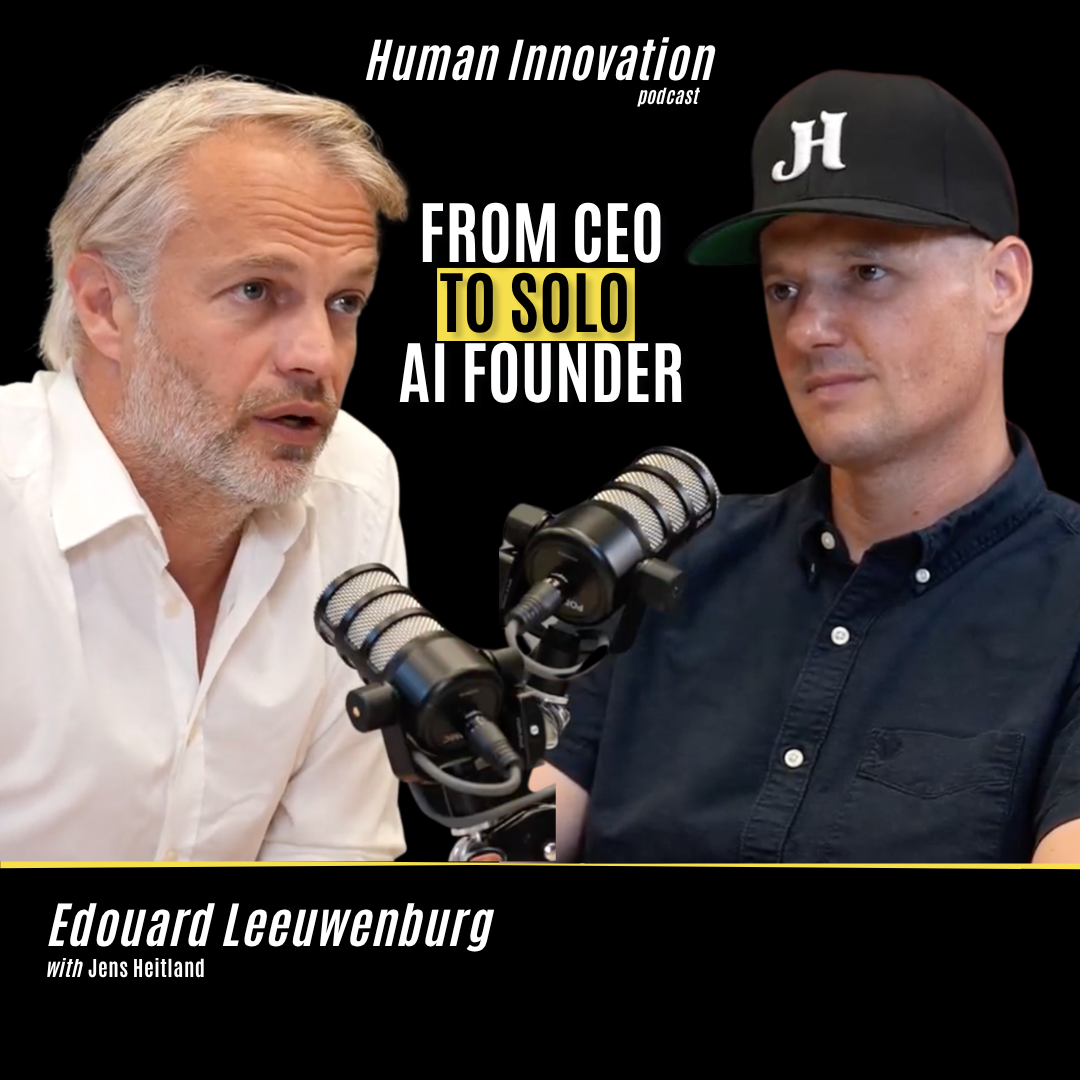
Jens Heitland and Edouard Leeuwenburg revisit the OneFit turnaround years after their first conversation, then move into how Edouard built his own AI sales tool from the ground up. They discuss the difference between change forced by a crisis and change driven by small, repeated steps, and why the second kind tends to last longer. The conversation covers how Edouard built a full AI executive team, including a virtual CTO and CMO, to run his company with minimal staff. Jens and Edouard also explore what a one person, high revenue company looks like today, and what it takes to build one without a technical background.
Youtube Podcasts
Edouard Leeuwenburg on Change, AI, and the One Person Company
I sat down again with Edouard Leeuwenburg years after our first conversation, back when he was still running OneFit through one of the more difficult stretches a company can face. That earlier conversation was about survival, about margins, about a business model that needed to be rebuilt while the world was frozen in lockdown. This one was about something different. It was about what happens after a person like Edouard steps out of that kind of pressure and starts building again, this time with nobody but himself and a set of AI agents at the table.
The environment he described at OneFit was one most executives will recognize. A company built for uninterrupted growth, suddenly forced to confront a business model that was not as healthy as it looked. Margins declining. Customer sentiment souring. A culture built around expansion having to learn restraint. Edouard's role in that period was not to dictate the outcome, it was to orchestrate a process across finance, product, and customer teams, while staying accountable to a head office that owned the final call.
What he took from that experience was a distinction I have seen play out across other organizations as well. Change driven by a single forcing event, a pandemic, a market collapse, moves fast because there is no alternative. But Edouard estimated that most lasting change, somewhere close to two thirds of it, comes from something quieter. Small adjustments, connected into a sequence people can feel and understand, tend to hold longer than a mandate handed down from above.
That same instinct for small, connected steps shows up again in what he built after OneFit. Rather than hiring a team to launch his AI sales tool, Edouard built himself an AI executive staff instead, a CTO, a CMO, a CSO, each defined by a written profile with clear boundaries around what it can and cannot decide. Every morning he runs a short standup with all three, and lets them challenge each other's work before anything reaches him. The tool itself grew out of a frustration he had heard from salespeople for years, the friction of typing updates into a CRM system instead of spending that time with customers. His system replaces the typing with a spoken instruction, and the AI handles the rest.
The consequence of this setup is not just efficiency, it is a kind of freedom that would have been structurally impossible five years ago. Edouard described a one billion dollar, one person company as something no longer theoretical. A founder with deep operational experience, no technical background, and a well built agentic system around them can now run at a scale that once required a full organization. What used to require capital and headcount now requires clarity about what each AI role is responsible for, and the discipline to keep building the underlying structure, the brand voice, the boundaries, the memory, that everything else connects to.
What I keep returning to from this conversation is not the technology itself, it is the discipline underneath it. Edouard did not chase every new AI tool that appeared over the past year. He built a system, tested it against real customers, and let it evolve slowly enough to stay coherent. That restraint, more than any specific tool he uses, is what makes the whole structure hold together.
Timecode:
01:04 OneFit CEO During Covid
02:54 Fixing the Business Model
04:34 Culture Customers Partners Reset
06:49 How to Drive Change
10:02 Results and Handing Over
12:56 Life After the CEO Sprint
15:15 Entrepreneurship Origins
18:04 AI Meets Sales and CRM
19:29 Freevent Demo and Benefits
23:28 Predictable Funnel and Cashflow
26:12 Building With Virtual Team
27:45 Adaptive Sales Assistant
28:38 News Driven Follow Ups
29:27 One Person Company Vision
30:56 Building an AI Org
33:44 Daily AI Triage Workflow
35:15 Freedom And Lifestyle Gains
38:17 Pilot Customer Workflow
39:33 Learning AI By Doing
41:53 Privacy And Local Models
43:54 Avoid Tool Hype
45:14 Pharmakon And Change
47:44 Simple Agents And Wrap Up
Guest Links:
Website: https://lionizer.io/
Transcript:
[00:00:00] Jens Heitland: Can't believe that's the second time already. Mm-hmm. Eduard, it's so cool to, to have you back in person podcast, and I still remember last time you were sitting in, in, um, the holiday house in north of Netherlands, and I think I was still in Denmark or in Germany at that time. It's a long time ago. And we were talking about you being the CEO at OneFit, and really dove into that, and today we're, we, we, we really go into AI entrepreneurship.
[00:00:32] Jens Heitland: I'm super excited to learn more from you and as well, like the death of CRM. But before we do that, let's, let's pick up where we left off. Like, you were the CEO of OneFit, and what happened since then up to today?
[00:00:48] Edouard Leeuwenburg: Yeah, Jens, thanks. Thanks for having me. And indeed, it's been, uh, quite some time. It was Texel at that time.
[00:00:56] Edouard Leeuwenburg: And, uh, uh, wow, uh, got a bit more grayer since then, I can tell you. Um, yeah, what happened? Um, l- let's start with, with, uh, that story at OneFit. Um, I, uh, prior to my assignment as the CEO or managing director of OneFit Netherlands, I had the, uh, interim role of, uh, uh, CMO at, uh, the new, uh, mother company, Urban Sports Club, at that time.
[00:01:25] Edouard Leeuwenburg: And they had just acquired OneFit in the Netherlands. Um, and they asked me whether I wanted to, um, take over the position in the Netherlands. Yeah. And, and so I did. Um, and, um, interestingly enough, uh, the, the day, uh, my announcement was made, uh, two weeks later, uh, COVID hit, and everything was in lockdown.
[00:01:47] Edouard Leeuwenburg: Um, which basically meant the whole world, uh, the whole world for OneFit would then, uh, well, freeze up. Yeah, the sports was no longer available. And it also gave us the excellent and unique opportunity to drive change. Uh, because everything was frozen, we could really look at the whole company, the business model, uh, the, uh, the, the culture at the office and, uh, the, the customers and the sports venues that we work with.
[00:02:14] Jens Heitland: Maybe just, just to add on for the people that have not watched or listened to the first episode, OneFit is a fitn- fitness club, or was a fitness club.
[00:02:23] Edouard Leeuwenburg: It's a, uh- At gym ... sport, it's a sports aggregator. Yeah. So what it basically means, you take one subscription, and from that one subscription you can do sports, um, uh, with all the connected venues.
[00:02:34] Edouard Leeuwenburg: So you don't need to have a subscription per sports venue. That's one big plus. Uh, the other big plus is that, uh, you can cancel, uh, at any time. So there's no, that not, not that typical, uh, January 1st sign up and then you- Yeah ... pay for 12 months. Um, and there are a lot of additional bonuses and, and, and perks to it.
[00:02:54] Edouard Leeuwenburg: Um, the issue, uh, when I started is that, uh, this was all, uh, relatively new and, uh, it, it was growing, uh, very good, very, very successfully. Only the issue was that people were so fond of it, and the people, the, the, the first movers that jumped on that program were the most diehard sports people. Of course.
[00:03:17] Edouard Leeuwenburg: So, so that basically mean that they did a lot of sports. We had to pay a lot of money to all the, uh, venues that were connected. Um, we call that check-ins. And in, in, in some cases, the, the, the, the, the business model was, was not, uh, as successful as we wanted. Margins were declining, and in some cases, uh, as we looked at it on a city-by-city level, even negative.
[00:03:43] Edouard Leeuwenburg: Um, obviously, uh, with, with very, um, good funding of investors behind it, uh, we were able to play that game of growth. But obviously, as, as the world changed and even the sentiment of investors changed, we had to prove that the business model would, uh, could become healthy. Mm. Now, um, the unique thing about this is that because everything was frozen, we could really look into the whole business model.
[00:04:10] Edouard Leeuwenburg: We could, uh, pinpoint leaks. We could, uh, play around with new options and, uh, learn from other companies and other industries. Um, so this is one of the changes, uh, uh, we, we went through. And, uh, we worked, uh, a lot with the people at the head office in Berlin, who were also, of course, examining these models for, for years already.
[00:04:33] Edouard Leeuwenburg: Yeah. Um, and just before the whole lockdown web ha- happened and before, prior to my, uh, uh, position, uh, the, uh, founders themselves also introduced a, a, a few changes that didn't go down well. Uh, where they basically said, "Hey, guys, we gotta change it. This is what it is. Now eat it." Yeah. Uh, so a lot of customers were frustrated.
[00:04:56] Edouard Leeuwenburg: Um, and that's the second thing we had to change, the, the, the whole, our whole, um, um, appearance towards customers. How do we treat customers? Uh- And, um, then there's two other things that needed to be changed. Uh, one is the culture at the office. Uh, obviously the company was set up to grow, uh, independently, and now with the new head office- Yeah
[00:05:18] Edouard Leeuwenburg: obviously there would be redundancies. Uh, the culture, uh, prior to COVID was a culture of unlimited growth no matter what, so everything was okay. And then, of course, this guy came in and had to start- ... say, "Well, we're not gonna do this anymore, and we might wanna..." You know? And that also led to a l- a lot of, uh, frustration of course.
[00:05:42] Edouard Leeuwenburg: Um, and the last change was our attitude towards the sports venues, which prior to the whole situation was a more, well, we dominate the market kind of cocky kind of way. Mm. Like we... And if you don't want to join us, whatever. Uh, into a more, um, uh, way where we were trying to open up to them and, uh, help them become successful.
[00:06:06] Edouard Leeuwenburg: Obviously very big issue because competition was also knocking on the door- Yeah ... heavily. Yeah. So, a lot of moving, uh, plates, I would say. Uh, it was a, uh, three years, uh, assignment where I think, uh, I bumped into many walls. Uh, learned a lot, um, and also experienced change on various levels, uh, in various, uh, interactions.
[00:06:36] Edouard Leeuwenburg: And, uh, this whole topic of change stayed with me. I, I, I like changing things, but I wanted to become more effective in driving change. And, uh, this is where I learned, um, a lot of it. And, and I think in the end there's two things, I think, when, when it comes to change, and also this whole OneFit experience is a, is a great ex- uh, example.
[00:07:00] Edouard Leeuwenburg: Change can be driven based upon big events that push it. Yeah? So there's no question whether you should or should not. It's like COVID is there. Yeah. No- Okay ... no other chance to dive in. No other chance. So if you want to go to your office, bad luck. Yeah. You don't want to do online meetings, tough luck. You have to.
[00:07:20] Edouard Leeuwenburg: Yeah. You know? So we drive it. It's a bit like making foie gras, you know, we stuff it down their necks. And it's not always the, uh, nicest way, but if there's an emergency, you gotta. You have no other chance.
[00:07:32] Jens Heitland: Yeah. Exactly.
[00:07:32] Edouard Leeuwenburg: And, and, and you see if you look down in history, there are big events that make people change, like eruption of a volcano or big natural, um, um, um, things happen.
[00:07:43] Edouard Leeuwenburg: There you go But not everything changes because of that. Mm-hmm. I would say b- uh, 60 to 70% of changes come from a different rate, and those are small things that have an immediate and a deep impact. And if you want to drive change in an organization, I think this is the way to go. Mm-hmm. So day one, and then you make a plan, which is like a 100-day plan where you're gonna change the whole company in two, three years, and you're gonna say the first changes will happen in one year from now.
[00:08:17] Edouard Leeuwenburg: That's not gonna fly. Mm-hmm. Yeah? People will, will... We all seen those things happen, and I think we can realize. You gotta find the small things, the small things that have impact, and if you can connect the small ting- things in a journey You get momentum. People start to see and feel the change, and then they will be on board with you, and then change on board
[00:08:40] Jens Heitland: That, that also means that you need to take them with you. It's not you come in and say, "That's the direction, and no, no matter what." It, it means you, with all the small steps- Mm-hmm ... you bring them on board, you give them the possibility to understand what it is. Mm-hmm. And then they're part of the change themselves- Yeah ... in driving it.
[00:08:58] Edouard Leeuwenburg: Well, yes and no. Sometimes as a, a, when it's, uh, purely, as a leader you need to make change happen fast, um, you could, I think you can say, "Well, guys, um, I'm very sorry but we're gonna do it this way." "But I'll take you along the ride. And by the way, I'll promise you that the first results will come in very soon." "So within a month from now we'll have the same check-in, and I will promise you change will happen." If you can manage that, yeah, people will, or change will happen because they see it, and they might say, "Well, it's not the, the thing I first thought of, or I, I accept it, but okay."
[00:09:33] Jens Heitland: Yeah? Yeah.
[00:09:34] Edouard Leeuwenburg: Now, I wouldn't say do this all the time. Uh, and, uh, change as a leader is, I think, best if you can let the people make the change, yeah? So you just, uh, set the way points and let them deliver. Uh, and, and make them embrace change and part of it. Um, so, so yes, you can drive change. Um, it's a balance.
[00:09:58] Edouard Leeuwenburg: You, uh, it's a bit of that feeling you need to have how, how to approach it. Yeah. Yeah. Okay.
[00:10:02] Jens Heitland: So y- you were the, the change driver of OneFit at that time together with Kobit. Where did it, where did it end? So you said you had a three-year assignment. Mm-hmm. Just, just to close that chapter. Yeah. How, how, how did you develop the business together with the team?
[00:10:18] Edouard Leeuwenburg: So, uh, together with the team, uh, we made little... Uh, so when it comes to the business model, for instance, we worked with small groups. Uh, we worked with people from finance, fr- people from product, uh, people from customer care. We even, uh, challenged some ideas with customers. We were in close, very close contact with the head office in Berlin.
[00:10:38] Edouard Leeuwenburg: Of course, being, them being the owners, we couldn't just say- Okay ... "Hey, let's, uh, you know, let's, uh, change it." And, and, uh, uh, that, uh, needed to happen. And my role was more of a less, more, uh, of the orchestrator, the, the guy in the middle. Yeah. Um, not the guy that made all the final decisions. Yeah. So it, it was more of a group process.
[00:10:59] Edouard Leeuwenburg: Um, a lot of data was used, of course. Now, in the end, what... And there were more issues, right? So there was, uh, uh, customer satisfaction that was going down. The employees were not really happy. Um, the partners were not really happy, the, the sports venues. The f- uh, financial situation was not looking that great.
[00:11:19] Edouard Leeuwenburg: So in the end, um- I was very proud to, uh, see that we'd fixed the margin, gross margin problem. Uh, it was growing and, and steady, so predictable. Uh, for the first time in eight years, the company would show green and positive numbers, uh, on EBITDA on, on a quarter. Okay. Yeah. Uh, but all, all those signs were going, uh, good.
[00:11:42] Edouard Leeuwenburg: Um, uh, as we slashed the, uh, I don't wanna say slashed, uh, as we reduced the employees by a third, the sentiment at the office was, was good. Yeah. There was a... I had a very strong management team, uh, good, good vibe, and, and, you know, the employees were, were, were satisfied. We were clear and honest, and- Yeah ... I remember.
[00:12:06] Edouard Leeuwenburg: Uh, we had a very healthy relationship with partners. Uh, we had fixed all the partner contracts, all of them, and there were more than 1,000. Yeah. So, uh, big ups for the partnership team at that time as well, who, who did an incredible job of making all the contracts, uh, again and renegotiating and making fair prices, so a completely new, uh, approach.
[00:12:30] Edouard Leeuwenburg: Um, and yeah, when, when I left, uh, it, that job was done, and, uh, also for me a great time to say, "Okay, let's go onwards." Hand over. Time to hand over and, and new challenges. And I think also the organization was, was not in need of a local CEO anymore. It was now more part of the central organization, and it's, uh, also change, right?
[00:12:55] Edouard Leeuwenburg: So- Yeah ... uh, yeah.
[00:12:56] Jens Heitland: How was it stepping out of... Like, it's almost like you were on a speed train for three years. Yeah. Super crazy change all the time, COVID happening at the same time. Right. And then you step out How was that as an individual, as, as the person Eduard- Mm ... not as the CEO?
[00:13:16] Edouard Leeuwenburg: No, terrible. Uh, terrible in, in, uh, because you're still on a high. Yeah The, the, the, these endorphins you keep getting every time, the, the pressure, um, and then all of a sudden there's nothing. Mm. And, uh, the learning in terms of change for me, and as a maybe a tip for others in this situation, um, do not take that energy with you in a new role. Mm. Yeah. Yeah, so because what you do, what you, you, you even from the smell of the coffee machine all the way to the drive to the office, all those emotions and feelings, you take them with you into a new role- Yeah
[00:13:59] Edouard Leeuwenburg: and it's not gonna work. You, it, it doesn't work like that. You have to really deconstruct yourself- Yeah ... and, uh, take time, and then build up again. So the, the, the minute you start with a new position, say to yourself, try to say to yourself, "I'm gonna rebuild everything again, myself, this role." Yeah. It's not stepping from one flying plane into another.
[00:14:24] Edouard Leeuwenburg: Yeah. You have to land and get up again, and that's my, uh, was my biggest takeaway. Yeah.
[00:14:28] Jens Heitland: So, so you took time for yourself before jumping then into the next role?
[00:14:32] Edouard Leeuwenburg: No. Okay. So that's why I
[00:14:34] Edouard Leeuwenburg: learned. Yeah. And, uh, no, I, uh, I, I bumped my head on, on many occasions. Um, looking back, nothing I'm, I'm negative about because that's life.
[00:14:45] Edouard Leeuwenburg: Yeah. Um, and, um- But if I would be able to do it all over again, I think I would take way more time, more way, you know, take more distance, and don't jump into every new opportunity that's thrown at you. Yeah. Because you might have fixed something at a company or you did something okay, it's not a guarantee for the next one.
[00:15:11] Edouard Leeuwenburg: Yeah. Not at all. Yeah. It's always different. So, um, yeah.
[00:15:15] Jens Heitland: Let's talk about the entrepreneurship bug that somehow got onto you over the last couple of years. So- Mm-hmm ... you, you came from very large corporations before telecom and s- and so on. Mm-hmm. And, and you figured out that there is something new, like a, a, a small fire in you starting to burn when it comes to en- entrepreneurship. L- let's, let's talk first about how did that came along for you personally. Mm-hmm. And then let's dive into AI and the possibilities with AI that are happening right now. Yeah. Yeah.
[00:15:48] Edouard Leeuwenburg: So I grew up in an, a, a, an, a, a family of entrepreneurs. Uh, so, uh, uh, that's something I was al- I was brought up with. So I, I know what it is to, uh...
[00:15:59] Edouard Leeuwenburg: I, I still remember, um, very fond memories, uh, uh, when my parents would work in the, in the store and I would sit there all day and, and see how things work. You could see products coming in- Right ... customers buying it, money in the c- in, in the till, you know, the, the- It, it still, it still resonates with me.
[00:16:16] Edouard Leeuwenburg: And, um, then, um, also in my career at large corporation, I always considered myself to be a bit of an entrepreneur within the- Yeah ... enterprises. So- Yeah ... uh, I come in, um, uh, as a normal role, but then quite fast you see something that's not going properly, so you write a plan, and you start fixing it. Mm.
[00:16:36] Edouard Leeuwenburg: That's basically what I like to do and what I have been doing. Um, I had the luck of having a bit of, um, um, uh, um, financial reserves when I finished the role at OneFit, and, uh, it, it gave me the opportunity to, to play around with some, um, some things. So I joined a startup, uh, and, uh, and, and some other companies where I played around and, uh, while I was doing that, AI started to, to come up- Yeah
[00:17:04] Edouard Leeuwenburg: the past three, four years, I'd say. And, uh, I've been following it, uh, closely and, um, we're now at the point where it, it's, it's automating so many things. It's doing so many things. Um, I jumped in onto that, um, six months ago. I started writing my first, uh, uh, prompts. I'm not gonna say I wrote my first code because AI wrote the code, okay?
[00:17:30] Edouard Leeuwenburg: Yeah. Uh, uh, let's be honest about that. But I, I've always also worked a lot with technical people and, and, and, and, uh, programming. Uh, so I'm not gonna say I'm a programmer. Yeah. Uh, not at all, but I do understand how databases work, how, uh, software works, and how that interacts, and how that then connects to people.
[00:17:52] Edouard Leeuwenburg: Yeah. And today, I don't need, uh, with all respect to programs in the world, we don't need that anymore. We can do it ourselves. Yeah. Especially when it comes to prototyping. Um, so I started, uh, thinking about what could AI bring To the world of sales and marketing. Hmm. Um, we've all seen the example, I think five years ago, where Google introduced a video.
[00:18:20] Edouard Leeuwenburg: They showed a video clip where the, um, or it was Alexa, no, I think it was Google, where the CEO of Google said, "Make an appointment for me at the address." Oh, yeah. It was Google. Yeah. Yeah. It was Google, huh? Yeah. And that was five, six years ago. Hmm. And that kind of stuck with me, and I thought, "If that's possible..."
[00:18:40] Edouard Leeuwenburg: And, uh, um, um, coincidentally, I, my previous, uh, assignment was in a sales organization, and I came across so many of these situations- Yeah ... where basically I s- I spoke with a lot of salespeople, and they said, "Why the hell," sorry for my French, "do I need to sit at a desk every day and enter administrative stuff into a stupid CRM dashboard?"
[00:19:05] Edouard Leeuwenburg: Yeah. "I wanna be out there. I wanna do sales, man. I wanna talk to customers." And a, a few of these salespeople even had their, um... Did everything by phone. They were even texting, but they knew the customers and the customers' wives, and they knew- Yeah, yeah ... there was so much information. So if you wanna have all that information entered on a keyboard In a CRM system.
[00:19:29] Edouard Leeuwenburg: I was like, "That's actually really stupid." So this is exactly the, the, the, uh, the crossroads where I started working on, and I built, I built my tool. It's called Freevent, freedom to sell, and basically the only domain still available, so- ... sorry for that. Um, and I started mapping all these journeys, like, um...
[00:19:50] Edouard Leeuwenburg: And, uh, uh, today, um, what it brings you is, um, you can pick up any channel, so WhatsApp, Teams, whatever you prefer. You can talk to your phone and say, "Hey, um, make me an appointment with Jens, uh, tomorrow at 10:00. Wanna talk about, uh, having the same cap he has with my initials. I wanna know where he got it from."
[00:20:12] Edouard Leeuwenburg: Then, uh, uh, the WhatsApp interface then uses voice to text. Text is then, uh, uh, examined by AI. AI chucks it into your CRM system, makes a note, makes a reminder, and the next morning at 10:00, I get that reminder. Yeah. Now, that took, uh, 10 seconds to do. It took me less than a minute to explain to you, and it's done.
[00:20:35] Jens Heitland: That means you're, you're not going to the CRM system, logging in and writing something. You're literally just using a tool that, like talking to your phone and that's like- Exactly. Like, "Hey" ... 10 seconds.
[00:20:46] Edouard Leeuwenburg: "Hey, google, make an appointment at 10:00." Yeah, exactly. Boom.
[00:20:49] Jens Heitland: Yeah, like- There it goes ... like, like the, the video call.
[00:20:51] Edouard Leeuwenburg: Yes. Uh. Yeah. And, and, and this is one example. There, there is a, there's a myriad of, of, of, uh, interactions available today in the tool. Uh, from, uh, tapping into meetings where it then uses the, uh, transcription, uh, then, uh, it makes all the points, which is already standard stuff today. Yeah. But it also gives you a sales analysis.
[00:21:13] Edouard Leeuwenburg: So it, it, it gives you coaching tips. So it tells you like, "Hey, uh, Eduard, uh, next time try to get to the punchline within 10 minutes," or, uh, you know, you do, you say a lot of uh, and it- Yeah ... you know? Yeah.
[00:21:26] Jens Heitland: What, what for me is in- interesting, so you, you take the corporate knowhow that you have built over the last decades- Mm and, and link that to a s- very specific problem that you have seen by working with companies- Mm-hmm ... on a daily base- Mm ... and, and looked into how can we create a solution to that problem so that the intelligence or the knowhow of the people is, is leveraged. But then with that as well, how can we make it e- as easy as possible for the people so that they can engage on the things that they're best in. Instead of a salesperson typing 20 minutes- Mm-hmm ... a salesperson interacting with, like, potential clients, leads and so- Exactly ... so on. Yeah. And what, what I have seen a lot over the last couple of, uh, months at least, is, is people just building a s- mini wrapper around, like, "Hey, I, I use ChatGPT and I literally sell ChatGPT to you- Mm-hmm a- as, as a kind of sales through," and I'm... But what I, what I like about what you do is, obviously you use the different d- diff- different chat engines or large language model, but it's not about using ChatGPT, it's about using the, the, the system that you have built to increase sales and then build customer retention and all the other things with that.
[00:22:48] Edouard Leeuwenburg: Yeah, yeah. Exactly, and, and it, it, it's a double-edged, uh, sword or knife. Uh, and on one hand it brings, um, ease of use and, and, and, uh, lazy... The, the salesperson can again... It's, it's a creative job, huh, being- Mm ... a sales guy. You gotta be creative, and you... It's the b- they like to interact with people, so let them interact.
[00:23:09] Edouard Leeuwenburg: Yeah? Yeah. So they'll... We'll give them more interaction time, so they... Well, that's one win. So you'll, in the end, will do more sales. Okay? And the second thing is, because of this whole system, the management team has way more accurate information, because everything's being stored. Yeah. Everything is relevant.
[00:23:28] Edouard Leeuwenburg: So, um, in my last assignment, uh, uh, one of the big issues is that was the predictability of the funnel. Yeah. There was no clear funnel, so we set up a funnel, and then we were able to already work on predictive models all the way down to shipping, production, manufacturing and, uh, cashflow. Yeah. Meaning, we're now talking with customer A.
[00:23:52] Edouard Leeuwenburg: The potential value of their deal size is, is X. Their, uh, pot- uh, the, the, the, the, the first, um, time we could produce the products is, is, is, is, is Z. Yeah. Meaning that if we ship it to their location, which is the other end of the world, blah, blah, blah, blah, and then with our incoterms like this, it means money, money on the bank Q2 next year.
[00:24:13] Edouard Leeuwenburg: Yeah. Yeah. So we were able to tie all those things together, and it was really dependent on everything w- that was happening in the front and with- Yeah ... the salespeople. Yeah. Of course. Yeah. And now imagine a sales guy talking to his, uh, finance guy, and the finance guy t- asking the sales guy, "How is stuff going?"
[00:24:30] Edouard Leeuwenburg: And the sales guy will say, "Yeah, it's amazing. I'm having so many deals, and blah, blah, blah, blah." The finance guy wants to know exactly when that's gonna hit on the bank account.
[00:24:38] Jens Heitland: Yeah. Of course.
[00:24:39] Edouard Leeuwenburg: Yeah. And it's a difficult situation. A lot of companies have this. And, and the digital companies, that's easier.
[00:24:47] Edouard Leeuwenburg: But the more old school companies- Yeah ... that produce stuff, the manufacturers So y- you can play around with more insights. Um, we're wandering off, but it's worth it.
[00:24:57] Jens Heitland: No, but I think it's, it's, it's super important because in, in the end is if, if we go back to OneFit or the other jobs that you have before- Mm as well with Telecom, which we covered in the first podcast interview a couple of years ago. Mm. All of that knowledge is today possible data-driven. Yeah. And in the old way it was, let's say, if it was good, it was already Excel tables. Mm-hmm. But in, in the end it's, especially in the large organization where, where the example you gave, where you have a whole value chain that you n- you need to interact with- No suppliers and, and other producers in between, you need to figure out how, how do you measure the from sales entry to, to, to the cashflow. And I think that's, that's what I meant with going back to your past and the knowledge that you have built, and it's not just an AI wrapper. Mm. It's a tool that you have built that leverages all of that- Mm-hmm
[00:25:53] Jens Heitland: and gives the potential to other companies in the most simple possible way. No. So that the friction of the salesperson typing in data and so on is, is, is taken away and they- No ... can focus on. No. And with that, a, a business has predictability- Yeah ... like, like you said.
[00:26:10] Edouard Leeuwenburg: Yeah. In, in, uh, al- almost instantly. Um, w- we tried to think, think of a way how to position the product, the free, free vent that we built, that I built, uh, which exactly AI built.
[00:26:23] Edouard Leeuwenburg: Um, I orchestrated it, uh, together with my virtual CMO, CTO, and CSO. The, the- Yeah. We need to talk about that. That's really awesome. Every morning I have my standup with my virtual assistants and, uh, um- Uh, uh, we, uh, trying to def- create a definition on where this, this product actually sits, and it's not software, and it's n- it's upper wear, somebody told me.
[00:26:49] Edouard Leeuwenburg: It's, it's, it's, uh, it's, it's not down, it's on top of. Yeah. And, uh, I build it agnostic, meaning, uh, we can tap into any CRM, uh, as long there's, if there's an API- Yeah ... you can connect to it. And it's really easy 'cause if there's like, uh, the other day it was, I was working on Exact, a very f- famous Dutch CRM platform with, with very strong financial roots.
[00:27:11] Edouard Leeuwenburg: You can see that in the platform. Yeah. And, and it's, it, it must be, uh, very challenging for a salesperson to, you know, be creative in that environment. They have a very well-documented REST API, and the only thing you need to do today is tell AI or your CTO- Yeah ... "Hey, this is the REST API," or it'll probably have found it for you.
[00:27:29] Edouard Leeuwenburg: Now connect all these things and set it up for me, and within- Yeah ... 15 minutes you're there. Yeah, so, um, then of course it's up to me to test a lot of stuff, but even testing is, is already- Yeah ... taken care of by AI. And, and there you go. So this upper wear then is able to connect, uh, all the information from your Exact CRM, connect it with all the new sources that we have in there, connect it to the behavior of your salespeople, and that's even connected to the learning model that we've built in there.
[00:28:02] Edouard Leeuwenburg: Yeah. So every salesperson has its own, uh, methodology, its own slang, its own, uh, method of working. Yeah. And, and, and Freevent is, is able to adapt to that. It learns while you go along. So, uh, you can say things like, uh, uh, "Shoot me an appointment," which is a Dutch way of saying- Yeah ... "Shoot me an appointment with Jens next week."
[00:28:24] Edouard Leeuwenburg: And the first thing is, "Shoot? You wanna shoot Jens?" No, no, no. So what do you mean? Do you want... Ah, appointment. Does it mean you want to make an appointment? Yes. Okay. Then it makes the appointment, and it learns that next time you say, "Shoot an appointment"- Yeah ... it does it. Um, it then- Follows up on what you do.
[00:28:43] Edouard Leeuwenburg: It tracks all the news me- and media sources, and it'll pop up a week later and say, "Hey, Jens has just had a podcast with company XYZ. Uh, did you know that? And should we m- make an appointment?" Yeah. You know? Yeah. And it does all these automations for you. Um, and again, it's agnostic, so it doesn't mean you need to have a subscription with a CRM system, or you're bound to only that CRM system.
[00:29:08] Edouard Leeuwenburg: Yeah. You can work all over the place. Yeah. Um, it's not unique, I think. S- In, in terms of, of what, what I'm doing is, it's not out there yet. Um, and I'm pretty sure w- within a year from now, there will be many others. Um, and that's just plain evolution.
[00:29:27] Jens Heitland: But I think where it is unique, it's connected to you, and that's, that's what I think, um- Mm. I, I was listening to... I, I'm listening to podcasts, obviously, every day. Mm-hmm. But one, one of the things that is, I think, for me at least, is coming- Mm ... is the, the one billion, one person company. Mm. The first one billion, one person company. Mm. Meaning that you have someone who is experienced in running a company- Mm understanding the complexities. Mm-hmm. And it's not the programmer. Mm-hmm. It's building, like you said, and we need to go into that- No ... building an AI ecosystem around you that is almost like your staff that is supporting you doing certain things, and that's an agentic setup that you have built. Yeah. And I think that's something that is available today.
[00:30:18] Jens Heitland: Most people are n- either not aware of it- Mm ... or don't know how to set it up. Mm-hmm. But what is interesting is if we think about, like us, we both have worked in very large organizations. We have a lot of knowledge- But we cannot build the technology. No. Let, let's say five years ago, we could not build the technology at all- Mm
[00:30:38] Jens Heitland: because we are no coders. We have zero idea about this. Today, we can hire an agentic AI CTO- Yeah ... that does a CTO role, which you define what a CTO is. Yeah. And then this person, AI agent, can, can do the work for you. Yeah. So let, let's talk about how do you orchestrate your AI organization?
[00:31:01] Edouard Leeuwenburg: Yeah. So, um, it, it, it's, um, it's, it's growing as, as we go along.
[00:31:07] Edouard Leeuwenburg: Yeah. Mm. So that's a deliberate cho- chose, uh, decision I made because, uh, even with AI constantly evolving- Yeah ... you know, you, you don't know what's gonna happen next. But I noticed that, uh... Simple example, when I started working on the whole product, um, I worked with, uh, a very simple tool called Replit, and it's, it's very easy to use.
[00:31:28] Edouard Leeuwenburg: You can... It, it, it makes designs, it, it does coding and et ce- et cetera. Um, I found myself, uh, every now and then ending up in a, in a, in a dead-end street, a cul-de-sac, as they call it. Yeah Because you're stuck, and you're like, "Oh, my God, the system has went way too far in this direction." Mm. I need somebody to help me constantly challenge what I, what my command is.
[00:31:54] Jens Heitland: Like what you would have in a real organization if you have a CTO.
[00:31:57] Edouard Leeuwenburg: Exactly. Yeah. And at the same time, I want somebody to, to look over my shoulder and challenge what Replit is actually doing. So I want to have somebody to challenge this, this bot. Yeah. So I basically said this to ChatGPT. I said... And ChatGPT also said, "Well, create an AI CTO."
[00:32:16] Edouard Leeuwenburg: And I did, and it's basically, um, uh, where I wrote together with AI a whole story. Mm. And I downloaded a lot of, uh, CTO profiles from, from LinkedIn and the internet, and combined that and, and created my, my ideal version of a CTO. Yeah. It's like the movie in the '80s where it's science-
[00:32:35] Jens Heitland: That's cool ...
[00:32:36] Edouard Leeuwenburg: and you built your person- and persona, and, uh, it's a v- it, it turns out it's a very friendly CTO. He or she or it is really, uh, uh, yeah, um, uh, yeah A, a great person, uh, personality. Um, it has a very strict set of boundaries. What do we do? What do we know? What is he, uh, he, it, let's say, it able to do itself and whatnot. Yeah. Um, and, um, today the setup is as follows.
[00:33:07] Edouard Leeuwenburg: Every time I have an idea, I challenge it with my CTO- Yeah ... on how we're gonna do this. Then, uh, the CTO prepares the, the, the prompts, uh, put, uh, uploads the prompts in Git, GitHub. Uh, this is where everything is stored, and then I use Cloud or Replit or whatever- Yeah ... I think is suitable for that situation to, uh, get the tasks from Git and start coding.
[00:33:33] Edouard Leeuwenburg: And then when it's done, the CTO does a double check, uh, and there's real interaction between them. Yeah. Okay, this should be better. This and this and that. And then when it's ready, it's ready, and I get it presented to me. Um, the same way I have this with my CTO, I also have my CMO. Yeah. And, uh, what happens every morning, uh, at about between 8:00 or 9:00, depending on my day, I have a little chat with all three of them, and I let them check each other's work.
[00:33:59] Edouard Leeuwenburg: Yeah. And what then happens is that the CMO comes up and says, "Hey, I see there's a new great feature. Shouldn't we update the website on this?" Yeah. "Or shouldn't we this or," and, or, "It's great for your LinkedIn story," blah, blah, blah. Uh, by the way, all the updates on LinkedIn are, um, um, uh, stalled because of the holiday season.
[00:34:17] Edouard Leeuwenburg: I get it, but there's a whole trove of information ready to blast out. Yeah. Um, so this, this, this triage is now happening, and the biggest issue is that at about 2 o'clock in the afternoon, my brain is fried. Yeah. Because in a normal organization, you talk with your people, and they talk with you, and they say, "Okay, we're gonna do that."
[00:34:46] Edouard Leeuwenburg: You have a cup of coffee. You have lunch. Yeah. And then a week later, you come back, and they're like, "Hey, this is the progress we made." That's all gone because within a min- within an hour- Yeah ... they come back- They're done ... to you. It's done. You're like, "Okay, oh." So, uh, and I, I, I read some articles about this, the, the whole brain fry- Yeah
[00:35:05] Edouard Leeuwenburg: working with AI. Yeah. It's definitely true. And, uh, so I, I have to go back and, so every day at 12, I have to walk with my dog and, you know, reset the brain.
[00:35:15] Jens Heitland: But isn't this amazing that in the end you get more things done- Yeah ... in a shorter amount of time, and you still have more freedom than being a hired CEO somewhere?
[00:35:24] Jens Heitland: Absolutely. Because I guess if we go back to OneFit, you were not be able to go with the, the dog at lunchtime.
[00:35:30] Edouard Leeuwenburg: Well, I did bring the dog to the office-
[00:35:31] Jens Heitland: Okay. Let's do- ...
[00:35:32] Edouard Leeuwenburg: but those were very short walks. Uh, yeah, indeed, and, and you were... Yeah, and, and, um, yeah, it's, it's, it's truly amazing what, what's happening.
[00:35:41] Edouard Leeuwenburg: And, uh, I mean, the other day I, I said, "Let's write an email to customer, uh, X, and tell him, uh, give him an update." Yeah. And without I even, without even me noticing, it had already done so. Yeah. Spooky, some might say, but when I checked the email, it was correct, and it was all perfectly. So, and now today I see it seeping into my, uh, private life as well with the family.
[00:36:04] Edouard Leeuwenburg: My wife and kids were also becoming quite, uh, fond of using it. Uh, and, and there's... Yeah. It's, um, it's really great, and it's easy.
[00:36:14] Jens Heitland: What, what I like about it, because in the end, if, if we look at one-person companies- Mm ... and which I think will be, if we talk again in five years- It, it will be a normal thing.
[00:36:25] Jens Heitland: Yeah. It's, it, it, you don't need to be a global company to do all of this. I mean, you, you... It's a digital ecosystem that- Yeah ... it, that you have chosen. Y- you, you don't need to sell to everyone in the whole world. No. If you have 2050, whatever, depending on what's the business model, what's the product is- Mm-hmm
[00:36:42] Jens Heitland: let- let's, let's say, just a rough number, you have 250, 300K per year. Mm-hmm. You earn more than, uh, most of the CEOs out there- No ... and you have more freedom, and you, you don't have employees. You literally pay yourself from this. No. Have maybe a couple of tech costs and so on. But let's say y- even if it's 100K, y- you can survive easily with 100K- Yeah
[00:37:07] Jens Heitland: depending where you are in the world.
[00:37:08] Edouard Leeuwenburg: And, and you don't have to turn to drop shipping-
[00:37:10] Jens Heitland: No, exactly ... or, or,
[00:37:11] Edouard Leeuwenburg: or influencing-
[00:37:11] Jens Heitland: Exactly ...
[00:37:12] Edouard Leeuwenburg: or, or weird stuff. No, and it's, and, uh, and but i- I mean, money is not the driver, in my case.
[00:37:17] Jens Heitland: No, I mean, i, I'm just, just marketing it- Mm ... so that people understand. You have the possibility as, like us from the past- Mm-hmm step out os- of a corporate role and do what you dream of doing. Right. And you can come by financially as well, because a lot of people are kind of golden handcuffs working in a large organization and don't want to have the risk. No. But you can do this even next to your role right now, and then you step out when you have enough income.
[00:37:44] Edouard Leeuwenburg: Exactly. And that, that step has become way more easier today.
[00:37:47] Jens Heitland: Yeah, exactly.
[00:37:48] Edouard Leeuwenburg: Um, it's, yeah, there are so many examples I can give you, which I'm not gonna 'cause it's gonna be boring, but Yeah. Um, and, um, all the... Um, and, and even, I mean, personally, the whole things about a one, uh, one person, one billion company, blah, blah, those are journeys I'm really not focusing on.
[00:38:07] Edouard Leeuwenburg: No, it's, you need to, you need to w- work with different topics. Yeah. You need to really push boundaries and so on. Yeah. But you don't have to. No, I, my, my, my personal drive is making a click. Yeah. So, so making something where a customer says, "Wow, this is exactly what I needed. Thank you." And just this morning, I, I spoke with one of my, uh, uh, pilot customers, uh, a great company.
[00:38:27] Edouard Leeuwenburg: They also have, have a different CRM, and basically every morning they, they prefer email, and every morning their salespeople get an email, like, these are the tasks you have to follow up today. These are the things we saw in the news about your customers. By the way, we've analyzed previous, uh, order, orders from your customers, so these ones are most likely to make a reorder.
[00:38:53] Edouard Leeuwenburg: Start calling them. And as I also have a background in email and optimization and, and operation stuff, there's nothing as annoying to get an email that you then need to go to CRM- Yeah, yeah ... log in, fill it. Yeah. No. We made a simple interface, so every task yous can say done, follow up, or next. It opens a, a immediate popup, and it's done.
[00:39:13] Jens Heitland: Yeah. That's cool.
[00:39:13] Edouard Leeuwenburg: So no back and forth. You can do it from your mobile. Uh, and if you wanna do this on WhatsApp or Teams, it's... Well, Teams is what? Eas- a bit easier 'cause you, you can use, uh, uh, direct links. But it's about making life easier and simpler. That's, that's the whole thing, uh, basically. And it, it helps them, so, um, yeah.
[00:39:33] Jens Heitland: Let, let's go back to how did you learn AI? Because there might be, like, two or three listeners saying, "Okay, but I have no idea about AI."
[00:39:42] Edouard Leeuwenburg: Yeah. That's the beauty. Just go there. Yeah. And, and, and make it, you know, and, and-
[00:39:45] Jens Heitland: How, how was your journey? Like, first let's say ChatGPT came out- Yeah ... and, and you used it like Google or whatever. Yeah, yeah, yeah. Exactly. What was your journey to being able to run a company?
[00:39:56] Edouard Leeuwenburg: So, um, I think what made me, what made it work for me was asking it questions in terms of how does this work? Mm. Or how do you... How, you know, uh, when it gave me an answer, my question always like, "How did you get here?" Or how- Yeah you know? Yeah. So you get a bit of a feeling of how it works. And I remember about a year ago I spoke with somebody in the creative industry, which is also pretty much ups- upside down right now. Yeah. And, and, um, it was a she, and she told me, like, "Well, the big issue we have is writing the correct prompts, because if you change one little thing, the whole movie changes."
[00:40:34] Edouard Leeuwenburg: Mm. And I remember at that time saying, "But..." And I, I, I challenged her. I said, "Do you still write prompts? Why do you write prompts?" Mm. And they were like, "Huh?" I said, "Well, that's the great thing about AI. You c- you can make it write a prompt for you, and then take it from there." Yeah. And they were like, "Oh, yeah, that's the next step."
[00:40:51] Edouard Leeuwenburg: And this was just before Argentic was coming in, which I think is the, the, the... one of the bigger ch- uh, uh, uh, enablers right now. Yeah. Um, where it's, which is basically an agent tool. Yeah. So it starts doing things for you. Uh, but, uh, so long story short, uh, be curious. Yeah. And, and, and, and, and try stuff.
[00:41:14] Edouard Leeuwenburg: It's always about... I still remember receiving our first speeding, uh, re- receiving a speeding ticket And my wife told me, like, except from the fact she was pissed off I had a speeding ticket. And I was like, "I don't have the time to write a, a reply." So I said, "Oh, you know what?" I just took a picture with my mobile, shared it with, uh, with, uh, Chat, and said, "Write me a, uh, a letter."
[00:41:39] Edouard Leeuwenburg: Uh, and it was a parking ticket, by the way. A parking fine. And within a minute the message was there, and it was sent to the- Yeah ... authorities. It was done. And she was like... I said, "It's done." She went, "Oh, okay." So just try it, yeah? Yeah. Um, be careful with privacy. Be careful with what you share. I wouldn't say, uh, as a CFO, uh, download all your records and all your instances and throw them out there on, on, on, uh, on, on Chat.
[00:42:06] Edouard Leeuwenburg: Uh, that's a bit of a thing - ... to be careful with. Um, but even there, there are easy things to do. Um-
[00:42:12] Jens Heitland: Yeah, I was, I was about to say, I have an agentic setup as well. Mm. And I have a CFO that I have daily updates with. Yeah, yeah. And what I, I did, I built that on a local model. Yeah. So everything is stored on my own machine. There's no connection to, to the outside. I mean, there's internet connection, but it's kind of in a, in a sandbox that- Yeah ... there's, like, nothing goes out of that. Mm-hmm. Because for, for me it was w- we are still a small company. Mm-hmm. And, like, hiring a CFO is, like, no chance, and I have decent understanding of financial stuff- Mm-hmm but I'm not a CFO. No. Like, um, like bookkeeping and all of that stuff, yes, I had it in school or in uni afterwards, but I w- I, I literally built an AI agent that is my f- chief financial officer. Mm-hmm. And it works. Yeah. And it's, it's like, like you said, it's just digging into, okay, I want to have everything, all transactions and everything in one place, but I want to have it private, and I don't want to share it with Chat or Claude or whatever. Mm-hmm. How could we do that? Right. So that's... I, I literally asked that question. Oh, that's not that difficult. We have this machine. Use that machine, do this, this, this, this. They're all free tools available. Yeah. You, you can literally just do it- Yeah ... and you can connect it to your bank accounts, everything.
[00:43:31] Edouard Leeuwenburg: Yeah. And by the way, while we're having this, this, this discussion, it brings me back to the first thing I said about change. Small s-steps- Yeah ... with a deep impact. Absolutely. So that, that, that, that parking ticket was a small step with deep impact, yeah? Uh, not only did it save me money, it saved me my relationship, and it saved me time.
[00:43:50] Edouard Leeuwenburg: And, uh, so, so that's how it happens. But, but Stay curious. Um, and another thing I noticed, it was about six, seven months ago when Claude all of a sudden popped up. Yeah. It was huge. Yeah. And I'm pretty sure there was a huge push on marketing from them. Social influencers, like business influencers, all of a sudden everybody was going, you know, totally ape shit about Claude, because Claude blah, blah, blah, blah, blah.
[00:44:14] Edouard Leeuwenburg: And while I stuck with where my setup, because I was fairly happy and it was working for me- Mm ... um, I noticed this hyping thing also started to pop up. Yeah. And, and, and, and working for some time now with all these tools, every week there's another tool that pops up, and you have to do this, and you have to do this.
[00:44:33] Edouard Leeuwenburg: My tip would be, um, don't get, uh, don't, don't get too much into that. Yeah? Stick to your plan, and incrementally go into new ways as you feel comfortable. But you don't need to be a, a, a hipster tool junkie that jumps- Yeah ... on every new tool, 'cause you'll get lost. Yeah? So, so stick to what makes you comfortable, and if you wanna stick with ChatGPT, that's fine.
[00:45:00] Edouard Leeuwenburg: You know? Yeah. It, it, it already brings you so much more than, uh, what you can do, uh, by yourself. And, uh, so don't believe the hype. Um, and, and, and, and, um Yeah. Uh, a- also, uh, uh, re- please remember that, uh, and this is a discussion we had before and one of my favorite topics on, on change, everything that's new has a good side and a bad side.
[00:45:26] Edouard Leeuwenburg: Yeah? And, and we all talk about the history that we will think about, about 100 years ago and try to look 50 years down the road. Mm. But this is already something that was signaled in the ti- in the time of the Greeks, yeah? So it's called the pharmakon. Everything that's new has a positive and a negative side.
[00:45:44] Edouard Leeuwenburg: So the mimen- minute people say, um, uh, uh, ChatGPT or AI is the death of this or that, that's, that's BS. That's not true. It does change things, yeah? So for instance, um, digital music has changed the way that we sell compact discs or, or vinyl. Yeah. What has happened? Vinyl has become more premium. It's become more intimate.
[00:46:10] Edouard Leeuwenburg: It's... Or if I write, wrote you a letter by hand- Yeah ... that's an intimate thing, and it gets more awareness, yeah? Instead of a automatically generated email from chat. It doesn't mean that one new in- thing means the death of another. It means it changes, yeah? And if you start to look at things like that and you go all the way back into history, I think it was Aristotle's or whoever who said that, "If you start writing down stories, the collective memory will fade."
[00:46:39] Edouard Leeuwenburg: Well, that's, of course, the same kind of- Yeah ... stupid idea. Um, so embrace change. Uh, see the good and the bad things. Don't be naive. And, uh, and, and, and, and jo- jump on, on board. Enjoy the ride.
[00:46:54] Jens Heitland: Yeah. I think that's, that's a perfect ending. Yeah. Phew. Th- th- because I, I think there, there's so many details to that, and, uh, it, it's all about try and figure it out- Yeah
[00:47:08] Jens Heitland: these days. Be curious. And, and, and do that in a way that, that you don't F things up completely. Like, don't, like you said, don't share the things you, you shouldn't share, but- Yeah ... most of the things you can just test out and do it, and it costs almost nothing these days. No. And the, the cost will go down.
[00:47:25] Jens Heitland: Like, the predictions are that it's, will be, like, cheaper and cheaper and cheaper over the next couple of months- Yeah ... if not already.
[00:47:32] Edouard Leeuwenburg: Well, let's hope so, 'cause i- in some cases, I also see that I'm starting to pay more because I'm doing more. . There's something that's going up. But still, if you compare it to hiring a programmer- Yeah it's still relatively cheap.
[00:47:44] Jens Heitland: But it's also... But what I found out is you don't always need to have the perfect newest model for everything. Exactly. Like I have, going back to the chief financial officer, I have a local model that is, like, dumb almost. Yeah. It's not dumb, but it's like nothing compared to the newest model that is out there.
[00:48:04] Jens Heitland: Yeah. But it, it does all the mathematics, and everything is that standard. Even the old models from two years, three years ago can, can do all of the basic stuff. Absolutely. You don't need the most clever model.
[00:48:14] Edouard Leeuwenburg: Absolutely true. Yeah, and also, when we talk about building a, uh, virtual agent- Yeah ... that might sound spooky and, and very difficult, but it's just a simple text file.
[00:48:24] Edouard Leeuwenburg: Exactly. It's just Yeah ... you can pick up it- It's all text ... it's just text. It's like, uh, I want the per- You can even say what time it wakes up or how it treats you, how it- Yeah ... it, it... And, and this file is, is always alive. It keeps evolving, and that's it. So it, it, it... My CMO just wrote an con- uh, an entire brand book.
[00:48:44] Edouard Leeuwenburg: Nice. I haven't even watched it, but the good thing is, since the brand book is there and the color scheme is there and the logo has been defined, every time my CTO builds a new feature- It's connected ... it's connected. Yeah. So I don't need to say, "No, the logo's wrong again, or the coloring's..." No, it's, it's just there.
[00:49:01] Edouard Leeuwenburg: Yeah. So, yeah. Awesome.
[00:49:03] Jens Heitland: Yeah. Thanks. Thank you very much, Eduard. It was pleasure to have you back.
[00:49:07] Edouard Leeuwenburg: It was a pleasure to be here again, Jens. Until five years . Yeah. Okay. Cool.