
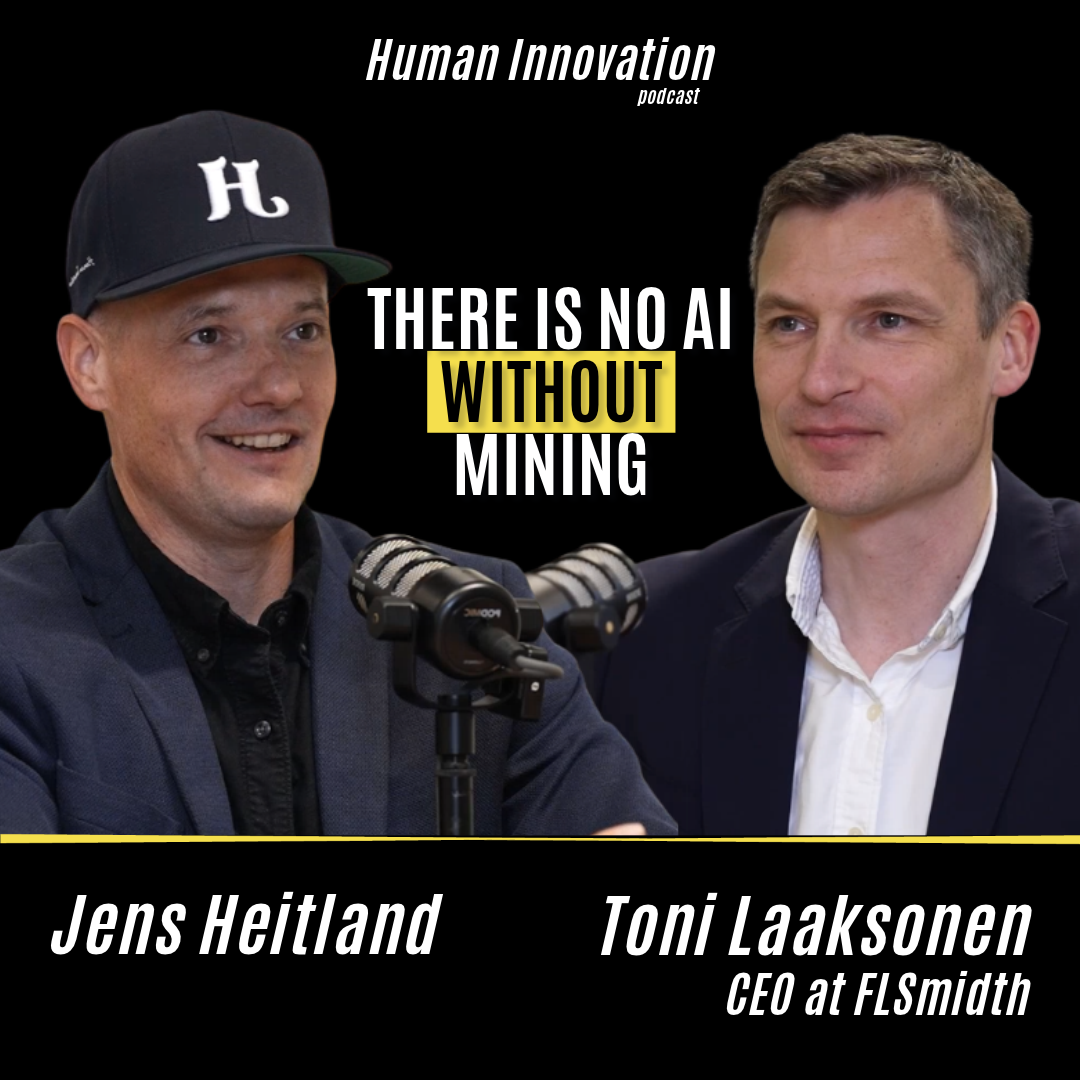
Toni Laaksonen, CEO of FLSmidth, joins Jens Heitland on the Human Innovation Podcast to talk about his path from a trainee position in Tampere, Finland, to leading a global mining technology and services company founded in 1882, including how he stepped into the CEO role after the company divested its cement business, why shifting a culture from cost focus to investment requires tangible proof and constant repetition, what ice hockey taught him about building teams with the right mix of players, and why copper and other minerals are essential for electrification, data centers and the future of AI.
Youtube Podcasts
BRING JENS HEITLAND’S FRAMEWORKS TO YOUR ORGANIZATION
When a Company Is Allowed to Grow Again
Large organizations carry the memory of their last chapter long after it has closed. A divestment is announced, costs come down, teams are reduced, and for a year or more almost every conversation inside the company is shaped by restraint. Then the restructuring ends and leadership turns toward growth. The strategy can change on paper in a single day. Inside the organization, the shift takes much longer.
In my recent conversation on the Human Innovation Podcast with Toni Laaksonen, CEO of FLS, we spoke about exactly this moment. FLS was founded in Denmark in 1882 and recently divested its cement business to become a pure-play mining technology and services company. Toni stepped into the CEO role after that transformation had already taken place, and he sees it as an advantage. The difficult decisions were made before he started, which allows the next chapter to be about investment, hiring and new ideas. He also described how overwhelming the first weeks were, with information arriving from every function and stakeholder at once.
What tends to happen after a long period of cost focus is that people stop asking for things. They learn which proposals get approved and which quietly disappear. Caution becomes a habit, and the habit outlives the reason for it. When leadership later says the company is ready to invest, many people hear the words and wait. Until something changes around them, the old pattern remains the safer choice.
Toni described the risk clearly. Without visible proof, people may conclude that the new direction is simply the CEO talking. So he looks for tangible signals that carry the message further than any presentation. He points to investments that have been completed, new people joining the company, and the decision to move an organization running hundreds of separate systems toward common platforms. That last change improves employees' daily work and makes collaboration easier to see.
The second part of the system is repetition. Toni spoke about saying the same message fifty times and still meeting colleagues who hear it for the first time. At scale, communication passes through layers, time zones and local priorities, and each layer absorbs some of it. For that reason, he is building a plan in which the entire executive team carries parts of the message, so that ownership of the change is shared across the leadership. His background as a defenseman in Finnish ice hockey shows in how he thinks about this. A team needs the right players in the right positions, and a transformation needs the same.
The stakes in his industry make the shift more pressing. Electrification, the energy transition and the growth of data centers all depend on copper and other minerals, while many existing mines are aging and harder to operate. Without mining, there is no AI, no electric vehicles, and no telecommunications. An organization serving that industry needs people who feel free to explore, invest, and propose new solutions.
In my experience, the end of a restructuring is rarely the end of its influence. The culture that formed during the cost focus stays in place until people see enough evidence that the rules have changed, and the amount of evidence required is usually greater than it looks from the top. Toni’s approach of visible actions and patient repetition reflects an understanding of how organizations actually absorb change. I am grateful to him for traveling from Copenhagen to Amsterdam and for speaking so openly about his first months in the role.
Timecode:
00:00 Welcome To Amsterdam
00:17 Values Behind Leadership
01:42 Early Career Ambitions
03:00 Home Friends Keep You Grounded
05:17 First CEO Confidence Boost
06:54 Work Ethic And Drive
08:28 Learning To Lead Globally
10:23 Culture Differences In Teams
11:44 Ice Hockey Leadership Lessons
13:23 Feedback And Coaching Mindset
14:52 Stepping Into CEO Role
16:31 First Day CEO Reality
18:29 What FLSmidth Does
21:40 Post Divestment Growth Strategy
24:04 Culture Shift From Cuts To Growth
28:30 Why Mining Matters Now
31:46 Zero Emissions Mining Path
34:06 Change Management And Systems
38:01 Five Year Vision And Legacy
41:05 Why Young Talent Should Join
42:30 Next Decade Of Mining Tech
44:09 Closing Thanks And Farewell
Guest links:
Connect with Toni Laaksonen
LinkedIn: https://www.linkedin.com/in/toni-laaksonen-03933839/
Website: https://fls.com/en
Connect with Jens:
https://www.jensheitland.com/links
Transcript:
[00:00:02] Jens Heitland: Toni, welcome to Amsterdam. Great to have you here in person. Looking forward to learn more about what you do and how you see the mining business going forward.
[00:00:13] Toni Laaksonen: Big thanks, Jens, for, for inviting me. It's, it's a pleasure to be over here, so.
[00:00:17] Jens Heitland: Let's directly jump in. So you started as a trainee in a small town in Finland, in Tampere, and worked your way up to be the CEO of FLS. Tell us what are the values that you learned and shaped for yourself over this amount of the career until today that bring you into the CEO role.
[00:00:40]Toni Laaksonen: So, from my perspective, there have been a few critical values which have been helping me throughout my career. One is like trust, that I need to work with people who I trust very well, and especially in an international setup, it goes a long way because you cannot meet the people face to face on a daily basis.
[00:01:00]Toni Laaksonen: So you really need to have a team which you can trust. Then collaboration, that has been one big key to me. When you build more and more collaboration within the organization, then people are more willing to work with you, and then vice versa. And it helps a lot when you try to accomplish different things within the organization.
[00:01:21]Toni Laaksonen: And then honesty, I try to be transparent and honest when leading people and also when dealing with any of my colleagues. So those two, three things I would say have been very key in my career, and I try to keep them as part of my leadership when I'm now leading the bigger organization.
[00:01:41]Jens Heitland: Yeah. When you were, if we go back in time, like, you starting the trainee position in Tampere, what was your career perspective at that time? Did you have already the ambition to be a CEO one day, or what was it at that time?
[00:01:56]Toni Laaksonen: That's a really good question. I had no idea that I could be a CEO at one point.
[00:02:02]Toni Laaksonen: Like, I was just thinking that I would like to do interesting things during my career. At that point I was starting from more like a financing and management consulting side of things, and I did industrial management consulting for smaller companies as a trainee.
[00:02:22] Jens Heitland: Mm.
[00:02:23]Toni Laaksonen: And I had the opportunity to work with many companies, learn the perspectives from there, but I had no clue that I would be a CEO at one point.
[00:02:33]Toni Laaksonen: I was just thinking that, "Okay, this is fun that I got a chance to work somewhere." I have fun working with different companies, and then at some point I was thinking that it would be great if I could do something internationally.
[00:02:46] Jens Heitland: Yeah.
[00:02:47]Toni Laaksonen: But that was it. I didn't think that, okay, at some point I would be a CEO of an international company located outside of Finland, so no clue on that.
[00:03:00]Jens Heitland: So I mean, you have lived in several countries. For me, because I lived in several countries as well, going back to where I grew up is always a little bit strange because I have a lot of good friends from that time still, and when I come back, meeting with them for a beer or something during Christmas break or so, then it's always interesting because they're still in the same industry where they grew up in.
[00:03:27] Jens Heitland: They're sometimes even still in the same company, and that's, like, 30 years ago. How is that for you when you go back into your hometown?
[00:03:34]Toni Laaksonen: It's pretty similar to me. So some of my friends are still living in the same city, working over there, and they have the same or similar jobs as they had in the past.
[00:03:46]Toni Laaksonen: So of course, their perspectives to life are a bit different, and then it's always interesting to hear their opinions, how do they see things. But of course, from them, you can then collect a lot of information about what has been happening in your home city. So that's positive.
[00:04:06]Toni Laaksonen: Luckily, there are certain friends who keep visiting me, so it's always a pleasure to get your friends visiting you. They visited me in the UK when I was over there, and now a couple of times they have been to Copenhagen. So, therefore, it's great to have these good friends, and then they get some perspectives on what's happening with my work and with my career when they're coming abroad and having some time with me.
[00:04:35]Jens Heitland: Yeah, and the beauty at least for me is always because I had a large corporate career, which is so far away from their life, they're always keeping me honest. They're like, "Yeah, you're still the small Jens like we know from the old days." How is that for you?
[00:04:49]Toni Laaksonen: It's absolutely the same. They think that I'm just the old Toni as I used to be, and then you can really have open and honest discussions.
[00:04:58]Toni Laaksonen: They are not thinking that I'm some sort of a big CEO or something like that. I'm just a normal friend from their perspective, which is great because then you can have all kinds of discussions, and you don't need to think about your corporate career or your position. You can just relax and be yourself.
[00:05:16]Jens Heitland: Yeah. So if you look back in your career, what was the stepping stone where for the first time you thought, "Oh, I could be a CEO"?
[00:05:25]Toni Laaksonen: One point which was very helpful in my career from this perspective was the decision when I thought that, "Okay, I need to find an international position." So the first positions which I had were fully in Finland.
[00:05:42]Toni Laaksonen: Yeah. So I was just dealing with the Finnish market, and I was thinking that I would like to travel abroad. I would like to get international connections, deal with several countries. And then one position came available with a company called Outotec. Nowadays it's part of Metso, and it was in the mining industry, and it was a very international position.
[00:06:08]Toni Laaksonen: And I got really interested in that one. And when I jumped there and started doing international business, I was thinking that, "Okay, this is not so difficult." I was thinking that it must be much more difficult in many respects. But then, when I started leading international teams, I learned that, okay, this is something that I could really do.
[00:06:32]Toni Laaksonen: And at that point, I would say that gave a lot of confidence that there is a way upwards and I can really manage this type of business. And then gradually it started building up from there. Yeah. But that was a key point, I would say, in my career. If I had just continued in Finland, I wouldn't be here.
[00:06:53]Jens Heitland: Yeah. If you look at the ambition and, I mean, you're still young. You're not retiring, I guess, at least in the next... five years.
[00:07:02] Toni Laaksonen: Hopefully not.
[00:07:03]Jens Heitland: So where does the energy come from that drives you, going from the early days in Tampere to today and going forward? Do you feel where the energy comes from?
[00:07:15]Toni Laaksonen: So I would say that one thing which has been driving me is that I like to work hard. Like, and there's this saying that if you just do continuous development and you constantly work hard, it beats the talent in the long run.
[00:07:39]Toni Laaksonen: Maybe that's something that describes me well. Like, I like to focus on things, develop them forward. I try to find better ways of doing things, and I'm really putting a lot of effort in my work. And that has been one critical thing, I would say, throughout my career because then it's piling up.
[00:08:03]Toni Laaksonen: Yeah. If you work hard every year and there is this drive and passion in the business, then it builds up, and it keeps building up over the years. And suddenly you figure out that, okay, I can do these things. I have been developing quite a bit based on this attitude, and that has been one driving force in my career.
[00:08:28]Jens Heitland: If you look back, living in different countries, working in different organizations and working in different cultural environments, leading international teams, how did you develop the first steps and now really as a CEO, how did you develop your leadership skills?
[00:08:46]Toni Laaksonen: So with the leadership skills, I would say that it started from very small, that I had a few people reporting to me and then I just started collecting the learnings from there on how to deal with different cultures.
[00:09:02]Toni Laaksonen: Mm. And it's totally different to lead a team in Finland compared to an international team. Therefore, the change to an international business setup was very critical.
[00:09:13] Jens Heitland: Yeah.
[00:09:13]Toni Laaksonen: And that gave a lot of perspectives to me. And from there you can start understanding how people behave in different types of situations.
[00:09:24]Toni Laaksonen: And then from there you also visualize and start thinking that you need to have the right players in the right responsibilities. Yeah. And this comes then from my sports background that when you get a mix like that, that you identify what we need to do, you develop the right type of positions, and then you get the right players, then the team setup works, and suddenly you gain quite nice results.
[00:09:54]Toni Laaksonen: And when managing an international setup, it's even more critical to get this right, and that was something that I learned quite fast. And then it's the same. With the lower levels and with the bigger levels, you need to get the right people into your team doing the right things, and then things work out.
[00:10:15]Toni Laaksonen: And that's one big thing when leading at lower or even higher levels.
[00:10:23]Jens Heitland: Yeah. So if we compare leading a Finnish team to now leading an international team in Denmark, but in two different locations and two different cultures, what are the extreme differences if we just take those two?
[00:10:39]Toni Laaksonen: So if you're just leading Finnish people, Finnish people are pretty straightforward in that sense that if you ask them to do something, that, "Hey, let's do this task next week," they will do it. You can rely on that. That it happens. That's good and bad. The positive thing is that you know that then the outcome happens, but then the negative side is that they are not questioning.
[00:11:07] Jens Heitland: Yeah.
[00:11:08]Toni Laaksonen: They are not questioning me that if I'm saying this, that, "Hey, let's do this," it might be a wrong direction.
[00:11:14] Jens Heitland: Yeah.
[00:11:14]Toni Laaksonen: Then in some other cultures, I would say that people are as well questioning the leader that, "Hey, is this really now the right thing to do?" And that happens more with several other cultures than with Finnish people.
[00:11:28]Toni Laaksonen: And that was a big learning of course, when I started with the international teams. And it's good to have these critical perspectives as part of your team, and then also those players in the mix when you are leading the organization.
[00:11:43]Jens Heitland: Yeah. Let's look into ice hockey obviously.
[00:11:48]Jens Heitland: When you played ice hockey, what position did you play?
[00:11:51]Toni Laaksonen: Defense. So I wasn't like the star of the team scoring several goals in the game. I was just playing defense, so I had a clear role in the team that I had to blank the opponent so that they are not scoring goals.
[00:12:08]Toni Laaksonen: That was my role. I never, ever played in a situation where the coach was expecting me to score, like, 10 goals in one match. Always the role was related to defense and ensuring that we are not losing the game. So from there I really learned that you need to have different profiles.
[00:12:32] Toni Laaksonen: if you have just like a goal scorers in your team, you will not win. You, need to have a good goalkeeper, you need to have solid defense, and then certain players who can score the goals for you. And with this right type of a combination, then you, really start winning. But if you have just defense or just, forwards, then it doesn't work.
[00:12:54] Toni Laaksonen: Yeah. And, you need to have the right mix. the Finnish ice hockey teams are pretty good in, this. They, have all kinds of players in the mix normally because Finland is a small country, but still we have been doing pretty well in ice hockey. So people learn, that how to deal with, different responsibilities and positions over there.
[00:13:16] Toni Laaksonen: So that, that's also one key aspect which I, have been, like, utilizing throughout my career.
[00:13:23] Jens Heitland: If, if you go back to your early ice hockey trainings and how you were onboarded as, I guess, as a, as a young talent into ice hockey, how did the trainers work with you, the coaches, to, to learn this?
[00:13:36]Toni Laaksonen: In Finland, the culture was very straightforward. I must say that the coaches were like sometimes even yelling and shouting that, "Okay, this is the stuff you need to do on the ice." Of course, we were small kids, so you need to have certain discipline over there so that things will not blow out.
[00:13:55]Toni Laaksonen: But it was pretty straightforward and we were told what to do. And this was especially when we were younger. Of course, then you had a bit more freedom when you got older and older, like when you are in your 14s or 15s or 16s, then there's more freedom on the ice, and then you can bring up your talent a bit more.
[00:14:19]Toni Laaksonen: But the early days were pretty straightforward. And that's also one reason why for me it's easy to gain feedback from my boss. So anyone who has been my boss can really provide open and transparent feedback. I don't mind. Actually, I think it that way, that if I receive the feedback, then I know better what to develop in myself and in my organization.
[00:14:48]Toni Laaksonen: So it has been very useful in that respect.
[00:14:51]Jens Heitland: Yeah. If we look into your leadership style now as a CEO, you're now roughly 10 months into your CEO role in this organization. How did you start with your leadership journey in this organization and position yourself as the CEO? Because you have been in a different position inside of the same organization and then jumped into the CEO role.
[00:15:17] Jens Heitland: How did you start your positioning journey for yourself as a leader?
[00:15:21]Toni Laaksonen: Yes. That's actually a difficult thing when you're jumping up in the organization because quite many people knew me, quite many people had a perspective on me that, "Okay, Toni is the service business line leader within the organization."
[00:15:36]Toni Laaksonen: Mm. So when I jumped to this new role, I was thinking that I want to highlight more this collaboration aspect-
[00:15:46] Jens Heitland: Mm ...
[00:15:46]Toni Laaksonen: and a continuous development of the company so that we are more efficient in the future, and we can tackle the customers' challenges in the future in a better way.
[00:15:58]Toni Laaksonen: So I saw that we maybe had certain silos within the organization when I was working with that one division, and then when jumping up, I tried to break the silos as much as possible. That's continuous work. We need to continue doing that even further, but through this collaboration, I believe that the organization can be more efficient, and we can achieve even more, and then of course, this brings better results to our customers.
[00:16:27]Toni Laaksonen: So that's a key topic to me at the moment.
[00:16:30] Jens Heitland: Yeah. Let's jump into the first day as a CEO. What do you remember?
[00:16:36]Toni Laaksonen: It was an overwhelming day I must say. I must say, the amount of information which you receive suddenly is amazing. Like, I thought that as a division president, which is the biggest division within our company, you know a lot.
[00:16:56]Toni Laaksonen: You think so, but then when you jump into a new role and suddenly you receive all the stakeholder information, all the information from all functions, it was really an overwhelming day. And of course, when the news was published and communicated widely, I was receiving a lot of messages outside of the organization, people congratulating me and so on.
[00:17:20]Toni Laaksonen: So the amount of information and messages was overwhelming. And my wife actually said after the first maybe eight weeks that, "Toni, you have two modes, like you're either sleeping or working." And yeah, the start was tough in that sense that there was a lot to do.
[00:17:42]Toni Laaksonen: Now I would say the situation is more balanced.
[00:17:48] Jens Heitland: Yeah. And you get used to it most probably as well- Yes ... as part of it, be- Yeah ... it.
[00:17:52]Toni Laaksonen: Absolutely. Absolutely. Because when you have been dealing with certain things, then you can handle them faster. You know immediately what to do.
[00:18:02]Toni Laaksonen: When you're getting started, so many things are completely new to you that you're like, "Oh, what should I say? How should I answer?" And so on. And then of course, the big thing is how do you work with the board? So then I got more introduced to the board, started building relationships with the board members, and then that dynamic is completely new when you are jumping up to a position like this.
[00:18:28]Jens Heitland: Yeah. Let's maybe explain what your business is about so that the listeners understand the context of it. So you're the CEO,
[00:18:38] Jens Rode Podmic Voice: CEO of FLS, which
[00:18:39] Jens Heitland: is based in Denmark, but it's a global business. Explain that a little bit more in detail.
[00:18:44]Toni Laaksonen: Yeah, so the short name for the company is FLS, and the full name is FLSmidth, as we say it when it comes to our stock exchange reporting and so on.
[00:18:57]Toni Laaksonen: But it's a Danish company, founded in 1882, so actually 100 years older than me. I was born in 1982, and having my birthday in two days, so-
[00:19:12] Jens Heitland: Oh ...
[00:19:13]Toni Laaksonen: exactly 100 years in between me and the company. So a very old, very well-known company in Denmark. And it started from the cement business originally, and the founders were developing the company first from Denmark, and then expanded internationally.
[00:19:36]Toni Laaksonen: And there was a big head office and operations close to the city center of Copenhagen. So the company is very well known across Denmark. Then we started developing towards mining, like 20 to 30 years ago when the company acquired smaller businesses and then developed the mining division.
[00:20:01]Toni Laaksonen: So the company had two divisions before I joined, mining and cement. And then last year the decision was that we focus fully on the mining side. The cement was divested out, and now we are like a pure play mining company, and we offer services to the mines, so we don't operate the mines by ourselves.
[00:20:22]Toni Laaksonen: Mm. We provide field services, repairs, spare parts to the processing plants, and then we have technologies, equipment and bigger solutions for those minerals processing plants. The main applications from our perspective are like copper and gold. So they are the biggest customer segments to us.
[00:20:43] Jens Heitland: Yeah.
[00:20:43]Toni Laaksonen: And they can get a full minerals processing plant from us, so we can supply the end-to-end solution, or then individual equipment or even just small spare parts for their purposes. And we operate globally. So in Denmark we have about 100 employees, but in our global setup we have more than 6,000.
[00:21:07]Toni Laaksonen: South America is the biggest region from our perspective. There you have huge copper mines in Peru, in Chile, also in Brazil and Argentina as well. And then North America is also a big stronghold for us. It's the second biggest market from our perspective. And then when it comes to other mining markets, we are doing a lot of business in Australia and Africa, so the mines are not so close to the European capital cities.
[00:21:37] Jens Heitland: Not, not, not close to Denmark, at least.
[00:21:39] Toni Laaksonen: Yes. Yeah.
[00:21:40]Jens Heitland: So you said it already, a 100-year-old organization with 100 years of traditions, with 100 years of experiences, and then the decision last year to focus on mining and really zooming into that, and you taking over as the CEO with all this transition happening before you even started.
[00:22:03] Jens Heitland: How do you take it from that with all the things that are happening during transitions like this in organizations, stepping in and looking into, how do I build this new team? How do I build the new direction of the organization, taking basically over as the CEO?
[00:22:22]Toni Laaksonen: From my perspective, that was actually a positive thing that we had gone through this transformation just before I started because this gave an opportunity for me to start building the new strategy and new way forward- Mm
[00:22:40]Toni Laaksonen: in the company's history, which I hope is much more positive than this type of restructuring situation where you divest the business. Because now our platform as a company is ready so that we can start a growth journey, and we have been doing a lot of planning since I started to develop the new strategy and the way forward, and we are about to launch that at the end of this year.
[00:23:07]Toni Laaksonen: And there, the idea is that we are exploring new growth opportunities globally for the business, which practically means many investments, new resources, people development, talent acquisition, and so on. So quite positive things.
[00:23:24] Jens Heitland: Yeah.
[00:23:25]Toni Laaksonen: And then from my perspective, when I can bring up ideas like this, bring up a plan like this, it's a positive story which is then also helping me to cascade the message throughout the organization.
[00:23:41]Toni Laaksonen: Yeah. And it's great to start from this angle than starting with an angle that, okay, I need to start restructuring the entire organization. So therefore, I really like that the situation is like this. It helps me a lot, and it's much more convenient to develop now the plan with the executive team.
[00:24:04]Jens Heitland: From my experience working in very large organizations myself, international as well, we have done restructurings and reorganizations like every business does. One part we always looked into is how do we transform the culture? Is that part of what you're looking into as well?
[00:24:26]Toni Laaksonen: Absolutely, and it's a big part of the journey now because many people have seen this, that we have been taking out certain businesses.
[00:24:36]Toni Laaksonen: We have been scaling down our global workforce because of the situation, and now we need to change the message and change the mindset and culture completely.
[00:24:51] Jens Heitland: Yeah.
[00:24:51]Toni Laaksonen: Like, first you do this, that you downsize certain things. You offload certain things, and then now you need to start thinking that hey, now we invest.
[00:25:01]Toni Laaksonen: Yeah. Now we hire. Now we develop our talent. So it's a big mindset shift, and requires a lot of communication. That journey will start in full steam, I would say, in November, December time within our organization when we communicate our new strategy out. We also organize a capital markets day for the investors, and that will then require a lot of communication from my perspective.
[00:25:32]Toni Laaksonen: So we have been building the entire plan on how we then operate after the launch. How do we cascade the message? How do we get that through the organization? Yeah, and it will be a huge task.
[00:25:43]Jens Heitland: Yeah. If you look at specifics, what do you think... Like, you have led the division before, and you know the culture of the people that you have worked with.
[00:25:54]Jens Heitland: And now stepping up as the CEO, or after you have stepped up, what are specific cultural elements that you think are the success of the future, that will drive the success of the future?
[00:26:08]Toni Laaksonen: So one big critical thing is that somehow we need to get the thinking into the minds that now we are allowed to invest.
[00:26:21]Toni Laaksonen: We are allowed to explore new ideas. We are allowed to explore new types of opportunities so that the people open up themselves. Yeah. Now they have been just thinking that there is this huge cost focus, and we need to get the costs to the right level so that we can divest the cement business, and that has been a critical part of the organizational thinking.
[00:26:52]Toni Laaksonen: So that thinking needs to change completely, which then means that we need to, from my perspective and from the executive team perspective, we need to enhance this collaborative, positive thinking and momentum within the organization, that the team start to work together.
[00:27:15]Toni Laaksonen: They start building ideas together. They start to innovate together. So there are many aspects. And I would say that it requires also tangible things from my side that we are showing that, "Hey, here is one investment which we now concluded," or "Here are new resources which we hired," so that there are tangible things around the message which we are now cascading so that people would change their mindset.
[00:27:51]Toni Laaksonen: Otherwise, they might see that, okay, it's just Toni talking about something and it doesn't matter, that things will not change. Because the journey has been so long, I assume that we could accelerate it by doing certain selected things and showing that here are the practical, tangible aspects of how we drive through the transformation.
[00:28:14]Jens Heitland: Yeah. I think that it's a key part from my experience as well. If the people see that it is happening, and like you said, step by step, then they believe it, and then they lean in as well. Because sometimes it's just talking.
[00:28:27] Toni Laaksonen: Yes. Exactly, exactly, exactly.
[00:28:30]Jens Heitland: Talking about mining in general, what do you see as the future of mining?
[00:28:35]Jens Heitland: Why is mining even important for those people who are not into the business at all?
[00:28:41]Toni Laaksonen: Yeah, it's getting bigger and bigger for our everyday life, I would say. Like, there are many megatrends which require mining activities. Now we have this electrification ongoing globally, energy transition, data centers related to the AI boom and so on.
[00:29:02]Toni Laaksonen: So all these activities require copper and all kinds of minerals. Also, the world's population is growing continuously, which requires more construction, houses and so on, roads. So minerals are needed, and there are several things which are then pushing forward the demand for copper and certain other minerals, like lithium and so on.
[00:29:28]Toni Laaksonen: When this kind of a transition happens in the world, that we are heading towards more electric cars, more telecommunications and so on, it requires significant investments, and then they are backing up the copper demand in the world. Then on the other hand, you have limited supply from the mines, so you don't have too many mines in the world, a few thousand, and some of them are getting very old and even being closed.
[00:29:59]Toni Laaksonen: So demand going up and supply gradually going down, and the mines are getting more and more difficult to operate because you don't get the ore from the neighboring cities of the big capitals. The mines are very distant, and you need to get the investments to those locations and people to those places.
[00:30:25]Toni Laaksonen: So the combination starts to be very difficult in many respects. And then when the demand jumps too much, then there's a supply gap, I would say. And due to that reason, there should be a lot of investments happening around the industry, new talent needed for the industry, new technologies needed when moving forward.
[00:30:50]Toni Laaksonen: So actually, the timing to be in the mining industry is very favorable in many ways. And I can see it from our people that they are as well excited that we are part of this journey and helping the world to get these minerals from the ground, and then developing these new capabilities like AI when moving forward.
[00:31:13] Toni Laaksonen: So mining is actually enabling quite many industries in the world.
[00:31:17]Jens Heitland: Yeah. What is interesting about it is not everyone understands that there is a direct connection. If you would not do mining, then there's no AI long-term at least.
[00:31:27]Toni Laaksonen: Exactly, exactly. That's right. There are no electric vehicles without mining.
[00:31:32]Toni Laaksonen: There are no mobile phones, no telecommunications, because you need copper wires to connect the world. So there's a lot of things which are enabled by the mining industry.
[00:31:46]Jens Heitland: Then one of the things that I have seen you talking about is mining with zero emissions. Explain how that works and how you as a company enable that.
[00:32:00]Toni Laaksonen: Yeah. So, like mentioned, there are thousands of mines, and many of them use old technologies, like back from the '80s or '90s, even from the '70s, and those technologies are not the most environmentally efficient, so not the most sustainable ones. So what we try to do on a continuous basis is that we serve the entire industry.
[00:32:25]Toni Laaksonen: We try to provide better technologies to decrease energy consumption of the mines, decrease the water consumption of the mines, and also improve the efficiency of the mines. And through these technologies and services, we can really help the mining to be more sustainable. Our portfolio is developing continuously so that we can even help the new mines to get further with these plans.
[00:32:52]Toni Laaksonen: And all the mines have this sustainability agenda because they want to demonstrate to the governments that they can do sustainable mining in specific countries. Otherwise, they will not get the mining licenses to operate.
[00:33:08]Jens Heitland: So if you look into FLS and your leadership part of this, how do you embed that into everything that you're doing?
[00:33:18]Toni Laaksonen: So one big aspect is that when we are thinking about what type of products and services we are developing, we need to have the sustainability aspect embedded in the product development roadmaps. So we continuously want to think what would be the way like to decrease certain raw material consumption or taking down the energy consumption or how to process the ore more efficiently.
[00:33:46]Toni Laaksonen: So that's very well embedded in our product development and research and development. With those activities, we then ensure that in the future when we introduce certain new technologies, they will be even more sustainable and can be utilized to help any mines in the world.
[00:34:06]Jens Heitland: So with all of the things happening at the same time and you accelerating the speed, there must be a huge amount of change management, at least in your mind.
[00:34:16]Jens Heitland: How do you transform the organization? How do you go to market? How do you build sustainability into everything that you're... And then really deliver it to your ambition as well over the next years. How do you think about change management for yourself first and then for the organization?
[00:34:34]Toni Laaksonen: So like mentioned, from my perspective, the tangible examples of the changes are the ones which I try to highlight from my perspective. So if we can do certain tangible changes within the organization, tangible positive investments, recruitments and so on, I want to promote them as much as possible, especially now when we are launching the new long-term plans.
[00:35:06]Toni Laaksonen: So through them, I can then highlight the message to our leadership, but then hopefully also cascade that throughout the organization. And then when you have the clear messages in mind which you want to promote, then you need to do a lot of repetition. You need to repeat and repeat and repeat because the same topics, even if you feel that you have said that now 50 times, some of the people in the organization might hear them for the first time.
[00:35:39] Jens Heitland: Yeah.
[00:35:39]Toni Laaksonen: So you really need to be consistent with your messaging and repeating the clear ideas and clear things that we want to promote across the organization again and again and again. So it requires a lot of communication. Then on the other hand, if that's my aspect of this journey, then we also need to build a completely new plan for the entire executive team so that they also play certain roles in this transformation and in this journey.
[00:36:16]Toni Laaksonen: And they need to be responsible for certain communications so that we can cascade the message even faster. And when we get the message through the organization faster, of course, it then helps us to transform faster. And from the organizational point of view, I must say that we luckily have certain tangible things which we can do to demonstrate that now things are changing.
[00:36:42]Toni Laaksonen: So for instance, we have been having quite many systems, ERP systems, CRMs, supplier relations management systems and so on, hundreds of systems. And we want to now enhance transparency and collaboration by pushing the entire organization towards common system platforms.
[00:37:04] Jens Heitland: Mm.
[00:37:05]Toni Laaksonen: And that has been one tangible aspect which I have been already promoting now for a few months, as well as after I started in this position.
[00:37:15]Toni Laaksonen: And that's providing tangible improvements to the daily lives of our employees. Also showing an example to the organization that now things are changing, and things are changing towards collaboration and transparency. So that's one easy way for me to highlight that we want to do a change, we want to do a tangible change, and that this is impacting and helping our people to be more efficient and faster in the future.
[00:37:44]Toni Laaksonen: So that's one example, but of course we want to develop a few other ones. But through these kinds of things, I have been capable of already cascading the message quite far in the organization.
[00:38:01] Jens Heitland: If we look five years ahead from today onwards, so the company's 105 years old, and you look backwards, what are things you would love to communicate in five years from now?
[00:38:15]Toni Laaksonen: So if we have been doing well during the five years, I would like to communicate that our growth journey is continuing so that we have been growing over the years and the same positive momentum and journey continues and even faster. So that's definitely something that I would like to see, that journey has been working well and we have been growing, we have been expanding and introducing even better technologies to the world.
[00:38:46]Toni Laaksonen: Then, of course, from the customer's point of view, I would like to see that we are becoming a performance partner for our customers, helping them even more to be efficient, to be more sustainable, and then getting more minerals out from the mines. If that journey is successful, we would be hopefully even closer to our customers and then embarking on certain things around this one even after five years.
[00:39:18]Toni Laaksonen: Because the closer we are to our customers, the more we can help them with their production and with their sustainability, and that's something which needs to be a key focus for us in the coming years and also after the five-year journey. So maybe those are the big things I would highlight from there.
[00:39:39]Toni Laaksonen: And then from the people perspective, I hope that we have the right type of talent on board. We have been successful with our talent development in this expansion journey, and we have a very positive corporate culture which is forward-looking and seeking new opportunities for the company.
[00:40:00]Jens Heitland: So this is all the business part. What about the Toni part? Like the thing for yourself internally that says, "I was successful," looking back five years.
[00:40:12]Toni Laaksonen: So from my perspective, I would say that if we have a team in place which collaborates well, we have a good talent pool in place, we have invested in our people, and the structure is there, and we have found the right players to support our journey, then I will be extremely happy because this talent development, talent acquisition, that's super difficult.
[00:40:41]Toni Laaksonen: People think that starting a growth journey will be something easy. But finding the right talent from our industry, developing the right talent, retaining the talent, it's super difficult. And if we are successful in that and we have a collaborative team, I will be extremely happy.
[00:41:04] Toni Laaksonen: Hopefully that happens.
[00:41:05]Jens Heitland: So maybe doing a sales pitch, why is it interesting for a young talent to choose the mining industry, maybe even your organization, if you are, let's say, finishing university or are interested in finding a job?
[00:41:20]Toni Laaksonen: At least from my perspective, what I can say is that the positions are extremely international.
[00:41:28]Toni Laaksonen: Basically, you jump into a global industry immediately if you embark on this journey and you start working with the mines. You get the opportunity to work with all kinds of different cultures all over the world. I have been working with US people, South American people, Chinese, Indians, Australians, Southeast Asians, Africans.
[00:41:54]Toni Laaksonen: You can really travel the world if that's something that you're interested in. You can meet so many people, so many cultures that it's even difficult to imagine before starting the journey. So this international aspect, learning new cultures, those are certain key things, at least to me, which have been very nice in my career with mining.
[00:42:20]Toni Laaksonen: So I hope that that's something which is attractive as well to the new generations who are about to start working in different industries.
[00:42:30]Jens Heitland: Looking ahead, before we close, where do you see the mining industry and with that your organization heading in the next, let's say, decade?
[00:42:41]Toni Laaksonen: So I believe that the mining industry will be more and more important, and that this importance is becoming more known by the public audience, that it's sometimes difficult to spot how many things are enabled by mining. So that is a message which we want to convey, and when people start understanding the importance of mining, most likely they get more familiar to our story, and then they are more willing to work for the industry.
[00:43:16]Toni Laaksonen: Sometimes there has been this perception about mining that we have old technologies and so on. That's changing completely. We are utilizing AI, we are using remote controls, autonomous trucks, and so on. There are so many new technologies which the companies are embedding into their mix that the industry is changing and fast.
[00:43:41]Toni Laaksonen: And that then means that you can even remotely operate certain mines, let's say from Sydney or Perth, so that you don't need to be on site. Mm. So the future will be totally different, and I believe that through these new technologies, the new positions are something that are very attractive, not just for the traditional miners, but also for the wider audience.
[00:44:09] Jens Heitland: Toni, thank you very much for coming all the way from Denmark to Amsterdam and spending the time with me on the interview. I'm really looking forward seeing you succeed in your role and following your journey. Thank you very much for coming.
[00:44:22]Toni Laaksonen: Big thanks. It was a pleasure to join the podcast, and thanks for the valuable conversation.