
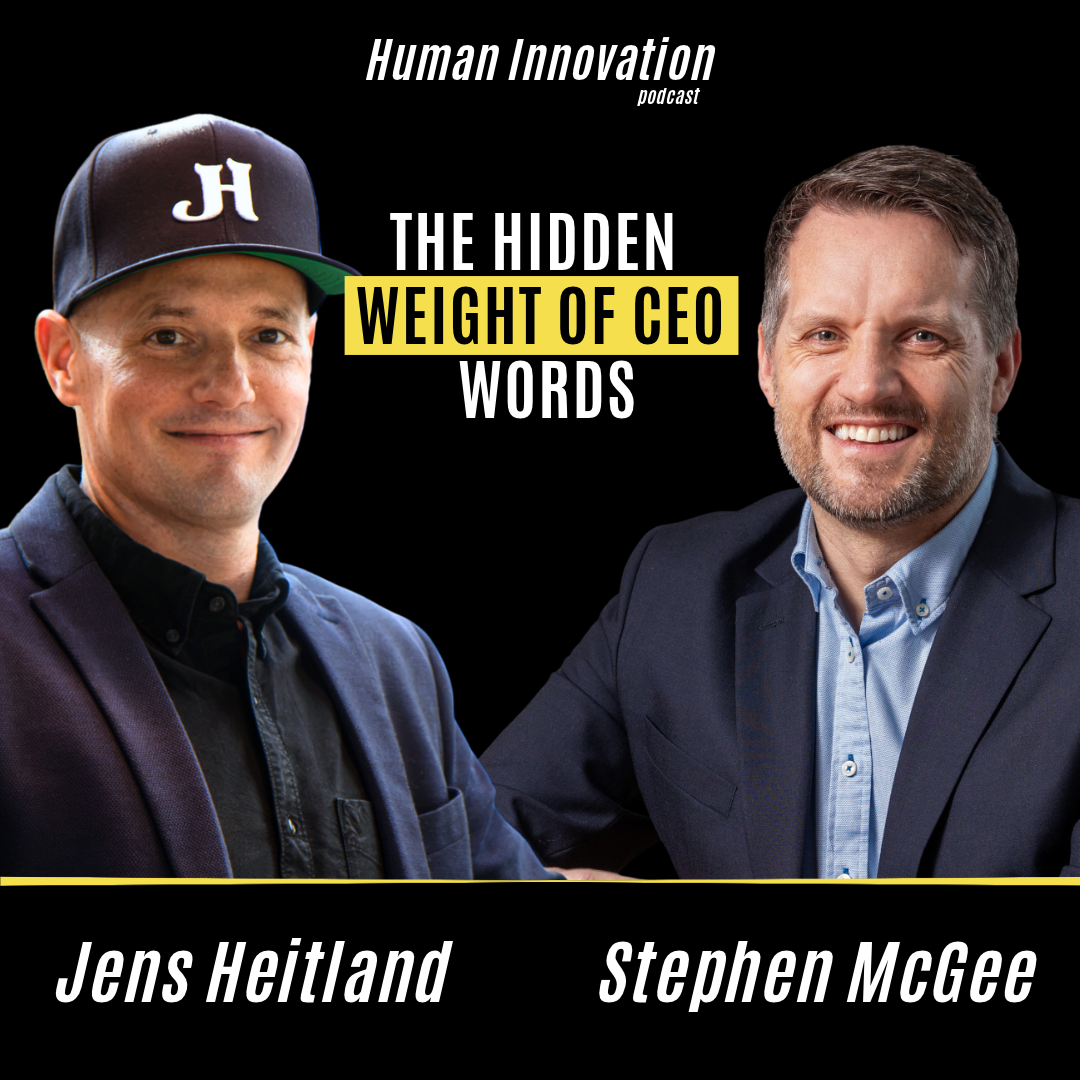
Stephen McGee, CEO of Scottish Friendly, joins Jens Heitland on the Human Innovation Podcast to discuss the move from CFO to CEO and the surprising shift that came with it: a leader becomes accountable for everything while being directly responsible for very little, and every opinion is treated as an instruction. The conversation explores how a mutual ownership structure lets a Glasgow-based life insurer make long-term decisions without quarterly market pressure, why customer service is an area where cost cutting can quietly erode advocacy, and how balancing customers, colleagues and owners drives long-term performance. Stephen also shares how he builds culture by putting the right people in place and stepping back, why performance and potential only make sense alongside ambition, how AI is changing both operations and customer behaviour in financial services, and why the future of savings will be shaped by the transfer of wealth across generations.
Youtube Podcasts
BRING JENS HEITLAND’S FRAMEWORKS TO YOUR ORGANIZATION
When the Opinion at the Top Stops Being an Opinion
In large organizations, moving into a top role changes the meaning of almost everything a person says. The words may be identical to the ones used a year earlier, yet the weight attached to them has shifted considerably. A suggestion that once sat comfortably in a debate among directors now arrives in the room as a direction, and the people in that room adjust their work around it before anyone has asked them to.
In a recent conversation on the Human Innovation Podcast, Stephen McGee, CEO of Scottish Friendly, described how this shift caught him by surprise. As CFO he had worked closely with many chief executives and assumed he understood the role well. He found himself accountable for everything and directly responsible for very little. Once his team was aligned, his days were defined by availability far more than by activity. Even when he prefaced a remark by calling it just an opinion, his team received it as an instruction.
What happens at scale is that authority amplifies everything that passes through it. A passing comment from the CEO travels down several layers, and at each layer people interpret it a little more firmly than the layer before. Over time, those interpretations harden into priorities. Teams begin to optimise for what they believe the top of the organization wants, and the quieter signals from customers and colleagues receive less of their attention. In my experience, very little of this is ever intentional.
Stephen described a deliberate discipline in response. After setting a clear direction and placing capable people in their roles, he steps back and lets them lead. He once asked one of his teams why he would need them in their positions if all he did was tell them how to do their jobs. His instinct also comes from coaching football outside of work, where a coach shouting constantly from the touchline rarely improves the game. The result he described is a business where the people closest to the work carry the decisions that belong to them.
The consequence of an unexamined shadow builds slowly. Decisions start flowing upward because people feel safer waiting for a view from the top. Capable leaders below the CEO begin to defer, and their own judgment weakens through lack of use. The organization grows busier at the top and quieter everywhere else. Customers eventually feel it as well, because the people closest to them spend their energy reading signals from above instead of responding to what is in front of them.
The same pattern appears in how development is handled. Stephen observed that a performance and potential grid tells only part of the story. Ambition changes with life circumstances, and without understanding it, development plans land on people who may not want the destination. He treats regular one to one conversations as the place where that alignment is found, and he regards a CFO he promoted moving on to a larger role elsewhere as a success for the organization.
Leadership at the top therefore asks for a particular kind of restraint. The work shifts from producing answers to creating the conditions in which others produce them, and from being busy to being reachable when it matters. Organizations tend to grow into the space their leaders leave for them. When that space is protected with care, people step into it, and the results often surprise everyone, including the leader who made room.
Timecode:
00:00 Ep.274_Podcast_Stephen McGee
06:29 Choosing the CEO Path
08:58 About Scottish Friendly
12:21 Mutual Ownership
14:14 What Makes a Friendly Product
20:29 Leadership & Culture
29:24 Performance, Potential & Ambition
34:43 AI & the Future of Financial Services
39:31 Vision for the Future
Guest links:
Connect with Stephen McGee
LinkedIn: https://www.linkedin.com/in/stephen-mcgee-90615115/
Website: https://www.scottishfriendly.co.uk/about-us/corporate-governance/our-people
Connect with Jens:
Transcript:
[00:00:02] Jens Heitland: Steven, welcome to the podcast. First question, I'm super curious. You stepped into your CEO role in 2022, coming from very large financial institution and have been CFO before. What was the biggest difference stepping into the CEO role when you look back?
[00:00:20] Stephen McGee: when I look back, I'm still a bit surprised at how different it was versus how I-- what I expected. I'd been CFO, I'd known quite a lot of CEOs, and I felt as if I fully understood what the role entailed. But it was, different. It was very, very different. And one of the biggest differences for me was you're not really responsible for a lot anymore. So you're accountable for everything, but you're not actually responsible for a lot. So, so your day as a CEO, once you've fixed all the things you need to fix at the start and get the, the, the team aligned about what you're trying to achieve, and we create a number of people left the business for various reasons.
[00:01:10] Stephen McGee: And so you get your team aligned, and after about six months, everybody's in place. They know their role, know what we're trying to achieve. What is my-- like, what is my job at that point? 'Cause I, I, I generally am not responsible for much. There's ve-there's very little that I actually have to do myself.
[00:01:28] Stephen McGee: Everything is done through my team. And I had a wee bit of a moment. So January, so I started in April, January the next year, I had a bit of a moment that I tried to work out what, what my role was and what, what do I do now that everybody's doing their jobs, everybody's going to the right direction, the business is fully aligned. And I got some advice from somebody, and they were actually talking about their role as a non-exec not as an executive, as a non-exec director. And what they said was, "Steven, quite often you're not busy as a non-exec director, but you always have to be available." And so you-- So, and that, that made me think about how does that apply as a chief exec?
[00:02:12] Stephen McGee: 'Cause that was sort of describing my day. My day was not-- I wa-I wasn't clear every morning about what I was actually going to be doing, but I knew that I had to be available for my team. So that was probably the biggest surprise, that you're not busy, but you have to be always available. Okay? And I'm not saying you're not, like, you don't have to work hard and all that sort of stuff, but you're individual.
[00:02:36] Stephen McGee: It's a different type of work. You need to, need to be available to help and support your team, and you don't actually decide very much either, or you try not to, because even giving opinions is different as well. So whereas as a CFO, my previous job, I was obviously a, a director in the business. I had a very good CEO who, he allowed us to get on with stuff, and my c- and my opinion carried a lot of weight, but it wasn't a decision. And then I came into the CEO job, and every opinion I gave, even when I said, "This is just an opinion,"
[00:03:13] Jens Heitland: Yeah
[00:03:14] Stephen McGee: that w- suddenly that was what actually happened. And just learning the combination of coaching and being available, but also just being very conscious not to give opinions and not, because that was, it wasn't taken as an opinion.
[00:03:30] Stephen McGee: It was taken as a, this, instruction, as a direction. So the biggest thing was, the availability versus, busyness, and the second thing was probably just around just being very, very careful about how big a shadow you cast and making sure that you don't give too many opinions, because that does, those opinions actually just skew quite significantly what the teams actually do.
[00:03:57] Jens Heitland: Yeah. How, how was it for you being responsible for the total then as a starting point? Because I, I'm pretty sure like a lot of people are approaching you, a lot of people compared to before it was may- may- maybe more the financial part where, where you were leading the whole teams and, and as the CEO, did that change?
[00:04:18] Jens Heitland: Did you push back? How, how was that in the, especially in the early days?
[00:04:22] Stephen McGee: So I embraced it because I wa- obviously I wanted the job, I wanted to have the full responsibility. But I did recognize there were quite a lot of areas where I had very, very little experience. So I tried to embrace those areas, but, and try and gain a bit more experience, a bit more understanding, but also try to step quite, take a big step back from the roles that I had performed.
[00:04:48] Jens Heitland: Ja
[00:04:49] Stephen McGee: very conscious that I wasn't the chief actuary, I wasn't the, the CFO, and, and allowing the CFO and the chief actuary to actually their roles without feeling as if I, I was doing that. And that helped. I think the combination of those two things helped because it allowed me to focus in areas where I probably hadn't had as much experience. Previous roles I'd had quite a wide, area of responsibilities anyway, so it wasn't just your traditional chief actuary or CFO type role. So I had property, I'd a lot of involvement around, on the people side and, with the HR team, et cetera. So those areas were actually a natural extension. But like customer services was, was an area where I'd never been involved.
[00:05:40] Stephen McGee: I'd done a lot of like back to the floor type, things. So call listening and just sitting down and people and shadowing people and all that sort of stuff. But really understanding, really understanding what that meant within the new organization. That was where my focus was. and I, I really embraced it, enjoyed it.
[00:06:02] Stephen McGee: One of the things about, hmm, myself is I need to feel as if I'm continuously learning and evolving. So this was just a natural thing that I could get stuck into and try and learn what, what it felt like on the ground for the business, and really to look at it through a customer lens as opposed to, and a colleague lens, as opposed to just looking at it through a financial
[00:06:27] Jens Heitland: Yeah.
[00:06:29] Jens Heitland: How was it for you deciding which company to be a CEO in? Obviously, there, there are always different choices that you can make in, in, in your career, and you have been working in an international organization before. Why did you decide to pursue a CEO role in an-- in the organization that you work in right now?
[00:06:48] Stephen McGee: I came to a decision point that I had been CFO in a subsidiary of a very large, international organization, and my decision point was, do I want to be the CFO in a bigger, like a bigger CFO role, or would I like, would I want to pursue a CEO career? And when I actually looked at the roles quite carefully about what the two different roles meant, I actually decided that, do you know what?
[00:07:21] Stephen McGee: The bits of my current job today that I really like and enjoy and get most excitement and value from is much more aligned to being the CEO of an organization than being the CFO of a bigger organization. And I'd done most of the work, that would have, you know, there'd been an easier progression to being a bigger CFO. And I did enjoy some of it, but there was a lot of it was just a, an effectively unnecessary evil for the bits of the job that I did. was a lot more of the CEO role that I thought was actually exciting and really was what I loved about my current job and what I'd want to do. And then I actually spoke to a number of headhunters around just how you can transition, how easy it was to transition.
[00:08:09] Stephen McGee: The feedback I got quite clearly was the easiest way to do that was to stay, if not in your own company, but on, in your own industry. So that narrowed the scope
[00:08:21] Jens Heitland: Ja
[00:08:22] Stephen McGee: quite, a lot. And I was just fortuitous that at the time that I was looking to leave my last role, a, a CEO role came up, in Scotland that really, really excited me and I was a, I, I was able to put my hat in the ring for that.
[00:08:39] Jens Heitland: Nice. So if, if we look at what you do right now as a company as well, and we look into investing into the future, which is one of, one of the, the topics that, that you and your organization work on, maybe let's start with a little bit explaining what the company's doing. So the
[00:08:58] Jens Heitland: , the company's called Scottish Friendly.
[00:09:02] Jens Heitland: Just explain first and then we go deeper into topics
[00:09:06] Stephen McGee: Scottish Friendly, it's a Glasgow-based, life insurance business. Our two primary products that we sell are our individual savings account for adults and a junior individual savings account for people that are under eighteen. And these are tax, advantageous savings, available to people in the UK. Okay. So it's a really, it's a savings vehicle, tax advantageous savings vehicle for, UK. The business itself targets people that are unwanted, underserved, and unwanted by the larger insurance businesses. Having worked in quite a few of them, I know they're going after very, very similar, people, and they're doing it for good reason 'cause those, that's where most of the money is, that's where most of the revenue opportunities are. But we are looking at actually to target an element of the population below that level that are pretty much underserved. They need the help, they need the support, but they're unable to actually pay, pay for that. And one of the things that really attracted me to Scottish Friendly the fact that we were targeting those people, but also the way we were trying to target it as well. I don't know, well, I do know a wee bit about, legislation in other countries, but in the UK, because of the way the tax treatment work, it's actually very, very complicated. one of the things I'm really passionate about is education's never gonna get there for most people. The gap is, is too complicated, and the education will not get there. So how do we actually bridge that gap? We bridge it through simplicity Okay. So we're trying to make products that are really simple to understand. They've got-- They're very easy to, administer and for you to take out and to do the things that you need to do. They're at a good pricing point. So we're not, we're not obviously hyper-competitive because that's very, very low margin, and we just... not big enough to compete in that space, but we are price competitive, so we... And the other thing I'm really passionate about is when you need that help and support as a customer, you can phone us up, and there's somebody at the end of the phone there. And the combination of all of those things, we-we're called Scottish Friendly, and we talk about friendly products
[00:11:40] Jens Heitland: Ja
[00:11:40] Stephen McGee: services that simplicity, ease of, ease of administration, but actually good value for money.
[00:11:48] Stephen McGee: But somebody on the end of the phone when you need that support, those are all the things that I, I take to mean, you know, the products we provide. We would love to provide more. That's what we're trying to do, as a business is actually bridge out from those products and provide more of the products that customers, actually need and to begin to support not just the individual but that family unit as well.
[00:12:15] Jens Heitland: One of the things that I found fascinating wh-when, when we talked before, and then I looked into it, was
[00:12:21] Jens Heitland: the shareholder structure is slightly different than other financial institutions. Can you give a little bit explanation about that?
[00:12:28] Stephen McGee: So we are mutual. So, we are actually owned by our members. So there are no shareholders of... We pay out a thing called profit share, which is a share of the profits that we've made, and we pay that out to, some of our members on an annual basis. But there are no shareholders there, which is, really, really good because having worked in shareholder organizations, you can have some very focused analysts and investors, really holding you to account month on month, quarter on quarter, and suddenly your share price goes down ten percent because you haven't quite hit targets. found that can lead to some quite short-term decision-making.
[00:13:13] Jens Heitland: Ja
[00:13:14] Stephen McGee: Whereas in our structure, and one- this is definitely something that attracted me to the business, we truly can take long-term decisions without having to worry about short-term, reports to the market and how the market might react and the commitments we made.
[00:13:32] Stephen McGee: So we're still held accountable by our members, but they don't have that... We are not looking for that very, very short-term return. They are there as a, an investor in our business and are there for the long term. So that, that dynamic really, really helps. You know, other businesses here in the UK, there's quite a few other mutual businesses in the UK, but we think we're relatively unique given the customers we are targeting, the products we have, and that shareholder structure
[00:14:03] Jens Heitland: Ja
[00:14:04] Stephen McGee: of a shareholder structure, ownership structure.
[00:14:06] Jens Heitland: if we look back to the friendly products and, and you, you take like obviously your definition of a friendly product,
[00:14:14] Jens Heitland: what, what did you see differently? Especially if we compare this to the previous organization that you have worked with of the friendly product, and what can other companies and other CEOs learn from friendly products?
[00:14:26] Stephen McGee: it's interesting that you like, or at least you've referenced the friendly products. When we were writing our purpose, friend- the word friendly in front of products was the bit that quite a lot of people did look at and said, "What do we mean? And do we really want that there?" And actually, it was our colleagues that wanted it. It were their colleagues that said, "No, that's actually We want that included because that's what we, how we think we do differentiate." So for me, what could other businesses learn? It's difficult because a lots of the bigger organizations, they have an advisor advising a client, and all they're doing is facilitating that advice journey.
[00:15:10] Stephen McGee: So they're just providing a product. They don't actually really deal with the customer directly at that point. The advisor is their customer, so they're providing whatever the advisor wants. And when you're doing that to 5,000 advisors or however, you know, there's 18,000 advisors in the UK. If you're doing that to even 500 advisors, they all want different things So that actually, for me, that goes against friendly.
[00:15:41] Stephen McGee: That's 'cause they-- All that does is drive individuality com- and further complexity into your business, and your ability to then that direct to customers is, is, is limited because of that complexity. So you're always trying to satisfy the need of those five hundred people that are wanting a bespoke product and service
[00:16:04] Stephen McGee: for their own cl- for their own clients. customers end up being your c- being your customers, but they don't see it that way. They see them as being your client and actually the customer. You're just facilitating that for them. So they could learn, they could learn. I don't want them to learn too much because I think it's a bit of an advantage for us as a business. But, but even if they did try to learn how to do that, they would be coming up against, against those advisors that want that bespoke. think for all services, having local contact on the phone when customer need it, you kn- you'll know yourself as a customer of people that don't do that, how frustrat- how frustrating that can be. And I, in my experience, I think it's false economy. Right? I generally think it's a false economy, and it's an obvious area to cut costs, but I don't think it's, I don't think it is creating advocacy. And me as a customer for your service, and I'll not go into names, but my, uh, who I have my broadband with, their cust- they, they, their customer service is terrible.
[00:17:18] Stephen McGee: And the only, the only reason they have my custom at this moment in time is because they're the only provider that can give me a feasible broadband speed. The minute I get the option to move away from them, I'll move. And as a business, if that saving, the, the cost you'saved to lose my advocacy, I just don't see that as being any, a real
[00:17:18] Stephen McGee: And the only, the only reason they have my custom at this moment in time is because they're the only provider that can give me a feasible broadband speed. The minute I get the option to move away from them, I'll move. And as a business, if that saving, the, the cost you'saved to lose my advocacy, I just don't see that as being any, a real
[00:17:40] Jens Heitland: Ja
[00:17:41] Stephen McGee: I, I don't know how they came up with that value. They talk about driving up profits through accountings, accountancy, and we-- and you can only g-grow so much through cost savings. you're not creating that advocacy within your customers, you know, how are you actually gonna grow in the future and, yeah. I don't, as I said, I don't want to give too many businesses, that much advice because of the competitive market that we're in. that feels, that feels like a decision that I, I can understand why businesses have done it, but then I can't at all.
[00:18:18] Jens Heitland: what I love about that perspective is that, uh, fitting to the theme of the podcast, you put the human first, like your customers and the people behind your products. That, that is the core thing, and it is not obviously you need to earn money, you need to make a margin, and that's part of running a business.
[00:18:38] Jens Heitland: But still you focus on the individuals, the people, and that's at least from an external perspective, extremely visible, and that's why I wanted to interview as well. I, I-- for me it is unique because I don't see that too often, and everyone that is listening to this, please, please have a look at, at what Steven and his team is doing.
[00:18:56] Jens Heitland: I, I, I'm really inspired by that
[00:18:58] Stephen McGee: if you think about the three key stakeholder in any business. So you've got the, the people that work there, the colleagues. You've got the people that own the business, the typically shareholders, and you've got the, you've got your customer, right? And I don't know any business that will grow if you focus on how you drive up the amount, greatest amount of value to shareholders. So we, at Scottish Friendly, we are trying to get the balance between looking at our customers and really trying to create advocacy there, but also making sure it's a great place to work. I think, I generally think if you get customer, happy customers and happy colleagues, that becomes a virtuous cycle. And over time, that drives long-term performance. I think if you, if you try and start with shareholder first or owners first, then all you do is you get into these short-term decisions.
[00:19:57] Jens Heitland: Ja
[00:19:58] Stephen McGee: and actually, it, it is contrary to the customer experience or the colleague experience, typically. Well, it's one or the other that's paying for that. And then you just, you, you might be successful, and there are lots of businesses that are successful, but they don't-- They're not-- If you look beyond five years, their growth trajectory is gonna stall because they've actually, all their decisions are about how we make it more effective, more efficient. It's nothing about how do we actually make it more attractive
[00:20:29] Jens Heitland: let's talk about the, the culture that you're building in the organization and, and, and the way you lead since you stepped up to be the CEO. Give us a little bit of glimpse how, how you see the perspective and the importance of employees and, and your leadership role as part of that
[00:20:46] Stephen McGee: I remember my son asking me, "Dad, what do you actually do?" Right? 'Cause it was during COVID. and, we're actually sitting side by side, because that's the way we'd set it up in the house. He's got his computer over to the side. and he was like, "What do you actually do?" And I was still the CFO at this point in time, but I think it's very valid for the CEO. And I said, "Josh," Joshua, his name's Joshua. I was like, "Joshua- my job is not to work harder myself, but is to get a wee bit extra out of every single person that works for me. So if you think about at that time I had about four hundred people working for me. If I the work of two people or even three, that's four hundred and one, four hundred and two. could just inspire motivate and create an environment to get even just five or ten percent more out of my team, that becomes four hundred and twenty people or four hundred and forty people. And that sort of have always framed me. I'm only successful if my team are actually delivering. Okay? And creating the right environment for them to deliver is critical to me and my success. So even if I'm being purely selfish about my own outcome, well, I'm-- I do better if they actually deliver more. And so I, I think it's been easy for me to align as a leader with what's good for the company, what's good for the colleagues, and what's good for me. Okay? And actually find creating the right environment being the most important thing. And that's not just about wellbeing and all that sort of stuff. It's actually being clear about what we're trying to achieve a business. How, how what we're doing today is aligned to actually that. Communicating how their role aligned to what we're trying to achieve and what we're doing today, and just making sure we've got a clear vision, aligned to our purpose about what we're trying to achieve as a business. And then as a leader, about getting the right people in place. And then once you have the right people in place, get out of the way. Just get out of the way. let them do their jobs. remember saying to one of my teams, "If all I do is tell you what to do or how to do your job and what to do, why do I need you to be here leading your part in the business?" So just have the confidence in your team, and be surprised about how good they can be. Like give them an environment that they can really excel in, and then you will be surprised. We are really, really busy at this moment in, Scottish Friendly because we've got a... We're working on a, a proposed merger early next year, and, and it-- what it has seen is an exec team are very, very busy working on these big projects. And actually our business is probably performing the best it's ever performed. Which is maybe a lesson that they've had to get out of the way for their teams as well and let
[00:23:54] Jens Heitland: Ja
[00:23:55] Stephen McGee: surprise. But yeah, for me personally, get the right people in place, be clear what you're trying to achieve, and then just get out of the way and let them get on with it and allow them the sense, the real sense of empowerment to just get on and do, do the best that they can.
[00:24:09] Jens Heitland: How, how was this for you, like in your previous roles? Was it the same? Did you pick it up from there? Did you have mentors that get you into this? Or is it just like something that came up in this organization?
[00:24:22] Stephen McGee: I probably have developed it over time. Uh, and I've-- I would say that my early sta- early years as a manager, I was, I was checking everything and, and double-checking and probably being more, director, like directing work and checking it and making sure it was right before passing on rather than leading. So I think it's definitely something I learned. I do take a lot from, sports. So actually, I, I'm a, a football coach outside of work, so, uh, and I take a lot of my dynamics, team building t-type stuff from just thinking about if this was a sports team, what, what would you do with a sports team? And you're the coach standing at the side, we've all, we've all seen the coaches standing at the side just screaming and bawling. Constantly. And you're thinking, "As a player, I never liked that, so why would I think that would work in the workplace?" Yeah, so I do-- I've probably had that sort of sports analogy, uh, experience always in my mind. But, uh, yeah, I would recognize it wasn't something I did right at the start as a manager, but through various, uh, leadership programs that I've gone on, picked up kernels, just, uh, real truths that I do believe in. And one of those is that, that bit around, you know, them pointed in the right direction and then get them, like, get out the way and let them get on to it
[00:26:05] Jens Heitland: if we take Scottish Friendly, so you took over in 2022 as the, the CEO. What was your vision at that time leading the organization into the future, specifically when it comes to your leadership and how you engage with the team members?
[00:26:20] Stephen McGee: So I stood up in my first day, and then it get, this get picked up, 'cause it was in the press release, then it get picked up in newspapers and all this. And I stood up in, in the first day, and I said, "My ambition for this business is to be the leading mutual UK life insurance business." Okay? So the leading UK life insurance mutual. Okay. But I then qualified it because I said, "That's not about scale." Okay? It's not about scale because realistically, know, you've got businesses that are 40 times as big as us, so it just wasn't go- it wasn't a credible thing to say. But it's not about scale. This is about how we service our customers, how it feels to work here, and what we're, how we're actually going to operate as a business. And that was, you know, that... Hopefully, that came across in the things that I've talked about and what's important to me. But I wanted us to be a great place to work. I wanted us to provide those real simple value-for-money products, and I wanted to really do more for our customers, than we were currently doing. And we're still on that journey, right? We, we got our engagement results last week, which are the be- we haven't disclosed these in the company yet, but they're the best they have been in my time here. The products are where we want, but, but we want more. The service is where we want, but we want more. So it's a, it's a...
[00:27:51] Stephen McGee: We're still on that journey
[00:27:52] Jens Heitland: how was the reaction of the, the different people, like, greeting you at the first day when you said that?
[00:27:59] Stephen McGee: I'd also say one of the things that I also said is we're only here because of our customers. And so if we don't do this for our customers, there'll, there'll no jobs for any of us, right? So I definitely put the customer right in the center. think Scottish Friendly, as a mutual, has a long history of putting customers first, so I think that resonated really, really well. The fact I was trying to create the environment, I think, to be honest with you, whilst it probably resonated well, there was a bit of skept- skepticism because, right, okay, yes, it's easy to stand up and say that. Just let's see, see how that works out over time. But I think they liked the, the feedback we got was really liked the ambition, liked the openness, liked the clarity about what we're trying to achieve. And hopefully we've been true to that. And, you know, we've same priorities in my first year, I think four out of fi- those five priorities are still the same today,
[00:29:05] Jens Heitland: It's good
[00:29:06] Stephen McGee: that, it, it does show you there's that level of consistency, that clarity does help. And, and probably keep just moving the bar about where I want us to be.
[00:29:17] Jens Heitland: Yeah, nice. So w- when we talked last time and, and we talked about like career development and so on, you said
[00:29:24] Jens Heitland: performance and potential are incomplete without ambition
[00:29:29] Stephen McGee: Yeah
[00:29:30] Jens Heitland: Share more about your perspective on that
[00:29:32] Stephen McGee: Most people have probably seen the performance potential nine-box grid when people are working in organizations and are trying to talent and succession plans and people to invest in. And when I work-- I worked in an organization where when you went out and spoke to all those people were identified, they were heavily motivated, and they bought into what you were trying to do to help support and develop them to fulfill their potential I then changed company and I decided, you know what?
[00:30:10] Stephen McGee: I'm gonna go-- I quite liked doing that in my last business. I'm gonna go, I'm gonna redo that here. And what I was surprised at is how many people were not motivated by it, how many people were just quite happy with the status quo, where they were. And I thought, you know, that's that motivation was a wee bit lack of motivation, a wee bit alien to me, and probably a wee bit something I've learned in my career 'cause it's happened, probably happened to me as well.
[00:30:41] Stephen McGee: Motivation does change over time and circumstance. Depending on what's going on in your personal life, you might have different motivations and ambitions. But unless you understand that for your teams, it doesn't really matter about what you think their potential is if, if, their current circumstances. You know, lots of people very ambitious, and they want to get to the top of the tree as fast as possible, but there's as many people that work is just a means to live, and actually, they're quite happy where they are. And if you don't understand that for them individually, then how do you ensure you're actually helping and supporting them in developing?
[00:31:22] Stephen McGee: And probably getting back to this, the point about motivated individuals. It'd be easy for me to say to teams, individuals, "This is your development needs. If you want to be that, if you want to be this, this is the ten things you need to do. And we're gonna concentrate on the ne- these three over the next six months." But if they actually don't want to get to that endpoint, then they're not actually gonna put any effort into the development. So really understanding what their, you believe their potential is, what their actual motivation is, and then tailoring that development to that set of circumstances. I think that's the real key, key thing to being a senior leader and really tapping into that potential, within your teams.
[00:32:09] Stephen McGee: If you don't do that, I think you can spend a lot of time and effort investing in the wrong people. But you need to recognize that that can change over time. So just because you've checked in once,
[00:32:21] Jens Heitland: Ja
[00:32:22] Stephen McGee: isn't, you know... So sometimes you check in people, they, it's not the right time for them. Sometimes you check in with people, and it was the right time for them.
[00:32:31] Stephen McGee: So just you need to check in on a regular basis just to make sure that you're still aligned. And I think if you can get that alignment, again, you get that motivation, and then they actually, they're, they're performing at a higher level and they're developing
[00:32:46] Jens Heitland: How do you do that in your organization?
[00:32:49] Stephen McGee: We have conversations. So, as a manager, so that instead of a leader, as a manager, a number of people report to me. what we did was, right, what, what was the ambition, what was our ambition as a team? What we're trying to... And how, your ambition as a individual? And how do we make sure there's as much overlap between those two things as possible? And then if you have, like, we've just announced that the person that was promoted, I promoted to be CFO, has now moved on to, or he's announced he's gonna move on. And that's not a bad thing for me. That's a success for me. He's come in, we're able to promote him, very, very capable. We're able to develop him, and he's now ready for the next role. If we, if, as an organization, we can't provide that next role, then I'm delighted that they... And actually would encourage people to go in and get it somewhere else. Because in doing that, I think people want to work for me, actually they do more whilst they're working for me because they know that actually they'll, they'll develop and they'll be successful, and they'll end up, they'll end up getting another role if we can't do it ourselves.
[00:34:05] Stephen McGee: So but that's all done, all done through conversations, okay? It's done through one-to-one conversations with that individual, sitting down, checking in on a regular basis, it. I would normally do it, on- once a quarter, just a bit of a check-in and then a, more deep dive at the end of the year to when we're just looking back, looking forward. We do the exercises, the, the nine-box grid exercises, but that's only names on a page. It's when you actually really get into the individual that it has to be through that one-to-one conversation.
[00:34:41] Jens Heitland: if we look back at the industry
[00:34:43] Jens Heitland: , where do you see the financial industry specifically in the points that your organization is working on heading in the next couple of years with all the technology that it is developing and is implemented in many, many organizations?
[00:34:56] Stephen McGee: In some senses it's very exciting, in other senses it's very scary. I was talking to someone yesterday, I think people that will really take advantage of the technology today are the ones that know what good looks like. So you can short circuit very, very quickly to a good outcome. You know, you still have to deal with the fact that AI tools, no matter how good they are, they still have hallucinations, and they get things wrong and all that sort of stuff.
[00:35:30] Stephen McGee: So you need that skill and experience to be able to actually filter that out. So take the percent of it, which is really, really good, and filter out that ten percent. So as I'm... Hopefully for my career anyway, this part stage of my career, it'll be an incredibly useful tool that will
[00:35:48] Stephen McGee: really cut through, cut through a lot.
[00:35:50] Stephen McGee: And I've seen plenty of examples where things that would have maybe taken me an hour and I can now do in less than two minutes.
[00:35:57] Jens Heitland: Ja
[00:35:58] Stephen McGee: prepare a response for this based on this fifty-page document. I did that yesterday. got a response within ten seconds, edited it, and sent it within two minutes.
[00:36:11] Stephen McGee: That would have taken me an hour to do previously. So that's just an example of the sort of advantages. But the tools, how you apply those tools throughout your organization and how you allow people to reduce things that are not adding real value. So we've got a lot of operations in our team, in our business that are relatively manual, quite labor-intensive, and we need to do them because we're heavily regulated as a
[00:36:43] Stephen McGee: financial services business.
[00:36:45] Stephen McGee: They need to be right. Anything that goes wrong, there's usually a cost and remediation. So how do we actually use those tools to really strengthen that work and allow people to add value, whether it be on the end of the phones really helping support our customers just actually looking at how we can make the business better, more effective, more efficient, add more products.
[00:37:07] Stephen McGee: That's, that's where we really want to go as a business. Now, as you hear lots of people talking about big saving, big cost efficiencies and all that sort of stuff, that, that is definitely an opportunity. But how do we recycle those savings into better outcomes for customers? That's where we are, are trying to do it. then you look at on the other side, all the, the scare stories about what AI might do and all that sort of stuff, and it's all... It's very, very scary.
[00:37:40] Jens Heitland: Ja
[00:37:41] Stephen McGee: be some- it'll be somewhere in between, I'm absolutely sure.
[00:37:44] Jens Heitland: do you see anything changing from your customers' perspective?
[00:37:47] Stephen McGee: We're already seeing some of it. So, what you tend to see is customer complaints about much, you know, quite often see much more articulate complaints. So the quality of what they're writing into, they're obviously... But, you know, I think it's good actually. the, the quality of the complaints that I see are y- have inc- have improved, and it does look like they're now leaning into some of those tools to help, to help complain. Obviously, we are a direct-to-customer, proposition, so we are take- we are actually looking for people to use us to do it themselves and use us. And what we see is actually people being a bit more inf-informed and a bit more confident about that because they've been able to probably cut through a lot of the information on, to actually get to what they want to do. do see is people still need a wee bit of a reassurance. There's still not as much trust there, so they still need a wee bit of reassurance, and that's where we often find they, they get in touch with us because they, they want a human the other side to be able, be able to tell them, "Yeah, that's... You're doing the right thing." Not from an advice perspective, rather from an administration perspective. So I don't think it's fully trusted yet, but I do think that will really help bridge that gap between complexity and understanding, and I think that's only a good thing, especially in the UK
[00:39:29] Jens Heitland: if we look at the big picture and
[00:39:31] Jens Heitland: purely focus on your organization, where do you see and, and your ambition with the organization in the next coming years connected to that?
[00:39:38] Stephen McGee: So we really want-- we still want to be that number, number one UK mutual insurer. So really helping and providing real support to our customers, pretty much a wider range of products than we have today. We, we do believe we get a lot of that through the proposed merger. And we, we want to become the default that those types of customers go to, uh, for financial products. We're not a bank, so they're not gonna go for a bank, but with those savings and investment products. And we really want to build out from that individual relationship to the family relationship, because what we'll see over the next few decades is actually there needs to be quite a generational wealth because a lot of the wealth has been accumulated, uh, in that boomer, so the post-war generation,
[00:40:36] Jens Heitland: Ja
[00:40:37] Stephen McGee: that a lot of tied up in property, and at some point that wealth has to be passed down to the next generation.
[00:40:45] Stephen McGee: And how do we actually build the relationship with our customers so we actually are more of a family unit, and therefore we can help and facilitate that transfer, that savings, that support mechanism across the family.
[00:40:59] Jens Heitland: Stephen, thank you very much for taking the time. It's really inspiring talking to you and, and s- I can really feel how much you are believing into your customers and, and, and the leadership importance as well. Thank you very much for doing what you're doing and taking the time for the interview
[00:41:16] Stephen McGee: I'd you very much
[00:41:18] Jens Heitland: