
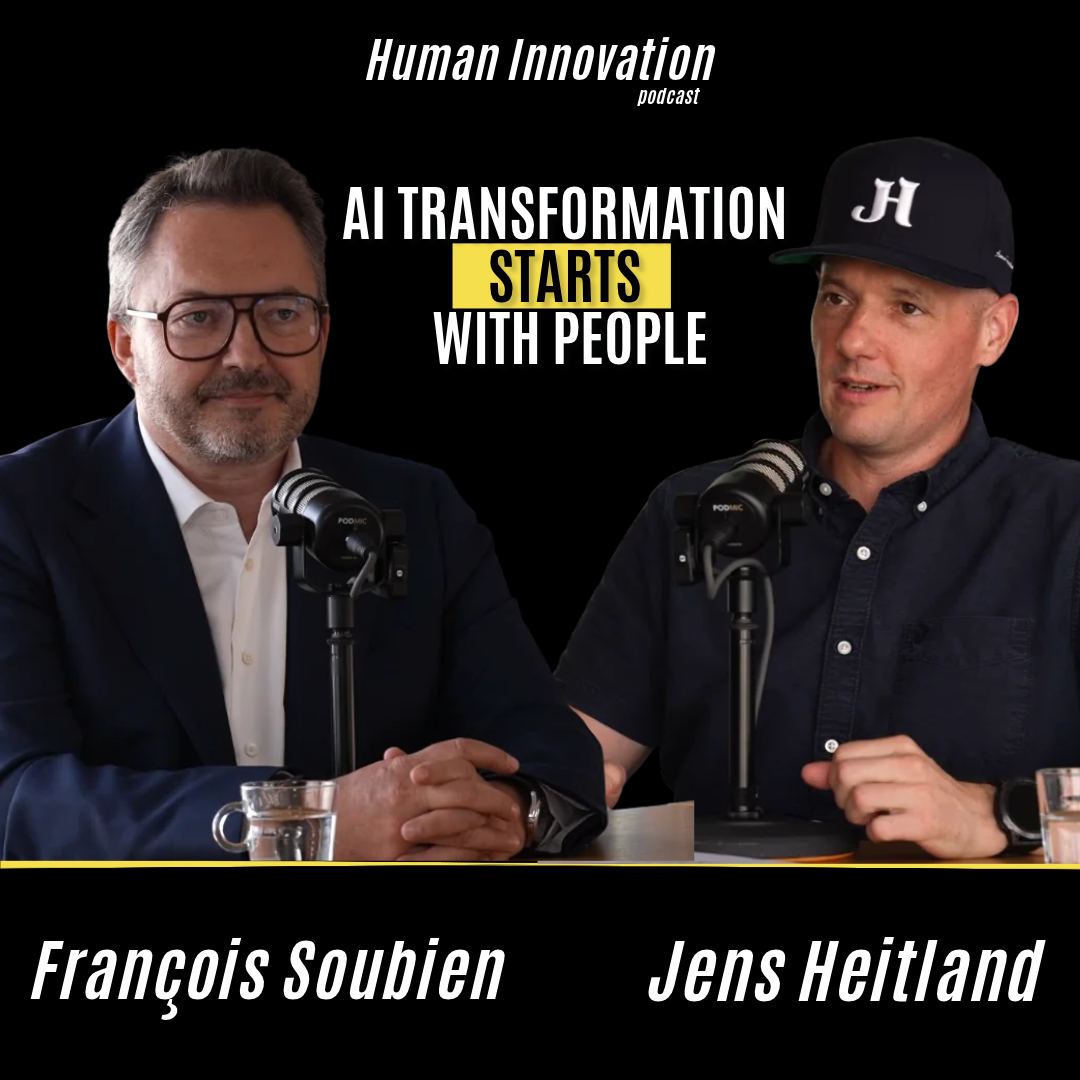
Jens Heitland speaks with François Soubien, CEO of global consulting firm Talan, about why so many AI pilots fail to scale and what separates real AI transformation from isolated experiments. Recorded in Paris, the conversation covers the 70/20/10 rule of AI budgets, where most of the investment goes into change management rather than the model itself. It also covers why certifying people matters more than buying licenses, how a chief AI officer can support adoption without centralizing every decision, and why staying model agnostic protects an organization as the technology evolves. François also shares how he uses AI personally as a CEO and which leadership traits he sees in organizations that adopt AI successfully.
Youtube Podcasts
Why AI Pilots Rarely Become Transformation
Across industries, artificial intelligence has moved from the margins of the leadership agenda to its center in a very short time. Boards ask for an AI strategy, employees arrive at work already using AI in their private lives, and executive teams feel pressure to show movement. During a recent conversation in Paris, François Soubien, CEO of the global consulting firm Talan, described how quickly the shift happened. Within a single year, the share of CEOs engaged in an AI initiative rose from around one third to 84 percent.
Under that kind of pressure, organizations tend to launch a series of small pilots. Each one answers a narrow question, runs in a protected corner of the business and produces a result that looks encouraging in a presentation. François called AI pilots a disease because they are designed as experiments and rarely thought through for scale. The money is spent, while the path into daily operations was never part of the design.
The system underneath explains why. A model on its own has become a commodity, available to every competitor on similar terms. François noted that AI labs have started placing engineers inside client operations, because a model only creates value once it works within a real process. The value sits in how that model is built into a business process, and that work belongs to the business before it belongs to technology. François shared a rule of thumb that changes the budget conversation. Around 70% of the effort in an AI transformation goes into change management, 20% into data and engineering, and 10% into the model itself. When attention is distributed in the opposite proportion, the outcome follows.
Over time, the gap shows up in people. Employees handed a new tool without a new role tend to keep working as before, or they quietly use personal accounts on the side. In a customer service center, the job moves toward supervising agents that draft answers, run analysis and warn clients about issues early. Unless the organization defines and teaches that new role, adoption stalls. Some organizations look for a shortcut through one large partnership with a single AI provider, and later find that one model cannot serve every function equally well. Fear adds to the drag, since many leaders still carry the early message that AI would replace people.
In my experience leading large innovation programs, the technology was rarely the hard part; the real work lay in how people understood their own roles. François places that human question at the starting point. He suggests CEOs ask how many people they want certified and working with AI in their daily processes in five years, instead of how many licenses to buy so they have something to report to the board. The first question leads into processes, impact and new roles, while the second tends to end in procurement.
He also described the traits he sees in leaders who move well: curiosity, an appetite for change and risk, enough technical understanding to use the tools personally, and the willingness to decide quickly. Role modeling carries a great deal of weight here. When a CEO visibly works with AI to prepare decisions, the organization reads that signal faster than any internal campaign.
Underneath it all is a question of how an organization learns. Every leadership team can honestly ask whether its business could be displaced by an AI native competitor within five to ten years. The answer usually depends less on which model was chosen and more on whether people were part of the change from the beginning.
Timecode:
00:00 Meet in Paris
00:11 Consultant to CEO
02:23 Mentors and Sponsors
03:55 Leading as a Mentor
04:39 Values That Scale
07:06 AI Wave Hits CEOs
10:03 Beyond Tiny Pilots
11:45 Strategy for Adoption
15:28 Transformation and Rhythm
18:59 Organizing for Scale
20:56 Why Hire a CAIO
24:21 Staying Model Agnostic
26:47 Leadership Skills for AI
31:28 Role Modeling With AI
37:34 Where AI Goes Next
39:04 One Tip for CEOs
41:11 Closing Thanks
Guest links:
Connect with François Soubien
LinkedIn: https://www.linkedin.com/in/francoissoubien/
Website: https://www.talan.com/global/en
Connect with Jens:
Transcript:
[00:00:02] Jens Heitland: François, great to meet you, and thank you for welcoming us here in Paris. It's a pleasure to be here. Let's directly jump in. I'm curious about, like, you started as a consultant, and today, couple of years later, you're leading a global consulting company. What are the experiences on your journey that have shaped how you think today?
[00:00:26] François Soubien : So first, welcome, and thanks for setting this up and making this happen. You know, I've been in the professional environment for the last twenty-nine years now, and essentially in a journey as a consultant through different companies. Last in row was with McKinsey & Company, but always with a specific eyes.
[00:00:54] François Soubien : My eyes was to be on the ground to ensure that I deliver pragmatism and impact with client I served. So this drove everything I do as a CEO today. And what I'm learning, or putting to practice is probably a better way to say it, is really three things. How do you build a performing leadership team?
[00:01:25] François Soubien : And this has been my education in the last decades. The second aspect is how do you define your clear strategy and execution plan to make it happen, to make what you want people to do, and how do you inspire them? And I think a consultant is well placed to do it. And indeed, third, you need to deliver on the performance, and there's either being on EBITDA, on growth, on cash.
[00:01:56] François Soubien : And this is also my education as a start, and also what I've been doing on a day-to-day basis when I was a consultant. However, that has been a new role for me. I fully embrace it, and I would say that after multiple months now, I'm at full speed, and even more energized than when I started to do it.
[00:02:23] Jens Heitland: If we look at both first days, so the first day of you starting your career as a consultant, and the first day as a CEO in Talan, how were these two days, and what was the difference of those?
[00:02:37] François Soubien : I think so the first thing is that these two days was a new day for me. A new learning, new people, but also people that care for you, huh?
[00:02:51] François Soubien : In all situation in my career path, I always find great mentors to help me to move to the next step. And I found this from my first job. I remember one of the leader calling me on a Friday night at 10:00 p.m. letting me know that I've got the job, and I told him, "Sorry, I've got already three jobs that...
[00:03:13] François Soubien : And I'm not planning to accept this one." And he spent one hour and a half with me, and I stay long with him. He was a great sponsor for more than five years. And then I moved to a different step to another company, and all along, I found a great sponsor to help me being successful.
[00:03:36] François Soubien : And that was the case also here in Talan because, you know, the company has been run by its founder. I'm taking over from them, but they're always around to help me to answer question when I have, in the things that we are planning to do with my team.
[00:03:55] Jens Heitland: If we turn this around, so you're CEO of Talan now, and you most probably have mentored a couple of people in your whole life as well.
[00:04:05] Jens Heitland: What are specifics where you as the mentor decided to help another person to step up like you have been helped before?
[00:04:13] François Soubien : I think there's different angle I could take, but there's one specific angle where, you know, I'm a client animal. There's something that I love is to increase, uplift, the growth, and this is what I've been transmitting to all my leadership and also the team I've been working with for the last three decades
[00:04:39] Jens Heitland: From a value perspective, so you have grown in different organization with different values and have built your own values as part of you growing.
[00:04:48] Jens Heitland: How do you transfer your values now being the CEO into the organization, specifically with the technology speeds that's happening right
[00:04:56] François Soubien : now? Yeah. I think the first value is really on ethics. This is a minimum that is required to ensure that in business environment we have the strongest ethics, internally and externally.
[00:05:12] François Soubien : So this is one aspect. The second value is impact. I don't want to do anything that is not related to an impact we generate with a client. I'm not interested in sales revenue. I'm not interested in EBITDA as long as client is not happy with what we do.
[00:05:31] Jens Heitland: Mm.
[00:05:31] François Soubien : Uh, the third, probably the third thing is, is content leadership.
[00:05:36] François Soubien : I really want that we bring the right content to the client, and I do not see any relationship as contentless. We cannot serve a client just to do hours. We're here to bring something and to put it to the next level of performance, yeah, being in banking or being in industry or environment.
[00:05:57] François Soubien : There's a fourth one, which is hard work. I know it does not sound very popular... but that was one of the recipe I'd put at play, is to put enough work to get to the momentum where you want to be. Yeah... and indeed overall there's one aspect is that you cannot do all of this journey without people.
[00:06:22] François Soubien : So the people component is very important, but it's not people relationship or for the sake of people relationship. It's really how do you transfer the trait of character of leadership to people you work with? How you gain also new competencies, new skills because you learn few things.
[00:06:45] François Soubien : And, you know, I have probably if you were one tag... If I were to give you one tagline, there's probably this one: Every day I learn something new. Every day. And I'm humbled to say this, there's every day I say to myself, "Oh, there's something I did not know," or, "Oh, this is interesting. I need to dig in."
[00:07:06] Jens Heitland: Let's, let's talk more about business. So one of the things that is happening globally right now, and we discussed that when we talked last time, is AI implementations in, like, small companies, but as well the biggest companies in the world, the Fortune 100, Fortune 500. They're all looking into, how do we leverage the technology that is very fast-growing right now in different ways?
[00:07:30] Jens Heitland: What I have seen from interacting with many different CEOs as part of the podcast is that some of them are scared, some of them are trying to dip their toe with little tiny pilots into AI, and some of them directly go into full mass implementation. From your perspective, what is happening right now in the different industries, and how do they take their first steps in implementing an AI, before we then go into how do you help organizations implementing AI?
[00:08:01] François Soubien : Yeah. So, so, uh, I would say so AI is definitively an industrial revolution for the entire world, so this is one aspect that we should not undermine. for many reason, I will not come to this detail. I'm sure that many people have already developed it, developed them, sorry. but, when you're a CEO, what I've seen in a year time, one-third of the CEO were interested in AI or started to do something in AI.
[00:08:33] François Soubien : One year later, 84% of them, are engaged into an AI program or an AI investment or initiative. Why? Because we have billions flowing into AI labs, and, it's quite concentrated. By the way, even, today there'saround 1,430, LLM in the world, so it's not only American or European- it's also Chinese.
[00:09:01] François Soubien : and, the speed at which the technology is going up push organization to take action. And, the way to take actions is, you know, some people are rushed by their board, so when you're rushed is never a good thing. some other have a strong appetite because they have a technical, understanding and background, they would like to get into it.
[00:09:26] François Soubien : and, some other just because their team, are pulling for it. Um, and just an anecdote, uh, they are pulling for it just because the AI is, uh, in a consumer environment, so with people like you and me, uh, is quite spread out. We have more than 50 people using AI on their day-to-day personal life, and, uh, what a surprise when you go to work and you do not see A- AI in the way you operate.
[00:09:55] François Soubien : So that generate what we call shadow IT, uh, or shadow AI, which is personal account used for professional matter.
[00:10:02] Jens Heitland: Yeah. So let's look into AI implementation. So let's work with the scenario. There's a company that does the first-- It's a global company that has different countries and they work in manufacturing.
[00:10:15] Jens Heitland: If we look at that company, they're starting small, little, tiny pilots. How would you help the company to understand as an external or advice to implement AI and AI transformations in their organization?
[00:10:31] François Soubien : Pilot, AI pilot are a disease. They are a disease because you invest a lot of money in doing pilot on which you did not think through really how they will scale when you get started- Mm-hmm
[00:10:46] François Soubien : because it was more an experiment, and this never scale. So for a CEO, it's just spoiling money. So the way we do it, so in our organization, you know that we are delivering consulting and expert services to scale, and to scale AI and be sure of the adoption of AI.
[00:11:12] François Soubien : And I've seen the best route today is really to get back to this approach and to do what we call the pilot to scale AI and adoption, where you start from the strategy and the business, and then the technology follow. And not-- you do not start with a technology because you have the pressure from the board or you have internal pressure to get something going.
[00:11:39] François Soubien : You'll get something going, but you will not go too far in this latest approach.
[00:11:45] Jens Heitland: If we look at the strategy, what are key components of the strategy that are distinguishing companies that are doing it successful and companies that are not implementing it successful?
[00:11:56] François Soubien : Okay. I think, I think the first thing, uh, you need to look at the end result.
[00:12:00] François Soubien : If you want... If you believe in AI, and you believe this is a differentiation factor against competition, which personally I believe, uh Uh, in. Then the best way to ensure that the technology is adopted, uh, by, uh, your employees is a number of certification. You have, uh, employees with the new way of working, and this is the way we operate.
[00:12:25] François Soubien : Till the point you don't have people certified on the job, I mean, it's meaningless. So this is one thing. When you start by this, you need to rethink some of your core business process, the way you operate, where you have AI agent, so agentic AI at play, with working with people. But these people will have a new job description.
[00:12:52] François Soubien : Mm-hmm. They will do something different. For example, if you're in a customer service center, you will not just answer the phone. This we do not do for long now. Or you will not just manipulate email or some data flows. You will hear supervise agent to provide answer, to do some analysis, to inform also some client in advance of a potential issue.
[00:13:21] François Soubien : So the work, the job of the person evolve, they just need to be defined. They just need also to be told and learn how they can operate with agent, and once you've done this in one area, then you can progressively scale. So I'm not saying that we should not be cautious in the approach we take or do it step by step, but we need to structure it from the business.
[00:13:50] François Soubien : And the last point I want to add is indeed, when you review a business process, you need to have a view in this function you do it, if you do it in procurement, if you do it in operation. For example, on what is your strategy for this function? Otherwise, it's hard to define the target state for a specific process.
[00:14:12] François Soubien : And this point is important. So this is why, in the company I run, I put a lot of effort in assembling teams from different horizon. Some partner come from what we call the MBB strategy consulting environment. They are veteran of strategy consulting environment.
[00:14:34] François Soubien : Some other are deep data engineering expert. Some other are architect of AI environment, et cetera. This mix is the recipe for the success of the delivery we do. And this is something that some AI lab are copying to a certain extent, not on us, we'll not have this pretension, but on what they've understood about the environment.
[00:15:04] François Soubien : Because-- and they call this the FDE, and because why? Because it's not enough to have just a model. A model is a commodity. Mm. Everybody has access to a model. Mm. What is necessary is to get this model working operationally in a business process environment, in a business environment.
[00:15:28] Jens Heitland: If we look at what you just explained, in the end, how I see it is it's, it's a complete business transformation. It's not an AI implementation. It is fundamentally looking behind all the different curtains and understanding what is your business and what will the business be in the future. So if, if, if we take that into the future, do you think every organization over the next five to 10 years has to transform to implement and use AI to leverage it?
[00:15:58] Jens Heitland: Or what is your perspective if we look at across industries?
[00:16:02] François Soubien : When you're a company, the question you should ask yourself is, will my business be displaced by an AI native or a company that invested heavily in AI in five, ten years? In many businesses, when you ask yourself this question, the answer is certainly yes.
[00:16:27] François Soubien : so, I think this is a timeframe at which company need to look at it. so it's true this is a transformation. There's different approach to do a transformation. It's not monolithic. it's not like suddenly we need to invest hundred of million and, do an impulse that, will put your company, ten years ahead.
[00:16:50] François Soubien : it may be, too much and too soon. but on the other side, it's not a small ticket neither on which marginally you try to do a few pilot. So each company needs to find its own rhythm. and also, the adoption is a key in all this system because you can invest massively, but if your employees, do not adopt the solution, it's, meaningless.
[00:17:20] François Soubien : One, one example I would like to, to give to you is probably the, um, uh, um, the AI we apply to ourself.
[00:17:27] Jens Heitland: Mm.
[00:17:27] François Soubien : So indeed we manipulate AI every day. Uh, we have a, a, a platform now that is multi LLM, uh, with 1,430 LLM inside, and we do the balance between the complexity of the process and the task to execute and the cost between this LLM.
[00:17:47] François Soubien : But what I want to say is that, uh, we started from a state where internally we were leveraging AI here and there, but we were not systematic about our, uh, enabling process, especially being finance, be- being controlling, HR, et cetera, being legal. Now we, we are, we are rolling out everywhere this AI, this combination of AI and human work, uh, and the team see a lot of benefits.
[00:18:14] François Soubien : And one f- one of the benefits is that, uh, not only we are much faster In what we do. So before, when I started, probably we have been waiting for days of week, uh, to get a specific s- an- answer. Today, uh, I do not wait day of week because we share the same, uh, platform. Uh, and, uh, in hours, uh, I have what I want, and all the people now, uh, internally are equipped, uh, with this approach, and it change also the mindset.
[00:18:46] François Soubien : It bring the next level of performance. Uh, it also bring the next level of quality. So these are the two thing on which where I, I can see really, uh, an uplift in, in my company.
[00:18:58] Jens Heitland: Yeah. From, from an organizational perspective, how, how did you, you structure the organization? How did you look at the organization to, to make the implementation happen inside of your organization?
[00:19:10] François Soubien : Uh, by, uh, me, it's very simple. I'm organized through what I call business line, which are professional, so consulting, data, uh, business solution, and, uh, the, and, um, a specific technology, a b- a business transform- business and digital transformation technology. Everybody does AI. All, all these business do AI.
[00:19:31] François Soubien : And in country, we organize per market business unit, uh, so market business unit goes into a, a business line. So when I need to deploy something is, uh, quite, uh, simple. I have the local, uh, empowerment. I have, uh, at group level some business line, and they articulate the change with the, uh, market business unit.
[00:19:53] François Soubien : Uh, so all choices we make are, uh, more into what we call a field and forum approach, so meaning I never take a, a central decisions and we decide to deploy. No, no, no. We leverage on the local initiative, uh, on the either business line or market business unit initiative, and based on this, we find an opportunity to scale it to other market business unit or to other part of the group and, and this we take the decision, uh, jointly.
[00:20:26] François Soubien : And I-- and, and just to, to, to finish, I have a chief AI officer at group level, and I've, I have also a chief technology officer at group level. They work con- jointly to ensure that everything we do is, uh, indeed, uh, cyber proof, uh, uh, I have the right level of confidentiality, uh, uh, the data are accurate, uh, and, and the model I use are not only efficient but also cost efficient.
[00:20:56] Jens Heitland: Mm. If, if we look at the chief AI officer The-- I haven't heard another company doing that. How did you decide to hire a chief AI officer, and what were the skillsets? Because, like, there's no study program, at least that I have heard, like chief AI officer. What, what were the, the, the skills you have selected the person with?
[00:21:17] François Soubien : So first I love to keep it very simple. First I thought about, okay, we need to scale AI internally. We do a lot of AI externally. If someone will take the torch to develop AI internally, I say that will be complicated because nobody was really interesting to do so.
[00:21:42] Jens Heitland: Mm.
[00:21:42] François Soubien : And on the other hand, I needed to inject someone that combine two component. One, the able to transform the internal of our firm, but also productive. I don't like to have overhead. I'm not an overhead CEO.
[00:22:03] Jens Heitland: Mm.
[00:22:03] François Soubien : So then someone that has appetite for a client.
[00:22:07] François Soubien : I start to think through my network and people I've served in the past, and I remember a guy with... he's now a friend. I call him, and I say, "Are you interested in a new journey?" And he was doing AI. He has been doing AI transformation in a large aerospace company for more than a decade, and I thought it would be the right fit, complex environment, AI-proven, appetite to deliver impact with client.
[00:22:37] François Soubien : And on top of this, he's a very caring person, so this where exactly what I was needed in joining us.
[00:22:45] Jens Heitland: Yeah. What would you recommend on, on client side? Like, if they look into a transformation, would you recommend them as well looking into a specific role that kind of combines all AI topics in, in one role?
[00:22:57] François Soubien : I think towards other CEO, my recommendation would be, one, indeed, they need to have someone that has an AI authority for the organization, huh. But it should not be a central decision authority.
[00:23:16] Jens Heitland: Mm.
[00:23:16] François Soubien : It should be a senior profile that help to scale AI internally in a field and form approach.
[00:23:26] François Soubien : I know these term are a bit technical, but the idea is not to centralize all decision. This never works-
[00:23:32] Jens Heitland: Mm ...
[00:23:33] François Soubien : because you need to contextualize AI depending on who use it and for what. And, you know, for example, if you have a copilot everywhere in the world, you will not do-- it's probably not necessary.
[00:23:48] François Soubien : You don't need all your employee to have copilot. On the other hand, you don't need all your employee to have Claude, is some specific application. So I think you need to segment and this work can go bottom up, but with an authority that know AI, that know what's coming next, where there's risks of sovereignty, for example, risk of cyber.
[00:24:17] François Soubien : All of this need to be orchestrated, and you need to have someone for that.
[00:24:20] Jens Heitland: Yeah. How do you work with your clients? Because the speed is so fast with AI development. Almost every week, a new model comes out. There's something in the press somewhere. How do you work with your clients so that they as well understand that you're at the forefront of the AI, let's call it revolution, or at least transformation in- Yeah
[00:24:40] Jens Heitland: in business context? How do you take them along as part of that?
[00:24:44] François Soubien : So we are at the forefront and, and there's one facts is that, uh, we have today, uh, 60, uh, uh, PhD, uh, that are our investment doing on what's coming next. Hmm. So we, we, we can anticipate on the technology curve what are the next level of innovation in AI.
[00:25:04] François Soubien : Uh, and this help our, uh, delivery team and market team to understand, uh, how they should, uh, they should work with client. The second aspect is we are agnostic, so meaning that, uh, we, we, we are not here to promote, uh, one, um, uh, AI lab or one other. We are here to deploy at scale impact with clients, so the deliberate choice that we take is to ensure first the sovereignty-
[00:25:32] Jens Heitland: Hmm
[00:25:33] François Soubien : to the large extent. And the sovereignty is to ensure that they have a model that can evolve, so some business process that can, uh, evolve over time because new technology, new capabilities are coming in. And, uh, I talk earlier about, uh, to segment depending on the need and to be sure that it's not a one-size-fits-all exercise.
[00:25:55] Jens Heitland: Hmm.
[00:25:55] François Soubien : So just to give a specific example, I see a lot of client who say, "Ah, we did a big partnership with this AI lab." Yeah. "We go at scale with it." But the problem with this approach it, this AI lab will not fit the need of everyone, and then they got stuck. So the way we approach it is more to have a technical platform, let's say, that is open enough to shelter a different type of LLM, and then based on the business process reengineering we do, we inject different type of profile into this platform for different thing.
[00:26:30] Jens Heitland: Yeah. And it, uh,
[00:26:32] François Soubien : I- So then you're not stuck.
[00:26:33] Jens Heitland: Exactly. I was about to say, in the end then you make sure that they're always being able to use the best model for their purpose instead of, let's say, go with Claude or go with OpenAI or-
[00:26:44] François Soubien : Exactly ...
[00:26:44] Jens Heitland: any of the other models.
[00:26:45] François Soubien : Exactly.
[00:26:46] Jens Heitland: Yeah. If, if we look at leadership in the whole AI sphere, one of the things that I have seen is that there a lot of talk, but some are really scared as, as, as leaders and even top management to implement AI because they have no idea about it.
[00:27:06] Jens Heitland: They work maybe their whole life in a non-technology environment, and now a technology comes that you cannot ignore anymore, and the board is kind of putting questions on, on your table a- as the CEO and say, "Hey, what is your AI strategy?" How do you see leadership adapting, but also what are the leaders and the skills of leaders that are implementing AI successfully already from, from the ones you work with?
[00:27:31] François Soubien : So first, I see many board, and senior management team, they talk about AI, but they do not know really what is it.
[00:27:41] Jens Heitland: Mm.
[00:27:42] François Soubien : And by the way, after a conversation, I always align this with them, saying, "Oh, we have been talking about AI for one hour, but do you know what is it really?" And I can tell you people are honest who say, "No.
[00:27:57] François Soubien : That's true. You're right." Yeah. And I think the first skill to have is curiosity. I think when you have a new technology, you need to try it. Mm. You need to learn it. So for me, it's curiosity. How do you onboard your people, and yourself into proper training? You start to manipulate it for you.
[00:28:21] François Soubien : You have the usage of it. And this is why, for example, at Talan, uh, what we did is to set up, uh, our AI academy globally and, uh, uh, since the start of the year, we already trained more than 800, 800 of our consultant and expert into it, uh. Mm. Um, so the first thing on curiosity, you need to have a certain appetite also for, change, because if you do not want to change anything in your organization, don't go to AI.
[00:28:54] François Soubien : I mean, it will never work.
[00:28:55] Jens Heitland: Yeah.
[00:28:56] François Soubien : But, because the change management effort is quite, important, and there's a specific rule you spend On the total budget, you will spend seventy percent of this budget onto change management. twenty on data realignment, engineering, data platform, and ten on the model itself.
[00:29:15] François Soubien : That's a bit
[00:29:16] Jens Heitland: the rule. Yeah.
[00:29:19] François Soubien : And, and decide. But this is a trait of character of, many CEOs, hopefully, is to decide quickly, rapidly, because, the task is, enormous, so you cannot spend months and years to decide something. You need to do eighty/twenty.
[00:29:38] Jens Heitland: Yeah. So
[00:29:40] François Soubien : curiosity, risk-taking, in fact, technical appetite, and decision-making.
[00:29:47] Jens Heitland: Talking about the change programs, um, and I, I s- I see this 100% as well when I was working with large scale innovation projects. It was-- In the end, it was the same approach. You-- The implementation of the innovation itself was the easy part, but the transforming of the people mindset and so on, that was the difficult part.
[00:30:08] Jens Heitland: How, how do you help organizations with this part, like the transforming of the leadership and the mindset as part of your engagement with clients?
[00:30:16] François Soubien : In fact, uh, you need to do a mix between, uh, leadership and people operating the process. Uh, many leaders follow their team, uh, so i- if you follow the team, uh, then you have a better sense of what will be the value it will really bring.
[00:30:33] Jens Heitland: Mm.
[00:30:34] François Soubien : One, one of the issue, including for leaders, is that they scare about losing their job. Uh- Yeah. True ... you know, and, and for one bad reason, in fact, is, uh, I think one of the claim of the AI lab at the start was, oh, we will not need, uh, if I keep it simple, it was not this term- Yeah ... I'm just as a disclaimer, but, uh, um, uh, you will not, uh, need to work anymore.
[00:30:59] François Soubien : We will n- we will not need people. Uh, the system will do everything. Um, that's not true. In fact, the reality is that, uh, uh, the combi- what gives the power is a combination of human work with, uh, agent work. That, that's, that's the combination that need to, to make. And as this is new, you need to rethink through the way you operate.
[00:31:24] Jens Heitland: So if, if we look at
[00:31:25] François Soubien : this- I hope I understand-- uh, I answer to your question, uh?
[00:31:28] Jens Heitland: Yeah. If, if, if we look at this, how, how do you work with this inside of your organization, this transformation and the continuous mo- like because it's, it's moving so fast, the technology, so you n- continuously need to update yourself.
[00:31:43] Jens Heitland: How do you do that for yourself and your leadership?
[00:31:46] François Soubien : For myself? Uh, by myself, I'm, uh, augmented by AI. So, uh, today in our environment, uh, I'm using, uh, Claude. Uh, can use many other LLM, but at the moment I'm using, uh, Claude. And, uh, I, I have my persona, uh, in our environment with my own data access. I have access to all the data of our firm, uh, including accounting, et cetera.
[00:32:12] François Soubien : I have access also to external data, uh, when I need it for benchmark, uh, for learning new things. I have developed myself and, uh, and shared it with my colleagues, uh, my specific skills, uh, um, you know, some specific formatting I want, some specific analysis I do- Mm ... et cetera. Uh, I have developed with, with, uh, some colleagues, uh, uh, what I call an R Nest, what we call the R Nest, uh, which help us to, uh, improve the performance of the algorithm I'm using.
[00:32:49] François Soubien : Uh, voilà, so I'm, I'm a tech, uh, savvy, uh, and, uh, I also-- and this is one important aspect of leadership. I always believe in role modeling. And, uh, you know, if you want to accelerate adoption, uh, one thing that you need to do is to role model it. When people, especially, and start from the top, see that, uh, you're leveraging AI, you're super fast, you receive a mega dig-- a giga data of, uh, and, and you know it can take ages in meeting, uh, to dissect it.
[00:33:24] François Soubien : Here with, uh, with, with the system I set up, I think it, it takes for me a few minutes, uh, and then point to have, have the right question. So I think this is one component of leadership that is, uh, necessary at if, if you want your, um, leadership to be more fact-based Um, if you want your, your leadership to be fast in decision-making, if you want to free up time for your people, because at the end, the leader should spend time with his people.
[00:33:55] François Soubien : Yeah. So that's a bit, uh, how I do it at my level.
[00:33:59] Jens Heitland: Yeah. How, how do you ha- how do you ask questions? And so in the end, you have access to all data, and you have different possibilities to dissect the data and then understand the data. How do you ask yourself questions to then decide if this is the right direction or if this is the right decision?
[00:34:18] Jens Heitland: And how has that changed compared to five, 10 years ago?
[00:34:22] François Soubien : I think, I think the first thing, um, um, when you... I- it's like when you run a car. It's exactly the same. You need to know how this car-- what is the compartment of the car, uh, how to run it, and, uh, where, uh, how to go from point A to B And, um, one thing I've seen in many organization is people are using AI, but they don't know what to do really.
[00:34:47] François Soubien : Mm. Uh, they are not clear about their question, they are not clear about, uh, uh, their structuring. Uh, and if you're not clear, you do not get-- Uh, I mean, it will be, um, uh, a luck that you've got a, a consistent and deep output, huh? So the way, uh, to your question, the way I, I run question is very simply, uh, first I think through, uh, before touching anything, what is, uh, the outcome I'm after, what is the storyline I would like to get, uh, what are the specific data I would like to really set.
[00:35:22] François Soubien : And when I've got this, then I translate this into prompt and all the skills I have, uh, it makes the job. But I do a lot of iteration.
[00:35:29] Jens Heitland: Yeah.
[00:35:29] François Soubien : Because this is, uh, and just at my level, uh, uh, as a, as a CEO, uh, I do this by iteration, so that mean I always review the work, I refine, I deep in a certain area. So it's not, um, uh, uh, one single answer.
[00:35:46] Jens Heitland: Yeah.
[00:35:47] François Soubien : Uh, and, and I do the same when I, I do a change in my organization, when I decide to, uh, to, uh, take a different, uh, pricing level on a, on a specific contract. Uh, when, when we, um, when we invest, we, we do investment, uh, I, I, I always also question, uh, the same way. I, I, I do not need AI, but, uh, I have this framework where I question it.
[00:36:15] Jens Heitland: Yeah. The interesting part of that is if you do this as a CEO of a global organization, it's-- You're, you're a good example in transforming the organization just by you starting to use it yourself, even if it's in the beginning just kinda dipping your toe into it and testing and validating it. But the other people will see that because you're super fast in deciding, you're super fast in giving an answer, and so on.
[00:36:39] Jens Heitland: Exactly. How was this for, for you going from the old world, let's say before AI, at least the adoption that we have today, to today?
[00:36:49] François Soubien : I would say that by education I was, and with the experience I have, it's a bit strange to say this, but I was trained like a model. We were used to do the issue tree.
[00:37:06] François Soubien : We were used to do a business case. So all of this, for me, is a familiar environment.
[00:37:13] Jens Heitland: Yeah.
[00:37:13] François Soubien : But before, I was doing the same manually or with some bureaucratic tool. And today, I'm augmented this, thanks to AI, but it's exactly the same that I was doing before. Just that now I can do it at the speed of the light.
[00:37:34] Jens Heitland: Where do you see AI in the industry and the adoption going over the next couple of years?
[00:37:41] François Soubien : So first, we need to look at it by industry. There's industries that are more invent than others. If I take, for example, the banking and financial services, I think we have a good level of maturity, even it's a sovereign environment or sometime it's...
[00:38:01] François Soubien : But, but this environment especially, for example, all the corporate banking, uh, there's many application around AI, or there have been many application around AI ramping up for the last years. Uh, there's other part of industry, especially all the fragmented, uh, industry environment, where it's a bit more complex because you need, uh, AI applied to the physic, physical world.
[00:38:25] François Soubien : So this is not, this is an AI that require a lot of engineering, so it takes a bit more time. But I see in every sector, I see AI transformation ongoing. We have client in many sector, and we... This is where we work. And the second part is that the speed at which CEOs I'm talking to have the desire to transform is very high.
[00:38:54] François Soubien : So I believe that, uh, in the next five, 10 years, many of these organization will have implement AI at the core of their business process.
[00:39:04] Jens Heitland: If we close us out with the last question, you have a room of 100 CEOs in front of you. They're all curious and want to learn more about AI. What is the one tip that you would give a room of, full of CEOs to get their transformation going in their organization?
[00:39:26] François Soubien : To focus on people certified, the starting point. They need to look at, let's say, take five years or 10 years. Uh, in large corporation, uh, it can take a decade, huh?
[00:39:40] Jens Heitland: Yeah.
[00:39:40] François Soubien : But let's say it's five years. In five years' time, how many people do I want to have certified on AI, that they do this as a living, as part of the business process they operate?
[00:39:55] François Soubien : You start from that. If you start from that, it's a different question than saying, "How many license of Copilot- Yeah ... or whatever other solution should I deploy to have something to say to my board?" And, uh, if I come to the question I raised, uh, about the number of people certified, then therefore you say, "Okay, I certify people for what?
[00:40:17] François Soubien : I certify people for impact, because they will operate differently. They will generate additional value, so I will have a value to communicate to the board. Okay. So then you start to enter into the business arena. You start to prioritize some of the business process that you want to uplift. And then therefore, you will question the role of a human at work with a machine at work, the agent.
[00:40:47] François Soubien : And you will find a solution, and people will be happy to be in a competitive environment where they have the latest and greatest technology to operate the way they work on a day-to-day basis.
[00:41:00] Jens Heitland: I love the answer because it's, it fits to human innovation. Exactly. You started with the human in, in the starting point and, and then understanding how they can make the difference and make the impact.
[00:41:11] Jens Heitland: Francois, thank you very much for- Thank you ... taking the time and welcoming us here in your office. It was a pleasure talking to you.
[00:41:16] François Soubien : Thank you. Same here. Have a great trip back.