
EP271: The Human Side of AI Readiness in Europe
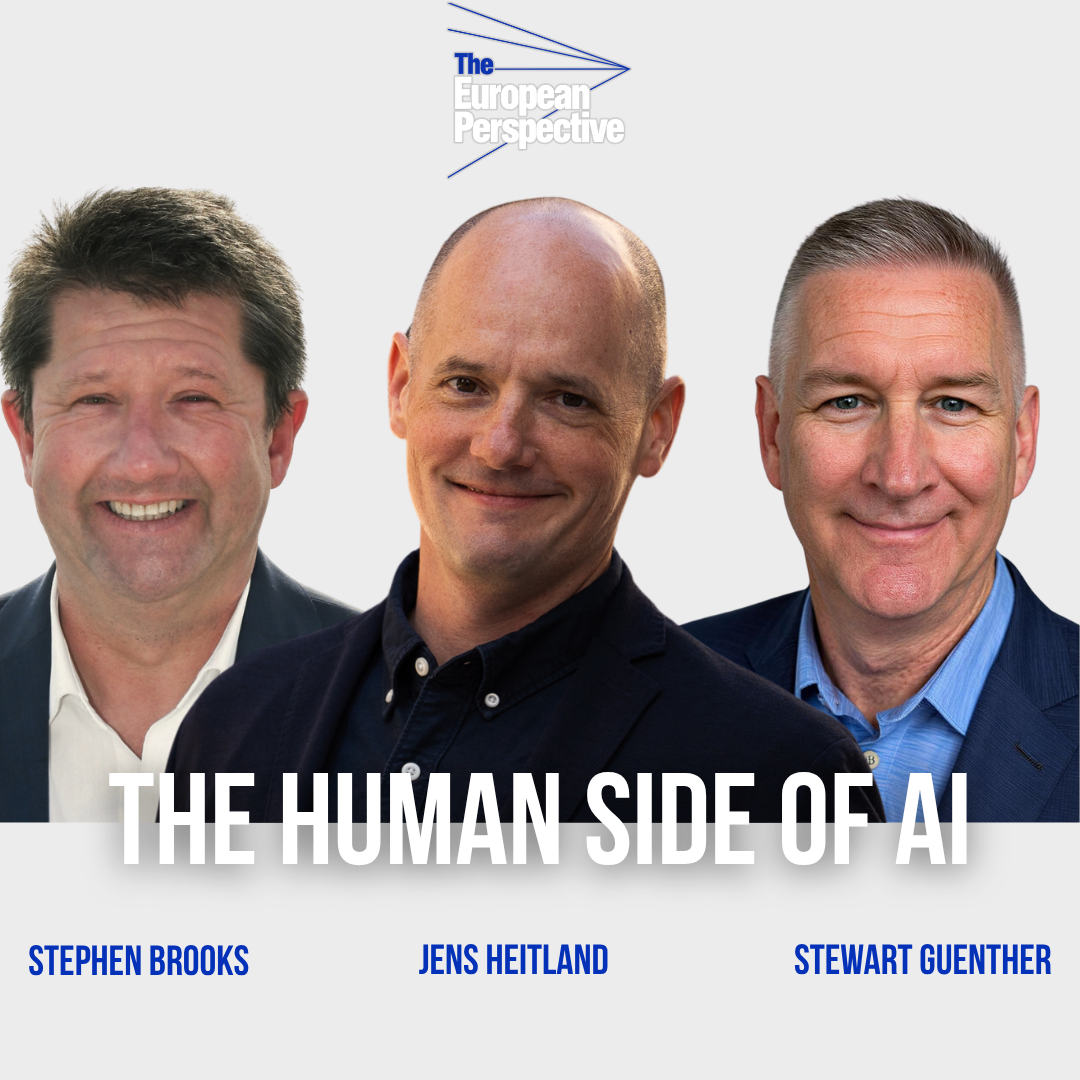
In this episode of The European Perspective, Jens Heitland, Stephen Brooks, and Stewart Guenther discuss how organizations in Europe are using AI today, why the human side of change is holding many of them back, what recent communication missteps at the large AI labs reveal about leadership under pressure, and how the layoffs moving through European industries could open space for innovation and new businesses.
Youtube Podcasts
The Human Side of AI Readiness in Europe
Across Germany, the Netherlands, and Belgium, a similar picture is emerging in large organizations. AI is part of daily work, yet it stays at the surface. People use it to search, translate a message, or draft a paragraph, then copy it into another system. There is little embedded data, few decision structures, and almost no sense of agents working alongside people. Today's technology is far ahead of how it's used.
In my experience, the gap is rarely technical. Data and security concerns are real in large companies, and they deserve attention. More often, the human side holds organizations back. Change processes aren't prepared, roles are unclear, and responsibility for AI often gets passed to a chief information officer or a digital lead. When the top of the organization stays distant from the tools, the rest of the organization reads that distance as a signal about priority.
Learning to work with an agent takes time. In our latest conversation, Stephen Brooks described how much he had learned in a few weeks of building his own system, well beyond the technical setup. Stewart Guenther noticed that the way he frames a problem changed once he learned to define a clear goal, set guardrails, and step back. He compared the broader shift to how corporate travel moved from dedicated agents to online booking, without anyone formally deciding it. Both experiences point to the same pattern. The value comes through practice, and practice cannot be delegated.
The consequences show up in places that seem unrelated at first. Over recent weeks, leaders at the large AI labs have shown how quickly a single message spreads when leaders and staff speak without a shared frame. At the same time, layoffs are moving through European industries, from automotive to logistics to banking. The reasons vary, ranging from energy prices to legacy structures and slower growth. People often name AI as the cause, but the deeper story usually concerns decisions made years earlier.
Organizations that move through this period well tend to share a few traits. They work out their future business model before the market forces the question. They build innovation close to the business edge, where new ideas can grow without the core absorbing them. They give those efforts years to develop, well beyond a single budget cycle. The knowledge needed for that work usually already exists inside the company.
People leaving large organizations fit into the same picture. Many of them carry decades of experience and could build businesses that solve real problems. In Europe, the first instinct after leaving is usually to secure the next job, which is understandable on a personal level. Where programs exist that help these people learn quickly how to run a company or work with agents, a painful moment can become an opportunity for the wider economy.
Europe builds companies its own way, rooted in steady, industry-focused businesses that know their markets well. Stewart expects European business voices to emerge that reflect those traditional industries, calmer than the tone coming out of Silicon Valley and still clear enough to attract customers, staff, and partners. Over time, organizations that keep that steadiness while learning to work alongside AI will likely shape the next chapter of the European economy. That shift begins with leaders who take the time to understand the tools themselves.
Timecode:
00:00 Welcome and the three topics
00:49 How businesses are using AI today
04:06 Business models in an agent economy
06:34 Education and communication around AI
08:46 Organizational structure with humans and agents
09:45 From travel agents to AI agents
12:07 Learning to work with an agent
15:08 How AI changes the way problems are framed
16:04 Why executives need hands-on experience
19:38 Corporate communication at the AI labs
30:35 How tech CEOs communicate in public
33:20 Leaders who avoid the media
34:13 New CEO voices in Europe
36:27 Layoffs across European industries
40:16 Productivity, headcount and energy
45:14 Innovation at the edge of the business
46:41 Supporting people who leave large organizations
48:23 Courage and European entrepreneurship
49:35 Small companies, large companies and AI
53:48 Closing thoughts
Guest Links
Stewart Guenther: https://www.linkedin.com/in/smguenther/
Stephen Brooks: https://www.linkedin.com/in/stephenabrooks1/
Transcript:
[00:00:05] Jens Heitland: Welcome back to The European Perspective. Steven from the UK and Stuart from the US, and myself from the Netherlands. Great to see you guys. How are you doing?
[00:00:17] Stephen Brooks: Good. Excited to be back
[00:00:21] Stewart Guenther: we're ready to get back to business, right? Summer's over, September's over. get going
[00:00:26] Jens Heitland: Exactly. Exactly. So three topics today. Number one is short term versus, versus long term. Number two is corporate communication and hiccups that we have seen over the last couple of weeks, and then the big layoffs happening. Let's start with short term versus long term and focus a little bit more on AI.
[00:00:49] Jens Heitland: Stuart, when we discussed this in the past, you said we need to s- we need to distinguish between AI. What, what do we talk about when it comes to A- AI? Let's start with that.
[00:01:00] Stewart Guenther: Absolutely. So, and also we need to talk about who the user is. So let me narrow this down to business consumption of AI as opposed to business serving of AI. So if you're, you're a middle-sized company or a large-sized company, you're seeing AI becoming prolific across your workforce. Whether you know it or not, increasingly folks are using AI to try and make parts of their lives easier, or you're probably finding AI embedded increasingly in your business systems that are trying to create more productivity for your staff, and therefore more addiction into that. So I think there's two main themes that we can look at right now. Salesforce is your classic large footprint CRM and solution, which has transformed the way we engage with that part of the business for the last 20 years, and they have quickly realized they've been ahead of the curve that AI is fundamentally able to replace them. So instead of trying to create more of a lock-in the way we see successfully with SAP from a cultural perspective, they've fully embraced agents, and they're actually changing the way they engage with their customers. This, in turn, is going to shape the way your staff about how they leverage these tools, 'cause right now AI is a big promise and a big boogeyman, and it's increasingly becoming just a tool stack and an impact on your tool stack. Look at the way companies like Salesforce are rolling this out as a, as I would say, a canary in a coal mine of what's coming next. And on the flip side to it, the power users, the people who are using different AIs to do different parts of their business, the promise of being able to create agents that are gonna be able to replace different function areas. Here's my near-term and longer-term prediction for us to consider. term, this is a force multiplier. It does not remove your QA team. It does not remove your CRM team. It does not remove your community management. But what it does do increasingly is what service centers and what call centers promised to do for the sales organization, AI is able to do at scale in terms of identifying escalation paths to then escalate to the right human who maintains that relationship. And then longer term, we're going to see increasingly folks using AI where they get to be the decision tree, and this is everything from what is the consumer face that the AI is gonna do with our audience? What is the consumer or the business face we're gonna do with other partners? We're not gonna replace humans.
[00:03:48] Stewart Guenther: We're just gonna be increasingly leveraging the AI to do kind of the garbage work, and then the human takes over and takes credit for it. You put it that type of a frame, I think you're gonna find a heck of a lot more success than a rip and replace, whether it is giving you productivity or giving you replacement options.
[00:04:06] Jens Heitland: I, I agree. For me there are two considerations to, your points. One is, what is the business model of the future for your organization? I think that's something not many organizations are looking into right now. I give you my example. We just did, a, brainstorming meeting, how would we build our business in an agent-to-agent economy?
[00:04:31] Jens Heitland: And for a media company, which I'm leading, that, means certain things completely falling away, and other things will be added because your customer is changing. In, a way you're almost building something where an agent talks to an agent, and the agent on our side is owned by us as a company, and then the consumer or the customer of us has an agent that is then interacting with our agent.
[00:04:58] Jens Heitland: So that's just one example. Then on the bigger corporate perspective, similar to that, what I have... what I'm seeing right now happening literally the last two weeks I've seen it, how far away some organizations are still from the basic use of AI. Like they're still on the level of, "Hey, I use it as a Google.
[00:05:22] Jens Heitland: I use it to translate a message, but then I copy-paste things." So there's no real agentic perspective. There's no real embedding of data, no decision structures, and the whole organization is literally just using it as a tiny advancement tool, and not really as with the capabilities that are out there already.
[00:05:45] Jens Heitland: And I get it, it's different when you have huge data and security concerns and so on. But I think at least for Europe, what I have seen in Germany, in the Netherlands, and in Belgium over the last weeks, I think there's still a huge amount of work to be done, and most of it is, is the human side that is not ready yet.
[00:06:06] Jens Heitland: Like the change processes and the organization is not ready yet. Even that you have technically you could maybe do it, the, the humans are not ready yet. And that, in my world at least, puts a lot of demand on the leadership, a lot of demand on, on, on the top management on how do we steer the ship towards that while working with the humans and getting AI implemented to gain what we are investing in.
[00:06:32] Jens Heitland: Steven, what are your thoughts?
[00:06:34] Stephen Brooks: Several things here. Education and communication, they're the two key factors with this. As you were just alluding to there, Jens, about, you know, people aren't, aren't really prepared. They haven't really thought about it other than, "Oh, it's a better thing than Google," and, "Oh, I can sort out some travel arrangements." Excuse me. And speaking as somebody who's now building an agentic system with your help, Jens, and thank you for that, I,
[00:07:03] Jens Heitland: You're welcome
[00:07:04] Stephen Brooks: I think you've got to be, as a, as an SME in Europe, you've got to be planning and establishing what your needs are gonna be. Not, not next month, but next year, and three years, and five years' time out of that because if we're not educating the workforce understand the benefits, which is what, what you were talking about, Stuart, that, that, you know, it's there.
[00:07:30] Stephen Brooks: Get it to do the menial tasks, get it to do the garbage, and then the human takes over and, gets the credit and refines and understands the, human aspects of that. So I think we've got to be at the education of that. We've got to be looking at the understanding of that. But being able to say, "What is it that we can do?" A carpenter wouldn't go to work with a paintbrush, right? So what's in that toolbox? How can you use that to your benefit? and I think that will in, corporates as, well as, you know, medium sized businesses, that will almost relax people about AI because it's, here.
[00:08:18] Stephen Brooks: It's here to stay.
[00:08:21] Jens Heitland: Yeah.
[00:08:22] Stephen Brooks: whether we're using it in defense models, or in building cars, or running businesses like media businesses and, fintech businesses like I run, here to stay, and I think we've just got to educate, communicate, and, bring people along with the journey of AI and, sell the benefits of it.
[00:08:46] Jens Heitland: Yeah. As part of that, I think a, a critical piece every organization needs to look into what is the future organizational structure and strategy that comes with that. I mean, obviously you started with the business strategy and then you built the structure, but I think the future organization will look different and will require different skill sets on how you structure the organization that it is efficient.
[00:09:13] Jens Heitland: So there will be a mix of agents and that which are technical AI agents, and there will be a mix of humans leading this AI agents. And there will be a lot of tasks that will be done and automated through AI, and there will be a lot of tasks that are typically the best thing for a human to do and, and, and, and they will do, do that task.
[00:09:36] Jens Heitland: And that requires a completely different mindset, a completely different culture, a completely different organizational structure to be able to run that in the future. Stig
[00:09:45] Stewart Guenther: I think you both made excellent points. Let me provide two concrete examples from the past of what's coming. So my thesis, my big bold statement here is going to be we're talking about AI, and now we're simplifying it around agents. And we should be aware of the impact that this is having on the, on the business and the business culture. But I would argue that a real easy example during the '80s into the '90s, and especially the late '90s, if you were doing anything with travel within your business, you knew who your particular travel agency was going to be. You had your assigned travel agent. You had your assistant who was gonna be making a call to your assigned travel agent. And then what-- how did we decide to, to, to normalize this and add more efficiency? We started creating a travel organization within a larger business who interacted with the call center or the travel agency. We had this whole interface. And then the internet came along, and no one said, "Hey, in six months we're gonna decide to fundamentally change our cost control structure around how we manage travel." All of a sudden, travel went from being these specialized people who were our gatekeepers inside the business, talking to specialized people who were the gatekeepers to the travel industry, and we just started using Expedia. I think we're gonna see a very similar but even faster adoption where there's not going to be a decision, "Hey, now we're using agents."
[00:11:08] Stewart Guenther: It's going to be we're discovering that there are agents running amok within our business, and we're really gonna become aware of that when we start to see the leakage that comes from this. And the leakage here, excuse me, is that all of these agents, all of these different tools, 'cause really that's what it is, these tools, they need context. And so that context is going to end up leaking outside of the organization and within the organization. If you do not have a context frame around what is true to our culture, what is true to... And earlier to your point, Jens, if we cannot really clearly articulate what our business model is, we are gonna end up facing drift as these tools look to serve and be force multipliers for different parts of the organization. So it-- we need to then now on top of being the lighthouse of the direction where we need to go, we also need to have the context managers to make sure that that direction is being articulated through our subsystems
[00:12:07] Jens Heitland: and key, key part to that is, and, and maybe we can, we can share a little bit, Steven, if you're up for it. It's, it's learning how you work with an agent. It, it sounds easy, yeah, you just talk with it, but I think you have a learning curve that takes at least one to two weeks when you work like five hours per day with it on how to interact with an agent in the most efficient way so that the agent is doing the work that you want the agent to do.
[00:12:34] Jens Heitland: And maybe in a corporate setting it will be different, but in the end, I think everyone needs to get into that to get their hands dirty and learn how it works. And it doesn't matter which agent or which setup you use. As more you try, and I was sharing that in the past, I started with an agentic perspective, which was purely focused on my run training and my health stuff, and I built a health agent, and I just dumped 10 years or plus of training data and food data and weight and so on into one big database, and then we basically figured it out from there.
[00:13:14] Jens Heitland: And that's how I learned to do it, and then I built it for the first business case, and step by step, I, I, I learned how to do it. And now I think w- I'm, I'm at a, at a place that they can run, they can interact with each other, and they help me really to get things done without me being the bottleneck in between.
[00:13:34] Jens Heitland: Steven, how was that for you to, to get your first agent set up running and learning with it?
[00:13:39] Stephen Brooks: getting it set up was remarkably easy. I had some great backup and support from you, but I think what I've learnt in these previous three, four weeks about all of this is, there is a way that you start to interact and almost personalize how your bot is working with you. And so, you know, the more interaction you can give it, the more they understand how you operate, the more you understand how they operate, which is vital. But I think the biggest part for me is the amount of stuff I'm learning as well. my technical ability is limited at best or was limited at best.
[00:14:29] Stephen Brooks: You know, I can, I can get my way round a Mac and all of that kind of stuff, and apps and things. But when you get into the weeds with this, when you get, when you get down to the nitty-gritty, y- you end up learning so much, and I think that's ... I go back to that education communication thing, is that that's what we've got to be, you know, letting people know. That this isn't, this isn't somebody pushing you out the door. This is somebody saying, "Listen, stay here, 'cause you're a vital piece this revolution," if that's what you, if, if that's what we can call it. "And, and without you, actually, it doesn't really work."
[00:15:08] Stewart Guenther: question for you guys. Question for you. As you've gone through this journey, have you by chance noticed that especially if you're still doing prompting and you're interacting with the agent to try and create new goals, create new business processes, have you noticed that the way you frame the problem set has changed?
[00:15:26] Jens Heitland: Yeah, 100%.
[00:15:27] Stewart Guenther: you break down, uh, what your goal set is?
[00:15:30] Jens Heitland: Ja
[00:15:31] Stewart Guenther: me, One of the things, 'cause I'm a control freak, I've had to really relearn to take your hand off the tiller. Trust, trust the system. If you can identify clearly what the goal is, and it doesn't mean you have to write a Bible, but if you can clearly identify the goal, you can identify kind of the steering guardrails and get out of its way and then interact in a limited way, it's amazing what it can perform. So one of the th- the reason I bring this up is this is an unintended benefit, but this alone really moves the needle, doesn't it?
[00:16:04] Jens Heitland: It does. It and it's equally for large corporation because we are now talking like we, we run smaller companies. But I think working with the big CEOs from multi-billion dollar companies in Europe, what I have seen is they're not there yet as well. They don't understand how this works. And if, if the top leader of an organization is not going into learning the way of thinking of AI and how do I work with AI, it's not going to happen because people then act as, "Hey, th- that's my chief IT or my digital officer that takes care of that."
[00:16:43] Jens Heitland: I think every leadership team member should put their, put their hands into these things because in the end it costs nothing except time in the beginning. I mean, I have-- I'm running the whole stack now on €200 per month, and it's super cheap. Comparable at least
[00:17:01] Stewart Guenther: Good for you. It, it-- buil- building on that very, very briefly. So, so, one of the things I've also noticed how many of us started this and kn- I need to learn AI. is important, I have to incorporate AI, I don't even know how to wrap my head around this. I don't know how to get my arms around this problem set, but I gotta do it. But once you identify, and it's not, "Hey, replace my business with bots," but once you identify that first taking out the trash goal or that first is this a force multiplier goal to me, isn't it amazing how much that pulls you in, and it pulls you in in positive rat holes to do more things and expand more things? The reason I bring this up is that when we think about AI as a strategic initiative, as a strategic investment, this helps us create white papers and have discussion groups. But why is it that your organization is seeing these tools proliferate across the surface? Because people are getting into this by taking out the trash.
[00:18:03] Stewart Guenther: They're getting into this by identifying smaller goals, and then that in turn opens up what else it can do, which causes them to expand the way they interact with this. So, so that's, that's I would argue is instead of as much as you need that top-down vision, really try and think about what that bottoms-up value is to get over that first hurdle, that first hump of AI scary, agent scary.
[00:18:28] Stewart Guenther: And then you gotta figure out, all right, now that the, the horses are out of the barn, how are we gonna actually corral this back into the culture of the business? Corral this back into the core business thesis of the business. And then how do we start to articulate, going back to the very top of this, how do we think about our own business and what's unique about our business and our business approach? And then we start adding that into the context. And this is where the executives have the keen perspective and the keen visibility as a steering agent as opposed to the Sherpa to make this happen
[00:19:05] Jens Heitland: Ag-agree. It's, it's really shifting the culture of the business as part of it, and I think that's what a lot of companies are not into right now. And one of the reasons is because the executive team members are not into it. They have kids there telling them they should go into it, at least what I hear, but they're not there yet.
[00:19:25] Jens Heitland: So I think it's a, it's a big topic and a lot of opportunities, especially in Europe, uh, I don't hear too much about AI. From the US, I hear it every day. So there's... Let,
[00:19:38] Jens Heitland: let's go into corporate communication, and we stay with AI because it's, it's just one of the hot topics. So there were a couple of hiccups over the last weeks on how the AI, the big AI labs or corporations are communicating.
[00:19:56] Jens Heitland: And s- there's, there's one part of, of, of the spectrum that says this all planned PR strategy, and then there's the other, uh, side where they say this is a complete, uh, playground and nobody knows what the other person is doing. And for those that have not heard about this, there w- there were several publicized pieces from employees and from CEOs of these big AI companies that in the end are negative for the business.
[00:20:27] Jens Heitland: That's maybe the, the softest way to say that. Stuart, y-you're closer to, to, to that market. Wh-what i- what is your perspective?
[00:20:36] Stewart Guenther: So the frontier labs are facing some real opportunities and challenge. what's happening is the open weight models are both increasing in capability and throughput, and also decreasing the footprint that's necessary. So what does that mean in English? You've got Anthropic, you've got Groq, you've got now Meta with Muse, you've got Gemini with their release early this morning. The large players, aside from the big two, which would be OpenAI and Anthropic, are in a absolute horse race to try and demonstrate capability and demonstrate throughput from their different models. They're now really legitimately having to worry about the open source, the Chinese, but all open source models right behind them demonstrating materially similar outputs with a very, very different cost structure. And moreover, now as the people are more comfortable with how they manage those weights, there is greater ease of leveraging either as a replacement or a partial replacement these open weights. Right, so that's, that's one baseline. But there's another thing that's going on. Anthropic is about to do an IPO. OpenAI is in the process of doing their IPO. These two companies alone are going to do with individual IPOs. If they hit their targets, they're going to generate more wealth within that one IPO than the last ten years of IPOs. This is insane. But what's forcing this is also the fact that their CapEx is material. Elon is taking great advantage of this as he builds out his own infrastructure and now even leases his infrastructure to these other frontier models. They are looking at a two tr-- Anthropic is looking at a $2 trillion IPO. are in their quiet period as they also do their roadshow. What have we learned in the last two weeks? We've learned that they're apparently their CapEx is significant, and their revenues, while unprecedented on the globe, have started to top. And so these are not tremendously strong things to show when you're about to IPO at a $2 trillion market cap Dario is a true believer. He has been concerned about AI for years. Sam Altman has been begging for regulation and to be regulated for years. This in and of itself is not new, it's very interesting that while both of these two companies are about to go public, and now it's come out that we're seeing some toppiness to their business models despite these incredible growth rates, they're looking to try and be forced into a regulatory model, being accused of regulatory capture. One way of looking at this, going back to the communications piece, why is it all of a sudden we have that famous guy who had a two-week-old a two-week-old X post, as I recall, who had worked for Anthropic for less than four weeks, and then posts, "Oh, by the way, we're all gonna die," and it explodes to hundreds of millions of views in a few hours? I don't think that was conspiracy. I think that was organic. But I think the timing and the release was extremely telling, it... Also the response of the CEOs, Sam and Dario saying, "We need to do a slowdown," to your specific point, Jens, this buildup created air cover for staff to communicate. And one of the things that Silicon Valley thrives on is this belief that they should be able to communicate freely, communicate In terms of what's happening with their business and where there's future going. that normally historically means talking about the positivity of the business. This time it led to a whole bunch of people saying, "Yep, we're all gonna die," and that fed the beast on a number of different levels. So let me re- let me bring this home. is two things that are happening here. it ends up being that the US Congress and the European agencies end up creating very strong locks on controlling the growth of AI, it is going to force, it's going to necessitate two things. It's gonna force a reduction in the speed of the evolution of the frontier models that are closed source, and it is going to force restriction outright elimination of access to a whole host of open source models. they will have to put a control paradigm on top of what the models can do, how new models can be issued, and look to ensure that there is awareness of how the models are addressing their internal calculus. That is going to necessitate restricting the overall market. If I can then in my IPO say, "Gosh, there's this terrible government regulation that we need to do to keep us safe. I am your utility of choice that's gonna enable you that slow, steady growth," it massively protects that future narrative. If it is allowed to maintain the Wild Wild West, these extremely large players run the risk of actually not only being caught up to, but surpassed by alternative models that is gonna force their ARR curves to go down or to the negative, and then their IPOs and were still post IPOs, they're gonna have some very, very bad quarters. So I think that in terms of the communications piece, earlier I had alluded to you're going to have through these tools a lot of leakage. This was a prime example of corporate communication where the CEO says, "Hey, let's be safe," which gave the opportunity for the lower staff to pin their ears back, and in the wrong media environment, a la the present one, that can be a wildfire you cannot control
[00:27:02] Jens Heitland: No, 100% agree. Steven, your perspective
[00:27:06] Stephen Brooks: I don't know if there's any more I can add to that, 'cause that was so on the money. For me, as Stuart said, I... Was all this a tactic? You know, that we're all gonna die and it's gonna take over the world and you know, we'll all end up just shuttling off this mortal c- this mortal coil. I... It happened at Google, it happened at Facebook, they topped out. That, right, they had to look for other ways of raising revenue and getting people on board. this is the, this is the greatest invention since the spinning jenny. And you know, and I think the end of the day, the market is keen for this.
[00:27:54] Stephen Brooks: It's worried about regulation, but all regulation will do will be o- to open up those, those Chinese markets even more, and people will, will circumnavigate the, you know, the products that they can't get access to. And, and it will stunt growth, and it will, it will hold back, and it will become an instrument of governments rather than an instrument of industry. And I think that's the biggest problem. Um, I, I... Listen, a $2 trillion is insane. Absolutely insane.
[00:28:29] Jens Heitland: If they get there.
[00:28:30] Stephen Brooks: if, if, if... Well, listen, even a, a $1 trillion IPO is, is, is pretty, pretty mad, right? So I, I just... Y- we just have to see how this plays out. Uh, but I think, I think you put it expertly, Stuart, as you, as you do on stuff like this. It, it's, it's, it's about time that the market either thinks p- we're embracing it, we're getting on with it, but all of that death and doom is just, is just hogwash and making a big noise over there so you don't know what's going over here
[00:29:05] Stewart Guenther: this is, this has got to be not just the F-up of the week, this is the F-up of the year, if not the, asset class, and here's why. At the very same time that one of these companies is announcing this need to slow down and this legitimate concern, y- you, you cannot decide, "Oh, 10% is not scary." Earlier in this, in this conversation, we were, we're talking about nuclear, uh, and look at how much a couple movies and how much some tragic events have radically changed the worldview around nuclear, and now we're struggling to try and find a way to reincorporate our energy demands, 'cause as much as this is an F-up for a week, all things we're talking about are only driving energy requirements and energy consumption unlike anything we've seen ever on the history of the planet, and it all needs to get done in literally the next 10 to 15 years. No, no, no fart. It's gonna happen. we're having all these things go on. We're telling one, "Oh, by the way, there's a 10% chance or so it's gonna wipe us all out, and just so that we're all on the same page, we've decided to create some wet labs
[00:30:20] Jens Heitland: Ja
[00:30:21] Stewart Guenther: have AI run." Are
[00:30:24] Jens Heitland: Ja
[00:30:24] Stewart Guenther: me? we're gonna tell you this, "I'm gonna wipe out humanity, and oh, by the way, we're gonna open up some labs." It's just, it's just... Really?
[00:30:35] Jens Heitland: For me, I'm always obviously focused on the CEO and the strategy and as well the preparation and how do they make the human stand out in different ways. So what I was analyzing over the last couple of months already, if we look at Dario, who is the CEO of Anthropic, Sam, who is the CEO of ChatGPT or OpenAI, and then I'm comparing them to Jensen Huang, who is the CEO of NVIDIA.
[00:31:05] Jens Heitland: And NVIDIA is not, um, a lab, and they're not, not building AI, though that they're now getting into the race as well with open, um, models. It's, it's so fascinating to see because NVIDIA is a public company, and Jensen Huang, uh, for me is like one of the best, best CEOs in the world from a public-facing representing the company.
[00:31:31] Jens Heitland: And he has been like this. He, he is how he is. I have looked back into him. He w- he was like this ten years ago, so there's, there's no change. What is quite interesting, if you look at the other two, obviously they're, they never have been in this huge responsibilities, and it's like they jump from first grade into the, the twentieth grade, um, in school without doing any exams in, in, in between because they haven't had the time to grow into a role like this.
[00:32:00] Jens Heitland: I mean, if you look in- into Anthropic, it's, it's literally over the last one and a half years and over the last, let's say, twelve months it, it, it went so big. So what, what for me is super interesting to see how they are communicating and, and the way they are communicating in written form but also on videos because o- on videos you see the, the human a little bit more.
[00:32:24] Jens Heitland: It's super restricted, so Sam and Dario are not doing too many interviews, and Jensen Huang who... is doing interviews all the time. It's quite interesting to see because he's just more comfortable. So go- going back to the, the F-up, I think it's also responsibility of the board of these two companies to help them communicating the right things going forward.
[00:32:48] Jens Heitland: So I think it's, it's the total companies that need to look into that, not just the individuals. But the individuals just need to be conscious even more so of the impact of every single word that, that you're talking outside in public, how that will be picked up in this situation. Coming from large corporate where this is normal because it's, it's, it's industry practice if you're a CEO, like you're not just talking what you're thinking these days, except maybe some special CEOs in this world.
[00:33:20] Stephen Brooks: It, it's interesting, isn't it, guys, that, that our recurring subjects are obviously AI because that, you know, of, of, of where it is. But it's also this boardroom communication and, and, and, and how CEOs are either, you know, with the program and communicating effectively or, you know, they, they, they shy away from media and they shy away from doing interviews. And for me, th- i- it's kind of a, a, a, an oxymoron around, well, what's your management style? Because i- if, if you're not out there banging the drum about your business and how g- how good it is and what, you know, what you're capable of doing, how do people inside the business perceive you when they see other CEOs doing just that, you know?
[00:34:06] Stephen Brooks: I- I- To me, I think that's ... It, it's quite an interesting angle to keep an eye on going forward.
[00:34:13] Jens Heitland: It's huge trend, that's moving slowly towards Europe. I think the US is like two years ahead. If you look at the way the CEOs and the corporate CEOs are communicating, Europe is still far away from that. But some are realizing it and they're like fascinating CEOs that are really good in that already in Europe.
[00:34:37] Jens Heitland: Um, maybe we should invite some of them in the future.
[00:34:40] Stewart Guenther: Absolutely. And I would say that especially with the toolkits that are available now, those European CEOs who take advantage of this, the learning curve is sharp, the impact is sharper.
[00:34:54] Jens Heitland: Ja
[00:34:55] Stewart Guenther: not a matter of you need to plan this for another two-year cycle. Y- the reach and ability that you have now in this world, especially if you are targeted in your approach, it's unprecedented. So it, it will be very interesting to see how Europe, uh, creates different voices that speak to different parts of this. 'Cause right now, the, the US is-- there's very much a duopoly in the communication, and it's either accelerationist or it's a more of a control and more of a slow approach. It's really down to those voices. Whereas I predict what we're gonna see coming out of Europe, it's gonna be much more reflective of the different traditional industries and industry stacks here. If you are a steady growth mainline business, you're important to the foundational elements of the economy. You don't need to communicate like a startup out of Silicon Valley, but you still need to communicate in order to attract customers, attract staff, attract partners.
[00:35:56] Stewart Guenther: This-- You still need that, but that doesn't mean you have to run around with your hair on fire. You now have that type of-- You, you can create the voice using some AI agent talk. You can, you can create the voice and then you-- I b- predict that we will see in different elements of the European economy, these voices become clearer, and then that will really resonate
[00:36:18] Jens Heitland: Yeah, agree. It, it will, will be fascinating to, to see as well what's happening now with the topics that we discussed.
[00:36:27] Jens Heitland: Let's go into the third topic, layoffs. There have been major layoffs and sometimes hidden in other projects, but there, there are major industries laying off people or reducing the, the human resources.
[00:36:44] Jens Heitland: I mean, car industry we have talked about in the past. I'm very close connected to retail. In retail, it's happening all around. Um, what are your perspectives? What is happening? Is that AI-related? Is that economy-related? Is that politically related? What are the reasons that a lot of companies are, like, sending third of their workforce or third of the certain departments home, which at least I have not experienced over the last 20 years.
[00:37:21] Jens Heitland: Thoughts? Let's start with Steven.
[00:37:23] Stephen Brooks: We, I mean, we've talked about VW in the past. You know, estimated 100,000 job losses by 2030. Some of that, I think, is just down to the fact they just haven't kept pace with the market. But that's just, that's just one business. I think every business will at some point had to have sat down and had a cold hard look, and have come up with, "Well, we just don't need these people because," right? the economy, we're not doing as well, we've got better advancements in this, and so on. And I was running some numbers before we came on, and was just looking at who those people are right now. And as of October 26, there are about 34,500 proposed job losses located in Europe, across 24 major countries like DB Cargo, Porsche, BMW, Nissan, FedEx, Aer Lingus, HSBC.
[00:38:25] Stephen Brooks: All of them in very different niches, but all of them either combating what's going on in the economy in Europe. I mean, we can't compete on, on electricity prices with, with China and, and, and America. So, you know, that kind of puts our AI and data center manufacturing, um, uh, o- on the back burner because we just can't compete, right?
[00:38:48] Stephen Brooks: So that's one thing. But also, what's happening, we've got wars in the Ukraine, we've got a war in Iran. And all of those things are affecting the European economy really, really hard. And of these, I'm sure, are very painful and very hard decisions for these businesses to take. But I'm guessing for a lot of them, that's a survival of where we are. And it is terribly sad. I don't think you can blame AI for this. I think if you wanna look at where that, where you can proportion some of the blame, then you have to look at the leadership and you have to look at the management, and then look at the economy, and so on. But it is terribly sad. I do believe these jobs will come back in other areas, though. Just like we were saying about getting to grips with an agentic system and bots, and finding out, actually, we do need more people because we are growing our business, because we're taking out the trash with this, and we're doing some other things over here. But that's a slow burner as far as I'm concerned. And it is terribly sad. The VW thing is tragic. But they sat back on their laurels for too long
[00:40:15] Jens Heitland: Stuart,
[00:40:16] Stewart Guenther: I Think I'm the old guy on the podcast, so I actually remember the 1980s. But one of the things that we talked about during the 1980s a lot was the promise of technology and the promise of productivity growth, and that became the mantra through the '90s. That became the crime tr- prime promise and the prime driver of the recent technology waves, everything from the cell phone to software and the internet, et cetera. what does productivity actually mean? What were we really saying? We were saying this is cost containment on the human capital side terms of replacing human capital, which is still and always will be the single largest OpEx aspect of any business, and we're telling you that you can have the best of both worlds. I would argue that where we are now is, depending upon the industry we're talking about and depending upon the technology stack, we have managed to gain those productivity gains, but we've also deliberately, in some cases, and I think automotive is one of them, because the OpEx and the CapEx is so large to retool the factories, that we've kept legacy systems that are human capital demanding even as technology has obviated that need. to be more critical, if you wanna continue to hit your up and to the right figures at the quarterly-- on the quarterly statements, you need to, at this point, reduce headcount even within the moving the atoms piece Now that's-- But to your point, Steven, that does not mean that the overall economy is shrinking. It does mean that the overall economy needs to broaden. And I also take a very strong cue from what you're saying, and that is as long as Europe remains very problematic on the energy front, that is going to stymie the ability for that economy to broaden more than anything. was the cause célèbre all the way back in 1819, back when we were calling it machine learning.
[00:42:20] Stewart Guenther: It was already the excuse to do what most large institutions and verticals were talking about. I need to reduce my headcount because either the pension exposure or just the general OpEx exposure is crushing me because my gross margins are shrinking because other economies that do not have these legacy, uh, pension, these legacy human footprint pieces, they can incorporate that technology that's current faster and newer and be able to in turn outproduce me more cheaply.
[00:42:52] Stewart Guenther: That, that sounds academic, but that's-- we're now at the point twenty-five years on, fifty years on, it's no longer academic. The pedal has hit the metal, and we're seeing reality to it. So what do we do? We can, we can cry in our soup about this or... And, and I think the thirty-five thousand, uh, is tragic. would argue that's a canary in the coal mine. And my outside perspective is, I think that the way that we're going to deal with the much larger dislocation is we're literally waiting for that strata to die out, trying to convince these heavy human capital industries to maintain their footprints that cohort ages out But what I would argue is that those companies which are-- have the ability to do this, be more innovative, extend the, the power plant, don't extend the steel plant the way it is now. Find how you can leverage modular technologies to bring back, to reshore, and actually create jobs. It won't be the same number of jobs, will be jobs that last based on the later technology. And then what's the argument here? Yeah, I'm gonna be willing... It's, and what-- where should I be looking? Where should I be looking to do this? What industries in which nearshoring and supply chain security is most important, that's where you want to invest. Where it's I'm willing to overpay compared to norm now because I can guarantee those on takes and those inputs are gonna hit my factory so I can keep producing, I predict you're going to see that much, much more the calculus, as opposed to the just-in-time approach that we've become very comfortable with over the last fifty years. I don't think this is a blip. I think this is a fundamental change in the way we're structuring. And then pulling this back to the AI, AI is going to be the facilitator to enable that to happen. It's not a panacea, it's not a get out of jail free card. But it's how can you leverage these toolers to force multiply the experts you still have in your business to start to create the shell and the infrastructure of your business next as you move forward
[00:45:11] Stewart Guenther: Never let a good crisis go to waste
[00:45:13] Stephen Brooks: Exactly.
[00:45:14] Jens Heitland: part of that as well. But fundamentally, I still remember, I mean, that was the time when we were working together, Stuart, in 2015, '16, where we were looking into what is the business model of the future of a large Swedish furniture company, let's say it like this.
[00:45:33] Jens Heitland: And one of the things we were looking at that time already was like, how do we innovate on the edge of the company so that we keep innovating all the time? And I think it's more important than ever to do this right now. Every single organization that is going to get into the problem and maybe is very human intense right now, they need to build almost innovation labs, innovation hubs on the edge of the business to innovate their way out of this.
[00:46:06] Jens Heitland: And then looking into how does Salesforce, I mean, they're extremely technology driven, obviously, and, and they most probably will be hit harder in the beginning. That's why they're pivoting faster and, and, and understanding this. But I think it's, it's equally important for a very old school business, and that can be accounting, whatever it is, understanding how you can innovate and leverage the capabilities that the humans have inside of the organization to build the future and really d-do that in a scenario way like we did in the old days.
[00:46:41] Jens Heitland: I think that's one of the opportunities every organization can, can do. Then if, if we look at the individuals that are leaving this organization, I think there's another huge opportunity for Europe. Uh, look, look at me or Steven. We were working in large organizations in the past, and we stepped out to build our own businesses.
[00:47:04] Jens Heitland: There are a lot of amazing people in these large businesses that are leaving the organizations that can build businesses to solve problems that we face in the world. How do we enable this type of people to speed run all the things that you need to learn to be able to run your own business? And that's not in the human culture or the European culture, not, the human, the European culture as it is in the US.
[00:47:31] Jens Heitland: In the US, it's way more entrepreneurial and everyone kind of hustles their way into this. In Europe, and I've talked to a lot of people leaving the companies, it's first step is always how do I secure the next job? They want to establish the next job and then figure out on the side if they can run a business, which I understand from a personal perspective.
[00:47:57] Jens Heitland: But I think we as Europe need to figure out how do we put programs together so that we help these individuals to build businesses, solve problems. and if it's not that, then at least how do you get into an agent system? How do you build-- How do you educate yourself so that you are in the future one of the most attractive employees going forward?
[00:48:19] Jens Heitland: I don't see that happening too much right now, but I would love to see it
[00:48:23] Stephen Brooks: I think that, and again, this is a recurring topic of ours, it's about courage as well. It's about actually stepping up and going, "This is what we need to do," and, having the courage to you know, put that together and get it going. That entrepreneurial spirit that America is, full of and has in abundance, we have in Europe, but we just haven't spoken about it enough. we haven't, you know, found our, jobs. We haven't found our Musk. yeah, you know, we, all right, we had Richard Branson and we had, you know, Mr. Dyson. But we haven't found those, guiding lights that have had the courage and, had that success story, of which there are many out there, that we can, you know, pin our star to and go, "That's the way we're going." And it does come down to courage. You're absolutely right. Build it on the outskirts, innovate with it. But the biggest step is actually stepping up and going, "Yeah, this is what we need to do."
[00:49:35] Stewart Guenther: Here's my chance to be contrarian, and positive. Isn't that weird? Contrarian
[00:49:42] Jens Heitland: Oh
[00:49:42] Stewart Guenther: at
[00:49:43] Stephen Brooks: and positive
[00:49:44] Stewart Guenther: And that is, um, so as you, as you drive around on the Autobahn, as you drive along the, the M3, as you drive along the, the freeways, remember what, if you can, and remember what it looked like at the turn of this century L- and, and what I would argue is we, we talk about how we don't have our Elons, we don't have our, our leaders in this regard, and part of the problem has been because what they do is they get on a plane and they fly to Silicon Valley and they leave.
[00:50:18] Stewart Guenther: So there are European entrepreneurs. And what do they consistently do? And they pick themselves up, move someplace where they perceive capital is easier, and then that un- unfortunately strips it from us. But what Europe has got, I would say several thousand years of experience, and that is, yes, there is an entrepreneurial, especially in the Mittelstandische, in, in the middle-sized businesses. I would argue that those companies which form the mom-and-pops that then become and grow into the middle size, the, the, the startup community of Europe tends to follow that more stable approach. And my argument here is just look at the, the way that things have changed along the freeways. Heck, look at how the freeways have changed over the last 20 years.
[00:51:07] Stewart Guenther: You've seen logistics firms, you see campuses, you see breakouts everywhere, but the size of these companies don't tend to have CEOs that need to become Darios, that need to become Elons. here's the opportunity and the risk. What our theme today of AI, it's a force multiplier, and what that is enabling is small companies now can behave like large companies and until you actually go to their office, it's very hard to distinguish a small agentic-based company from a larger company or a middle stand company. what that also does is it offers the middle size and the large firms the opportunity to behave like small companies, to have that perception of that nimbleness. And let me give an example. We'll see if it's actually successful or not, but the United States government has released two digital solutions following the Trump accounts. I'm not here to say it's good or bad with the Trump accounts, but this is an app that only works on your phone that allows moms and dads to quickly set up an investment account for their child and then literally like a cash app be able to invest into it and it does things. The US government found a way to cut its way out of a wet paper sack with a lightsaber.
[00:52:34] Stewart Guenther: This is stunning. And then what did it do a month later? What did it do this week? You now can file for your passport entirely online and get it done in an afternoon. And an afternoon meaning you don't have to give it up, no. Meaning you can input the data and know where you are in an afternoon as opposed to the whole rigmarole we've normally had to do The point is, if the US government can get out of its way, what the heck can an actual business do? And there's the opportunity and the threat because if you don't do it, I promise you I'm talking to companies who want to
[00:53:11] Jens Heitland: Yeah, agree 100%.
[00:53:13] Stephen Brooks: Ja
[00:53:14] Jens Heitland: there are a lot of opportunities using AI, implementing AI and, and doing that in a European way. I think we don't need to copy, um, the rest of the world, but we need to find our own ways. Like we as individuals use AI slightly different and learning with it. It's, it's really all about how, how do we, how do we innovate ourselves and, and move ahead rather than trying to protect what we have had in the past, which is very much, at least in my experience, a European perspective.
[00:53:48] Jens Heitland: How can we protect and not go too far? With that, closing words. Let's do a short round. Stephen
[00:53:57] Stephen Brooks: Education, communication. AI's not the devil. I mean, it really isn't. And think what we're on the cusp of is, like I said, the greatest thing since the spinning jenny. And if we embrace it, if we communicate the way in which it benefits us, I just think that that's good for everybody. And speaking as somebody who's become so immersed in it in the previous few weeks, does bring some instant rewards. It really does. If only in knowledge, if only in process, but certainly in profitability
[00:54:46] Stewart Guenther: So I'll give two sides to this, and I'll end with something provocative. So what can you do as an executive, or what can you do if you're looking to become an executive right now? We've talked in some macro things. What are some small problem sets that you can use to apply your basic Grok, your basic Claude, your basic Muse, et cetera? is it... And look to see if this can solve something for you. create an email. Pull together some information to put together a positioning document. Take a large amount of data. Or how about this? Just ask it to create a briefing on one of your customers based on your email traffic and see what it comes back to.
[00:55:33] Stewart Guenther: Or ask it of all things, "Hey, look at my last 50 emails and tell me what my voice is. How do I speak? What do... How do I normally do things?" Don't try and solve your business yet. Just see what it can do in a discreet way, and it's going to be eye-opening. Here's the warning: going to get addicted. This is because of the productivity, and because once you realize how much of a force multiplier it is for you, an accelerator for you, you're gonna be waking up in the middle of the night for a couple weeks thinking mid-sentence about what you want to do next with your bot. You're gonna be about the fact that you're, you need to tell your bot, "Stop waking me at 2:00 in the morning because you've responded to China. All right? I'm allowed to sleep." you're gonna, you're gonna go through these, elements, but it is absolutely worth it. Small goal, small test. Don't put yourself full out there, just to see what it can do. And then from the perspective of, "What else can it do to force multiply me, not replace me?" Then you can really see it. Now, here's my provocative thing. This is not a show about financial advice. We're not making financial predictions. Invest accordingly Take a look at the luncheon seating arrangement at the White House that happened this week. Take a look at who attended. Take a look at where they're sitting. This is telling you where the IPO market is going. This is telling you where the main thrust of in- innovation and innovation investment is going. There is tremendous insights from that. you are involved in any way, shape, or form in def tech, defense tech, a look at what's being rolled out by Hegseth and with this new aspects are doing for the Department of War. Again, they're laying out exactly where tremendous amounts of OpEx and CapEx are going, and there is incredible opportunities for innovation, for new market development, for new customer development. This is truly you are being given a 15-year plan for free, and it's gonna be very exciting to see the counterweight to this.
[00:57:53] Stewart Guenther: There's going to be a European Union version of this come out. There's going to be a desire, 'cause if nothing else, we're seeing this happening in Canada right now. I wanna get off the addiction of buying from America in these technologies. This becomes the driver for us to start creating our own in-house solution. You can be that in-house solution and take advantage
[00:58:15] Jens Heitland: I will go company level and individual level. Um, adding to what you said as on, on an individual level, the easiest way to start is you open up ChatGPT, Claude, or whatever you use and ask, "Tell me the, the best five videos I should watch to learn how an AI agent works." And then you watch an hour of YouTube videos, and you will learn so much.
[00:58:41] Jens Heitland: So that's on the individual level. Company level, towards executive management team leaders and board level, I think you need to put your heads together in the next board meeting and figure out what is your future business model? How do you innovate your business from the inside? Because I'm a true believer that you have all the knowledge inside.
[00:59:07] Jens Heitland: You don't need, uh, McKinseys and all the others. You can build a structure inside, and there are many, many good examples that have proven how to do it. Get, get your innovation engine inside of your organization and figure out what the future business model is, and let them run. Don't kill it after half year or a year.
[00:59:27] Jens Heitland: Let them do this for the next five to 10 years so that you're always five to 10 years ahead. With this, thank you very much, gentlemen. Was the European perspective again. Thank you