
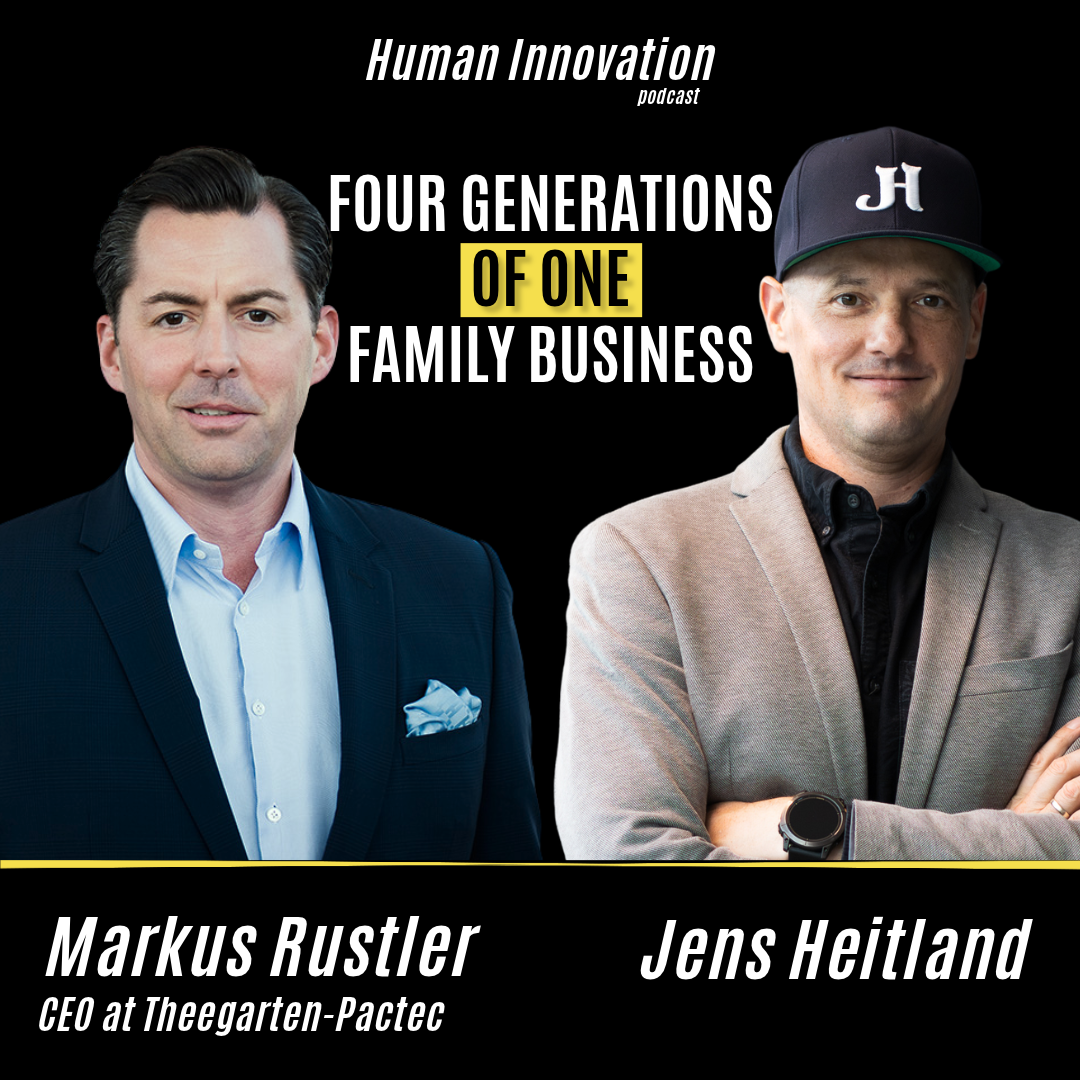
In this episode of the Human Innovation Podcast, Jens Heitland speaks with Markus Rustler, President and CEO of Theegarten-Pactec, the Dresden-based family company founded in 1934 that designs and builds high-speed packaging systems for confectionery and other small items. Markus shares how he moved from a career in finance into the fourth generation of family leadership, what he learned traveling with his father, and why he leads by listening to every voice before deciding. The conversation covers building customer relationships that last through political uncertainty, innovating for clients such as Hershey, keeping employees for decades, exporting 95 percent of production with strong markets across Africa, the role of the VDMA, the future of German engineering and the use of AI to support human creativity.
Youtube Podcasts
BRING JENS HEITLAND’S FRAMEWORKS TO YOUR ORGANIZATION
What Continuity Makes Possible in a Family Company
In family-owned manufacturing companies, leadership rarely begins with a formal handover. It begins much earlier, at the dinner table, on Saturday visits to the factory, in conversations children overhear long before they understand them. By the time a successor walks in as managing director, the organization already knows who they are. What it does not yet know is how they will lead.
I recently had the pleasure of sitting down in Düsseldorf with Markus Rustler, President and CEO of Theegarten-Pactec, a Dresden-based maker of high-speed packaging systems for confectionery and other small items. His great-grandfather founded the company in 1934. Markus took over in the fourth generation after starting his career in finance, far from the factory floor.
His first days came without any onboarding program. He described a desk, a phone, a dictation device he never used, and a building full of people watching him closely. Many of them had known him for years, though never as the person they would report to. One veteran mechatronics technician called him “Chefchen,” the little boss, and Markus took it with warmth. Small moments like that show a new leader where trust already exists and where it still has to be earned.
In that environment, he chose to listen. When conflicts arose, he heard every position before deciding, then explained the direction he took. At scale, that habit has a quiet effect. People who feel heard tend to accept decisions they would not have made themselves, and the explanation gives them something they can understand and carry forward.
The same pattern runs through the way Markus approaches customers. His father was known across the industry for refusing to discuss discounts. Markus kept that standard of quality and added something his generation could offer, which was lasting relationships, some of which have grown into friendships. Around 95 percent of what the company builds is exported, and in some years a quarter of turnover comes from markets such as Nigeria, Ghana and Cameroon. In a world that is dividing into blocs, he sees long relationships as the thread that holds when politics does not.
The system around the company reinforces this continuity. The move to Dresden after reunification placed the business next to a university with a dedicated department for production and packaging machinery. Students write their theses inside the company and often stay on. One technician joined at fifteen and was still working at seventy-five. Long tenure of this kind tends to grow from several things at once: security, fair pay, meaningful work and a city people do not want to leave.
Continuity carries its own risk, and Markus named it clearly. Holding the standard can slowly turn into standing still, and he described that as a form of surrender. Competitors, including those in China, are closing the distance, and he does not assume that a German reputation will last on its own. His answer is constant challenge, where each good result becomes the starting point for the next question. He places artificial intelligence in that same logic, as support that frees creative people from the tasks nobody enjoys.
What I take from this conversation is how much leadership in a family company depends on the patience to build trust slowly and the discipline to keep questioning what already works. Continuity gives an organization its memory, and steady challenge is what keeps that memory from hardening into habit.
Timecode:
00:00 Meet Markus Rustler
01:35 From Finance to Family Firm
03:34 Decision to Join
05:47 Sales Lessons from Dad
07:35 Relationships as Strategy
09:48 First Day as MD
13:38 Learning to Lead
15:16 CEO Life Behind Scenes
17:51 What PackTec Builds
19:37 Innovation Customer Example
24:58 Keeping Innovation Alive
27:59 Why Move to Dresden
32:32 Talent and Long Tenure
34:59 Export Driven Business
37:33 Future Outlook Industry
39:05 VDMA and Policy Influence
41:53 Germany Engineering Future
45:16 AI as Opportunity
47:25 Closing Thanks
Guest links:
Connect with Markus Rustler
LinkedIn: https://www.linkedin.com/in/markusrustler/
Website: https://www.theegarten-pactec.de/en/startseite/
Connect with Jens:
Transcript:
[00:00:02] Jens Heitland: Marcus, great to meet you here in Düsseldorf and really appreciate that you take the time. Let's go straight into it. So you have been grown up on a factory floor of a family-owned company. How did you get to be the CEO of the family-owned company, and who are you as a starting point?
[00:00:23] Markus Rustler: All right. So first of all, thank you for having me.
[00:00:25]Markus Rustler: Great honor. I've, of course, in preparation to this event today, scrolled to some of your previous podcasts. So big honor for me to be in this line now. Thank you. So my name is Marcus Rösler. I'm the president and CEO of Teagarten PackTec, which is a quite traditional family-owned enterprise, like so many in Germany, to be honest.
[00:00:52]Markus Rustler: So, a company which was founded by my grand grandfather back in nineteen thirty-four and then one day taken over by my grandfather, then my parents, and now it's with me in the fourth generation. And, as it is with family companies, I of course grew up with it, since the company was always, of course, one of the major topics at the lunch and dinner tables, during the holidays and after school, when I visited my parents in the factory on Saturdays, playing in the factory.
[00:01:25]Markus Rustler: So, even though I never studied engineering, let's say I have a quite good idea of what I sell there.
[00:01:35] Jens Heitland: So you, you, you started your career in finance.
[00:01:40] Markus Rustler: Right. Correct.
[00:01:41] Jens Heitland: So what brought you-- what brought your interest into finance rather than going into engineering, which is more of what, what the company is doing?
[00:01:49]Markus Rustler: This was basically a coincidence. I studied business administration first in Berlin and then in the UK, England. Not really having a very straightforward view on what I would do afterwards. But then towards the end of my course in the UK, I got a call from a very close friend of mine who had just joined a rating agency in Germany and asked me if I could imagine to help him out with building a certain segment of this company up after I finished my degree.
[00:02:33]Markus Rustler: And then I thought, "Well, probably it's not a bad idea to have something to start right after getting a degree." And at this time, joining the family company was at least not on the near table. Yeah. So I said, "Well, yeah, in any case, good to see something different and something to start my working life."
[00:02:57]Markus Rustler: And that's how I ended up basically, from the first day, consulting banks on financial products with no clue about what I was talking about. Yeah. But the good thing is what I really learnt is how to sell and how to present. So it was a quite good tutorial, I think.
[00:03:14]Jens Heitland: Was that mainly focused in the German market at that time or?
[00:03:18]Markus Rustler: Mainly yes. It involved international products, but it was basically ratings we sold to German banks and financial consultancies and so on. Yes.
[00:03:33] Jens Heitland: Yeah. So then came the day that you stepped into the family business. What was the trigger? What was the request from your parents, or how did that happen?
[00:03:44]Markus Rustler: Well, there was always, of course, the question on the table: how will the company look in future and who will manage the company? And it was always open. There was never pressure from any side, not from my parents, not from the other parts of the family, not from our board.
[00:04:03]Markus Rustler: But yeah, I think if I recall correctly, my father one day called me and said, "Well, we now have to take decisions. Please step back and think about if it is something you could be interested in." And that's exactly what I did. So I gave it a good thought, trying to imagine—and I was aged 26 then—trying to imagine what would be responsibilities towards the employees, of course, but also towards customers, towards family.
[00:04:36]Markus Rustler: But in the end, yes, such a nice opportunity you would probably never, at the age of 27, get an opportunity like that to run a company in this size—
[00:04:49] Jens Heitland: Yeah ...
[00:04:50]Markus Rustler: without founding it yourself, of course. So I decided, yeah, I'll give it a try.
[00:04:55]Markus Rustler: I'll do that. And then, in the first year before I joined, I have to admit, my father already took me along. So I was still working in Berlin with the finance business, but every now and then sort of sneaked out for two weeks and joined my father on international travels, visiting customers, trying to understand and get to know the customers and the equipment we manufacture and sell worldwide.
[00:05:28]Markus Rustler: Which was also a very nice time because I had a lot of international travel together with my father, with customer visits on one side, but then nice dinners in the evenings and when we spent somewhere over the weekend also visiting some places. So some good quality time together with Papa.
[00:05:45] Jens Heitland: Nice. Nice.
[00:05:46] Markus Rustler: Very nice.
[00:05:47]Jens Heitland: What are the key things that you learned during that time traveling with him and being kind of the shadow of him and understanding how he's... Like even if we take the business outside, but how he's interacting with important clients and people around him. Because most probably—
[00:06:05] Jens Heitland: you have seen him differently at home.
[00:06:08]Markus Rustler: Yeah, probably. Because I was also active in sales, so I had a rough idea on how you interact with customers, how you persuade customers, how you move customers to a signature. These sort of things I knew from my finance job.
[00:06:26]Markus Rustler: A bit different background, of course, than a confectionery producing company. And then I met my father, who had been doing sales for almost 40 years, I believe. Completely different. So also completely different than I do it today. But my father was quite a—or is quite, he's still alive luckily—is quite a straightforward guy.
[00:06:56]Markus Rustler: And when a customer asked for a machine, he said, "This is the price." And if the question was how much is the discount? My father always had a very simple answer, "I sell machines, not discounts. That's the price." And that was it. So very, very interesting to see. Yeah.
[00:07:18] Jens Heitland: But-
[00:07:18] Markus Rustler: And he was, he was famous for that in the industry.
[00:07:20] Jens Heitland: Which is quite interesting because I, I guess it still worked out well.
[00:07:24]Markus Rustler: It worked, it worked well. I guess there were customers which, especially in certain parts of the world, were not—
[00:07:31] Jens Heitland: Yeah ...
[00:07:31] Markus Rustler: not too happy with this approach, but in the end it worked, yeah.
[00:07:35]Jens Heitland: Let's talk about that. So you're operating in many, many different countries, and you sell in many different countries.
[00:07:45] Jens Heitland: What are the differences that you have learned from the early days with, like, you as a leader and how you would do that differently? What are the things that, that you say you brought in when you took over that are helping the business to grow even better today?
[00:08:03]Markus Rustler: Interesting question. I think what I really brought into the development of our company was relationships.
[00:08:12] Jens Heitland: Hmm.
[00:08:12]Markus Rustler: So, I'm more, I would say at least, and others have to judge, but I think I'm more a quite open, open-minded person. I'm good in building relationships and lasting relationships. And I think lasting relationships between our customers and our company weren't that strong before I joined.
[00:08:37] Jens Heitland: Hmm. And
[00:08:38]Markus Rustler: afterwards were developed more closely. So today—and I think we can take pride in that, not me personally, but the entire company—that we have very good and close relationships to our customers, which sometimes even go as far as friendship.
[00:08:55] Jens Heitland: Yeah. In a time where a lot of financial pressure, a lot of politics is going on worldwide, independent from the business, how important are relationships in this time compared to maybe the old days, twenty, thirty years ago?
[00:09:13] Markus Rustler: I think relationship is always, always helpful. But, especially, in, times where, world, sort of divides up into different, well, leagues, or however you want, to call that, a relationship is more important than ever. because just countries don't get along, well anymore, this doesn't necessarily mean that a long-lasting business relationship, has also to finish.
[00:09:42] Markus Rustler: And so, that is where relationships I think are, very, very important, yes.
[00:09:48] Jens Heitland: Yeah. Let's go to your first day. So you come from this financial company. You have been traveling with your dad already, and then it's your first official day starting in the family company. Let's bring us back to that point.
[00:10:04]Jens Heitland: How was that? What did you see? How did you experience your first day?
[00:10:10]Markus Rustler: Well, I think this is already more than 20 years ago, but if I remember correctly, there was a lot of cold water. Honestly, there was no such thing as a preparation program or anything in those days, at least not in our company.
[00:10:29]Markus Rustler: So basically I just learned by doing. So the first day and then, of course, the assistants had my office prepared. I had a computer on my desk, I had an email address and a telephone and, very funny in those days still, a sort of dictating tool
[00:10:50]Markus Rustler: tool, which I probably never used, but nevertheless it was on my desk, and pens and something to write on. And then, yeah, I came in at probably, I don't know, 7:00 or something. "Okay, what do we do now?" And then first meeting started which I joined. And what I think remember most on those first days was, on one hand, the employees being happy there's somebody who's following, but then the very close observance of me in person.
[00:11:28]Markus Rustler: I mean, a lot of them had met me before on exhibitions or on a visit to the company. But now I was there as the new MD and, yeah, so a lot of eyes on me.
[00:11:41]Jens Heitland: Yeah. I can imagine that was, at least for you internally, quite a lot of pressure taking a well-run organization and stepping in as the future leader with a lot of people that know you, like you said.
[00:11:58] Jens Heitland: How was that for you internally? Did you feel that pressure? Did you pressure yourself?
[00:12:03] Markus Rustler: I'm not very good at pressuring myself- ... so probably I didn't put too much pressure on myself. I'd rather took it, "Well, that's the way it is, and it will work out fine." Yeah. being, rather on the optimistic side.
[00:12:16] Markus Rustler: but of course the pressure was there. I mean, it's a business which has to work, which has to perform. and of course, even if you don't, let That touch yourself too much. the, pressure is there, of course, yes. but yeah, it didn't, harm me in any way, so- I'm still, here and
[00:12:38] Jens Heitland: I can imagine it, it was like a warmup phase as well with, the different team members, even that they knew you already- Yeah ... but not as their leader. Like, how are you as a leader? Are you the same like they met you before? Since I think it was-
[00:12:52] Markus Rustler: Yeah. And they, and they didn't ask decisions from the very first day- Yeah.
[00:12:55] Markus Rustler: of course, from, from my side. But, um, yeah, but still they, uh, they, they accepted that, uh, first of all, he's family. He is, uh, he's the son of the, of the big boss and- Actually, there were, there were some all very nice employees down on the sh- on the shop floor. Though I remember one guy, I loved him, yeah, an, an, an mechatronic who, who set up machines all his life.
[00:13:19] Markus Rustler: So he set up machines for, for our company worldwide, and he always called me, uh, uh, Chefchen.
[00:13:26] Jens Heitland: Yeah.
[00:13:27] Markus Rustler: So, uh, the little chef. Chefchen is a German word. Uh, yeah. I always liked that. Uh, it was perfectly all right for me.
[00:13:36] Jens Heitland: Nice. So starting as, as a leader in, in a young age, I mean, now, now you're, you're 20 years almost in, in, into your role.
[00:13:45]Jens Heitland: You know how you lead. You're comfortable. How was it in the early days starting to lead in a family context and learning to do things differently for yourself and as well in that ecosystem?
[00:14:02]Markus Rustler: Well, as I said, that was not a training I received in any terms.
[00:14:07]Markus Rustler: It was really hands-on learning by doing. I think what I did is I listened a lot. I listened a lot. I always kept calm and tried to find a democratic position. If there was a conflict somewhere in the company, I tried to hear and value every voice, every angle, and then try to find the best way for the company in the end.
[00:14:41]Markus Rustler: And I think this strategy always helped me out quite well, and I think I still do that today, to be honest. I might with age get a bit less patient, but over time I think this is quite normal. But yeah, in general, I always try to hear all positions and then try, with a good human understanding, try to find the best way, no matter which way it will be in the end, and explain why I took this direction.
[00:15:16]Jens Heitland: If we look at you being the CEO, and it doesn't really matter if it's a company that is family-owned or a company that's not family-owned and you're just the CEO. What are the things you see for yourself as being a CEO that a lot of people don't see from the outside?
[00:15:39]Markus Rustler: Probably the continuous work behind everything we do. It is not an eight-to-four job, but you are at least in your mind and in your thoughts basically 24/7 with the company. Well, there might be, of course, exceptions when you're with your little kids or out on the golf course, then you might get a chance to stop thinking about it.
[00:16:06]Markus Rustler: But besides that, when I wake up at night, usually I sleep well, but when I wake up at night, which occasionally happens, then of course there's always something I'm nibbling on, which has to do with the company, with a project. I think quite normal. And I imagine this is the case for most people in my position.
[00:16:31] Markus Rustler: Uh, so it is, it just never, it never stops.
[00:16:34]Jens Heitland: I'm asking because a lot of people see, ah, he's traveling to the US like you were just in the US. He's traveling here. He has these meetings, he has those meetings, and he can take decisions, and it all looks so easy from an outside perspective. But what I see with a lot of other podcast guests as well is that it's not that easy.
[00:16:55] Jens Heitland: It takes a lot of energy to, to be a good leader, to be a good CEO of an organization.
[00:17:03]Markus Rustler: Given that I'm a good leader and a good CEO, which again others have to judge on that. But, yes, of course it takes energy. There's always a bill to anything. So a lot of traveling in my personal perspective means I have less time for family, for my wife, for my lovely children, or for friends and hobbies.
[00:17:30]Markus Rustler: Since I live in Düsseldorf privately and the company is in Dresden, this means, of course, I travel every week.
[00:17:39] Jens Heitland: Yeah.
[00:17:40]Markus Rustler: Yeah. So I'm usually not at home Monday to Friday. And of course this has an impact on your private and personal life. Yes.
[00:17:51] Jens Heitland: Let's go to Tegart PacTec, the company that you're leading.
[00:17:56] Jens Heitland: Give us an explanation what the company is doing so that the listeners understand what the business is about, and as well the different countries that you're working in.
[00:18:05]Markus Rustler: Sure. So Tegart PacTec specializes on innovating, designing and building high-speed packaging systems for small-sized items.
[00:18:19]Markus Rustler: Mainly it is in fact confectionery, so everything from a candy to a bubblegum to a toffee to a chocolate bar or a chocolate tablet. And a few similar articles like soup cubes, so you know, Knorr, of course, Unilever, for example. Or others. Or detergent tabs, so for dishwashers, washing machines.
[00:18:45]Markus Rustler: But everything which is wrapped at very high speeds in huge volumes is basically our métier where we are looking at. And for this we are designing the machines, but not only the machines, also the entire production lines that in the end gives the producer a sellable product for its consumers.
[00:19:10]Markus Rustler: Yes, and we do this on a global footprint. Our machines are in operation anywhere from New Zealand, across Asia, anywhere in Africa, surprisingly, Middle East of course, Europe, North America, South America. There might be some exemptions like North Korea probably, but besides that, we take pride in being everywhere, yeah.
[00:19:37]Jens Heitland: You talked about being the innovator in the industry. What were challenges from customers that had very specific needs for their packaging that you solved through innovative ideas and helped them to be successful in selling their items?
[00:19:58]Markus Rustler: First of all, one needs to understand in this confectionery industry, there's not so much variety when it comes to the primary packaging.
[00:20:08]Markus Rustler: So you either have a twist wrap, like the traditional candy, or you have a folded product like a chocolate praline, or you have the flow wrap, which is like the Mars bar, for example.
[00:20:21] Jens Heitland: Yeah. Yeah.
[00:20:22]Markus Rustler: These are the traditional wrapping styles. And then every now and then there are some specialities.
[00:20:29]Markus Rustler: So for example, that is one example I'm allowed to talk about is Hershey Kisses. Hershey Kisses is probably the most sold, by volume, chocolate product in the US. It is a very traditional product. Produced more than 100 years by Hershey in Pennsylvania. And it is best I can describe it as a chocolate drop and has the form of a water drop basically.
[00:21:02] Jens Heitland: Mm-hmm.
[00:21:02]Markus Rustler: With a flat bottom though. And then it is wrapped in an aluminum foil and has a little flag which is sticking out of the top. So very unique, very special. And this, for example, is something a few years back when Hershey had to renew its production lines, was a tailor-made design we did for them.
[00:21:26]Markus Rustler: They asked us, "Can you do a machine which can wrap this product in this style at very high speed?" Which we then did, yes, and developed a machine for them doing 900 of these kisses per minute. And don't ask me how many of these lines they have worldwide. It is more than 20, let's put it that way.
[00:21:47]Markus Rustler: Yeah. So it's huge volumes. That is a quite good example of what we do. But then it can be any product, from a medium-sized family business company up to a multinational global acting company.
[00:22:03]Jens Heitland: Yeah. If we go to that example, so you basically innovated that inside of Germany?
[00:22:11]Jens Heitland: Or how did that happen?
[00:22:13]Markus Rustler: In this case, I mean, Teegarten is known for its superb quality—which is a big word, but for its unique packaging machinery and the way we design these machines. We talk about continuous motion machinery. So, in this very special case, Hershey knew that we are very good in these high-speed machines, and they approached us with the product and said, "Look, this is something we need to look in.
[00:22:46]Markus Rustler: Is there any way that you could develop a high-speed line for us?" And in those days—when this started, it was a bit before my time, before I joined the company.
[00:22:56] Jens Heitland: Mm.
[00:22:57]Markus Rustler: But in those days, I remember there was another competitor from Switzerland who got the same task from Hershey because they wanted the competition
[00:23:06] Markus Rustler: and the design.
[00:23:07] Jens Heitland: Yeah.
[00:23:08]Markus Rustler: And then, yeah, in the end, to make a long story short, we won this competition, then built multiple of these machines for the global footprint of Hershey. Yeah.
[00:23:21]Jens Heitland: Which means, if I understand that right, you innovated successfully and through that have a customer for years to come afterwards.
[00:23:29]Markus Rustler: In this special case, yes.
[00:23:30] Jens Heitland: Yeah.
[00:23:31]Markus Rustler: So normally, let's say it's not the normal route course, yeah? The normal route course is our people have a fantastic idea, and then we do of course market research. We try to analyze: is there potential? How big is the market?
[00:23:49]Markus Rustler: So the classical market research we do. Yeah. So this can be a quite straightforward way, and then we decide as a company, okay, this is the budget, now design and build a new machine generation, for example.
[00:24:04] Jens Heitland: Yeah.
[00:24:04]Markus Rustler: Another way could be as I already explained, the customer approaching us with a development task.
[00:24:13]Markus Rustler: These are usually the two drivers of innovation when it comes to the mechanical design of these machines. And then of course, we have a lot of innovation taking place through new materials available from one day to the other, new software solutions, new electrical components, which can, for example, do something faster than the previous generation.
[00:24:41]Markus Rustler: And this brings sort of intermediate innovation into our product. So it's not that we design a machine once and then build it for the next 20 years, but it always undergoes upgrades every now and then through new available knowledge or technology.
[00:24:58]Jens Heitland: How do you keep this innovation spirit in the company as a leader?
[00:25:03]Markus Rustler: Challenge. I always challenge. As I was saying, in the end, we achieve a good result, and then we already start thinking, "Okay, now this is very good, but what could be the next?" And the good thing is, it's not always the same product you have to focus on, but it can vary.
[00:25:21]Markus Rustler: It's, you know, okay, this is now good, but we haven't worked on this for a certain amount of time, so let's focus on that again. Yeah. That's probably how it is done. But then having very creative team members, which love their job and come up with great ideas—this is the key
[00:25:43] Jens Heitland: I'm asking because there are some industries that struggle with innovating.
[00:25:47]Jens Heitland: Yeah. And especially in Germany, at least I'm living outside like we discussed before. Looking from the outside in, it feels like there's some industry, and we don't need to talk about any specific, they're struggling with innovating and then sometimes even more so family-owned businesses. I'm just interested in how do you work with your team members that they still push for the innovation, look into it, try something new, or at least come up with ideas that maybe someone needs to approve or agree to, to test?
[00:26:21]Jens Heitland: But I just have heard it from other CEOs that there's nothing that comes to them, nothing that moves into that direction because everyone is focused on let's keep the standard and let's keep where we are. But they struggle with that.
[00:26:38]Markus Rustler: Well, I think "let's stay where we are and keep the standard" is a sign of surrendering.
[00:26:48]Markus Rustler: I mean, there is competition, not only from Germany, but there's also vast competition from other parts of the world, including China. And I think what we always understood at Teegarden is that, even though we might be from a technology point ahead and technology leading as a company, that's nothing you can rest on.
[00:27:12]Markus Rustler: You always have to do better to keep this distance to your next competitors. I think what everybody in Germany has to understand is nobody's waiting for us. Yeah? I mean, we still have, in most part of the world, good reputation, but this is not everlasting.
[00:27:38]Markus Rustler: Same for Teegarten. So that is why we always... And then competition, of course. We see what our competitors are doing and say, "Ah, here and there now getting closer, so yeah, we have to go the extra mile." This can also be always a good pressure point, let's put it that way.
[00:27:58] Jens Heitland: Yeah. So in, in the past you, you have decided to move the company to Dresden from Cologne, and you have invested even more into Dresden in, in, into a new factory over the last, um, decades and years as well.
[00:28:15] Markus Rustler: Mm-hmm.
[00:28:16]Jens Heitland: What was the decision to go to Dresden? I mean, you come from Cologne and you've grown up in the Rhineland. What was the decision to go there and then double down there?
[00:28:28]Markus Rustler: Okay. First of all, this decision again was taken before my time—
[00:28:31] Jens Heitland: Yeah ...
[00:28:31]Markus Rustler: and by my parents. So root cause for this decision was simply that, after the reunification of Germany and, with that the privatization of state-owned companies, there was this opportunity for my parents to buy their then biggest competitor, which was the PacTec part of Teegarten PacTec today.
[00:28:52] Jens Heitland: Mm-hmm.
[00:28:53]Markus Rustler: So PacTec, formerly known as Nagema, was a big state-owned conglomerate, which were excellent in what they did. Superb technology already, with worldwide focus. So despite being a communist German company, they were active worldwide. And then, yes, the opportunity just came to buy this company.
[00:29:20]Markus Rustler: And that's what my parents did. They invested, and then ran both companies for a period of four years alongside. So there was a Cologne facility and the Dresden facility. And then... So what I know from my parents, the decision was purely made on financial and other values saying, "Well, both companies parallel to each other doesn't make sense."
[00:29:52]Markus Rustler: So that's when they decided now we will merge everything in Dresden. And why in Dresden? There were financial reasons, but mainly the main reason was a much bigger facility, a better position for talent and more talent in Dresden than to be found in Cologne in this special sector.
[00:30:20] Jens Heitland: Yeah.
[00:30:20]Markus Rustler: Because what you need to know maybe is that Dresden is an excellent university in Germany having a department for production and packaging machinery. And of course, this is helpful if you have a big need for innovative young people coming from university, and that's what we do.
[00:30:41]Markus Rustler: And that was also a reason why Dresden in the end. Got it. So,
[00:30:47] Jens Heitland: yeah. That's smart. So you most probably get all the young talent from the university just straight away.
[00:30:53]Markus Rustler: Well, we do a lot of work together with the university. So if we have a special task, the university often gets a project from us to do, so then the older semesters come to our company to do their thesis, their PhD degrees usually done in our company.
[00:31:16]Markus Rustler: And then yes, of course, there's always a good opportunity to have a job following the university career.
[00:31:22]Jens Heitland: Yeah. For me, it's just interesting because a lot of companies struggle to get the young talent because young people, sometimes they want to go abroad, they want to go into other parts of the world, and at least what I hear quite a bit, they're leaving the eastern cities in Germany and moving somewhere else in the country.
[00:31:44] Jens Heitland: Um-
[00:31:44] Markus Rustler: Not so much in Dresden.
[00:31:45] Jens Heitland: Okay.
[00:31:46]Markus Rustler: Dresden is an old and very beautiful city.
[00:31:50] Jens Heitland: Yeah.
[00:31:50]Markus Rustler: And usually we find it exactly the other way around. Whoever once lived in Dresden doesn't want to leave it anymore.
[00:31:57] Jens Heitland: Okay.
[00:31:58]Markus Rustler: So we got quite a lot of students who have studied in Dresden, and then they said, "No, we wanna stay in Dresden."
[00:32:06]Markus Rustler: And that's why we are capable of hiring them and keep them as employees.
[00:32:11] Jens Heitland: Yeah.
[00:32:12]Markus Rustler: If you look at companies as ours, in our sector in other parts of Germany, usually they are in let's say more rural or remote areas, not so much in beautiful cities.
[00:32:27] Jens Heitland: Yeah.
[00:32:27]Markus Rustler: Yeah. And probably this is also an advantage we have with keeping talent.
[00:32:32]Jens Heitland: Talking about talent and employees, one of the things that stood out to me when we discussed last time was that you have really long-term employees, which is also not usual these days anymore, 'cause a lot of companies are having waves in between and a lot of people leaving, or they do, like, every two years a transformation, which is happening quite a lot at the moment.
[00:32:57]Jens Heitland: And you have long-term employees that are staying quite a long time, which fascinates me. What is the reason for that?
[00:33:06]Markus Rustler: No, in the end it is probably the safe haven of a family company, security in the end, and then an attractive job which is fairly well paid.
[00:33:22]Markus Rustler: I think all this comes together, yeah? I'm not saying that everybody who ever started at Teegarten PacTec stays there until retirement. But yeah, we have quite a lot of examples where exactly this happens. People joining the company after school, doing their Ausbildung, going through four years becoming a mechatronic, for example, and then staying in the company until their retirement and beyond.
[00:33:56]Markus Rustler: Yeah, so I think the most long-term employee I saw in my time in the last 20 years was also a mechatronic, doing a lot of work internationally, bringing machines to operation or servicing machines worldwide. He started during communist German times, when he was, I think, 15, as apprentice in the company, and then he stayed in the company until his retirement and continued to work afterwards until he was 75.
[00:34:36] Jens Heitland: Wow.
[00:34:36]Markus Rustler: So 60 years he was actively working for the company.
[00:34:42] Jens Heitland: That's cool.
[00:34:43] Markus Rustler: Yeah, that is, well, also for us unique, of course. Yeah. But yeah, very nice, of course.
[00:34:48] Jens Heitland: Still that means he enjoyed working there.
[00:34:50] Markus Rustler: Absolutely.
[00:34:51]Jens Heitland: So he was part of the family, if you want to call it like this, at least work-wise.
[00:34:57] Markus Rustler: Yes.
[00:34:57] Jens Heitland: Yeah.
[00:34:57] Markus Rustler: Absolutely.
[00:34:59]Jens Heitland: So from a business perspective, like you're based in Germany, that's the main headquarter and you work internationally. How important is the German market compared to the international market for you as a business?
[00:35:12]Markus Rustler: Varies of course a bit from year to year, but in general, you can say on average, 95% of our production is for export.
[00:35:23]Markus Rustler: Only 5% really comes to operation in Germany. And then out of these 95%, I'd say 80 are outside Western Europe.
[00:35:34] Jens Heitland: Mm.
[00:35:34]Markus Rustler: So that's truly global. And our biggest markets, and again, it varies from year to year, US usually has, or US and North America quite usually have quite a big footprint.
[00:35:47]Markus Rustler: But then Africa is a very important market for us. In some years, we do 25% of our turnover in Africa. And I'm not talking about South Africa or Maghreb, I'm talking about countries like Nigeria, Ghana, Ivory Coast, Cameroon, Guinea, Senegal. In all these countries we are really actively involved.
[00:36:11]Jens Heitland: Do you remember how this started? Was it already from the beginning when you took over from your parents that it was so international, or did you put more action on that so that it's getting more international?
[00:36:24]Markus Rustler: No. It has always been very international, and as I said, even during communist German times,
[00:36:30]Markus Rustler: the conglomerate, Nagema, was already actively selling machines to virtually every part of the world, as did Teegarten as a family business from Cologne. So I remember my father when I was a small kid, traveling to Africa for three weeks, in times without FaceTime, WhatsApp video, or even a mobile phone.
[00:36:54]Markus Rustler: So there was probably a call once a week on a Friday evening from, I don't know, Lagos or you name it, and everything is okay, and that's it. So he was traveling and selling equipment. I still have the old order books, even from my grandfather, to be honest, in my office, so—
[00:37:14] Jens Heitland: Nice
[00:37:14]Markus Rustler: you can see how orders were placed in those days, 40, 50 years ago. A telex coming in or a phone call and then a letter written, order confirmation being shipped by post. Yeah. Very different today.
[00:37:33]Jens Heitland: So if we look ahead, where do you see the industry but also Teegarten PacTec moving in the next, let's say, five to 10 years?
[00:37:42]Markus Rustler: Yeah, especially this fairly, let's say, short horizon, five to 10 years, is probably interesting because we are of course at the moment living in a world where predictions are tough to be made. Nobody knows what is coming in the next five years and if you think now we are at the bottom, next day it becomes worse.
[00:38:06]Markus Rustler: I think at the moment, and this accounts for most German machine manufacturers, surviving is number one focus and then trying to stay connected and trying to push the business. I think in our niche, packaging of small-sized items, we are fairly well off because that is something which will remain.
[00:38:40]Markus Rustler: World population is growing, people have to eat, and people need an indulgence every now and then in form of a confectionery, so these markets tend to further grow in future and as long as we can supply suitable and good equipment, efficient equipment, I think we always have a good chance to be there and do a business.
[00:39:05]Jens Heitland: In one of your roles you're as well working in the industry association, VDMA.
[00:39:10] Markus Rustler: Mm-hmm.
[00:39:11]Jens Heitland: How important is that for you as an industry leader and as well for Germany? Because a lot of other countries have different associations, different ways of working. I still remember when I was living and working in Germany, I was working with the VDE because I was working in the electrical industry—
[00:39:31]Jens Heitland: and was putting time into trying to figure out how to write new norms and these kind of things. What do you think is the importance for yourself as a leader and for your company being part of these associations and taking leading roles in that?
[00:39:47]Markus Rustler: Well, I think there are some different parts of the metal which have to be reflected.
[00:39:57]Markus Rustler: Now, as the CEO of Teegarten PacTec, I think my active role in the VDMA is essential in terms of staying ahead in terms of information on what is going to come, but also having some impact on how information is transferred to Berlin or to Brussels—
[00:40:30] Jens Heitland: Mm.
[00:40:30]Markus Rustler: when it comes to regulations and so on, because the VDMA of course also actively is involved in lobbying or influencing the politics into guiding them into the right direction, yeah? Because sometimes, as we all know, Brussels and Berlin tend to come up with ideas which are a bit away from reality, let's put it that way.
[00:41:02] Jens Heitland: Yeah.
[00:41:02]Markus Rustler: So there's this influence. Then, from a personal side, I think it is important to also give back. Yeah, I mean, I am in this position. I of course receive a lot of benefits from that, so it is also, I think, just fair to give something back, and I see the VDMA as one good opportunity to give something back.
[00:41:29]Markus Rustler: And then, the third perspective is again, relationship. Because of course you interact permanently with all sort of different companies which are also active in the VDMA and build close relationships, which then somewhere else again might be of benefit to all of us. So, networking is also part of it, of course.
[00:41:53]Jens Heitland: If we look at the industry as a whole, where do you see the industry going? You mentioned from an economical perspective, like it's not sure right now in total. Where do you see, especially coming from Germany, growing up in Germany and understanding how other cultures and other companies—
[00:42:13]Jens Heitland: countries see Germany, it was always a machine engineering perspective that a lot of countries really value in Germany, and I think it's still strong and have been—like, I worked in an international organization. I know how German engineers are thinking differently than other engineers. What do you see happening in the future?
[00:42:37]Jens Heitland: Where do you see the future going with an industry like this in Germany? Because, at least what I see from an outside perspective, it's tough right now, and it's maybe going to be tougher going forward.
[00:42:49]Markus Rustler: Yeah, I agree to some extent, at least. At the moment it is easy to be seen tough and challenging, and it is tough and challenging.
[00:43:00]Markus Rustler: But I think as German companies, we are still in a fairly good position. Yeah, we have talent, definitely. And I think as long as we can still motivate young people to create their own talent in terms of, for example, joining a university, studying engineering, machine building and so on.
[00:43:29]Markus Rustler: As long as this stays up, there's a good chance that we will also continue to engineer and deliver superb machinery. On the other hand, of course, we have cost disadvantages which are—well, not only in Germany, but which probably accounts for all of Western Europe—which have to be justified.
[00:43:55]Markus Rustler: And I believe most probably the mixture will be somewhere in between. You will always have high tech made in Germany, and you will have more standard equipment, which probably in the long run will not be able to be manufactured in Germany at our today's cost structure at least, and might therefore look for let's say more cost-efficient alternatives in other countries, be it in Eastern Europe, be it Turkey or be it India or China.
[00:44:28]Markus Rustler: I mean, this is already happening today. Yeah. But I think it's all about talent. As long as we as a country manage to bring up talent, to attract talent to stay in Germany—as long as this happens, we are fine. I'm less pessimistic on Germany's future than media might sometimes reflect today.
[00:44:56]Jens Heitland: That's why I'm asking, because from an outside perspective it's always very negative. I'm just curious how it is from the inside and understanding that as well.
[00:45:07]Markus Rustler: But then Germany is always, I mean—
[00:45:09] Jens Heitland: Yeah, I know.
[00:45:10]Markus Rustler: You live in the Netherlands, and you know Germany is always pessimistic.
[00:45:14] Jens Heitland: That's true.
[00:45:14] Markus Rustler: Yeah, yeah.
[00:45:16]Jens Heitland: So, before we get to a close, let's talk about technology and development and the impact of that. So artificial intelligence is one of the big buzzwords right now everywhere in the whole world, and the US and China are pushing quite a lot inside of their countries.
[00:45:38]Jens Heitland: How do you see technology development in your industry and as well for your organization, leveraging AI, leveraging other new technologies that will be enabled through it and so on?
[00:45:50]Markus Rustler: Well, in one word, huge opportunity. Well, two words, huge opportunity. Yeah, I think possibilities arising through the use of AI are probably almost unlimited.
[00:46:03]Markus Rustler: In the end, however, it still is only a tool amongst others. Yeah. I don't think that AI will ever beat human creativity, at least not completely. What I, however, strongly believe is that it is a good support to enrich human creativity. But that's also what we at Teegarten, of course, do.
[00:46:31]Markus Rustler: Yeah. I mean, I would never go so far to say, "Well, the next machine will be designed by an agent." Definitely not. But maybe we can more and more use tools to speed up design processes, to get rid of unloved tasks which nowadays have to be done manually.
[00:46:57]Markus Rustler: So all these sort of things, of course, bring a big opportunity. And then again, also for coming back to talent. Yeah. I mean, if talent in future can only be used in a creative way and normal daily work can be sort of delegated to agents, what a wonderful world this could be.
[00:47:25]Jens Heitland: Markus, I am fascinated by your organization and how you're leading in fourth generation a company that is in an industry in Germany that I'm really fascinated about. Thank you very much for your time today and doing the podcast interview.
[00:47:42] Markus Rustler: My pleasure.