
EP271: Sandra Silva: Growth Through Discomfort
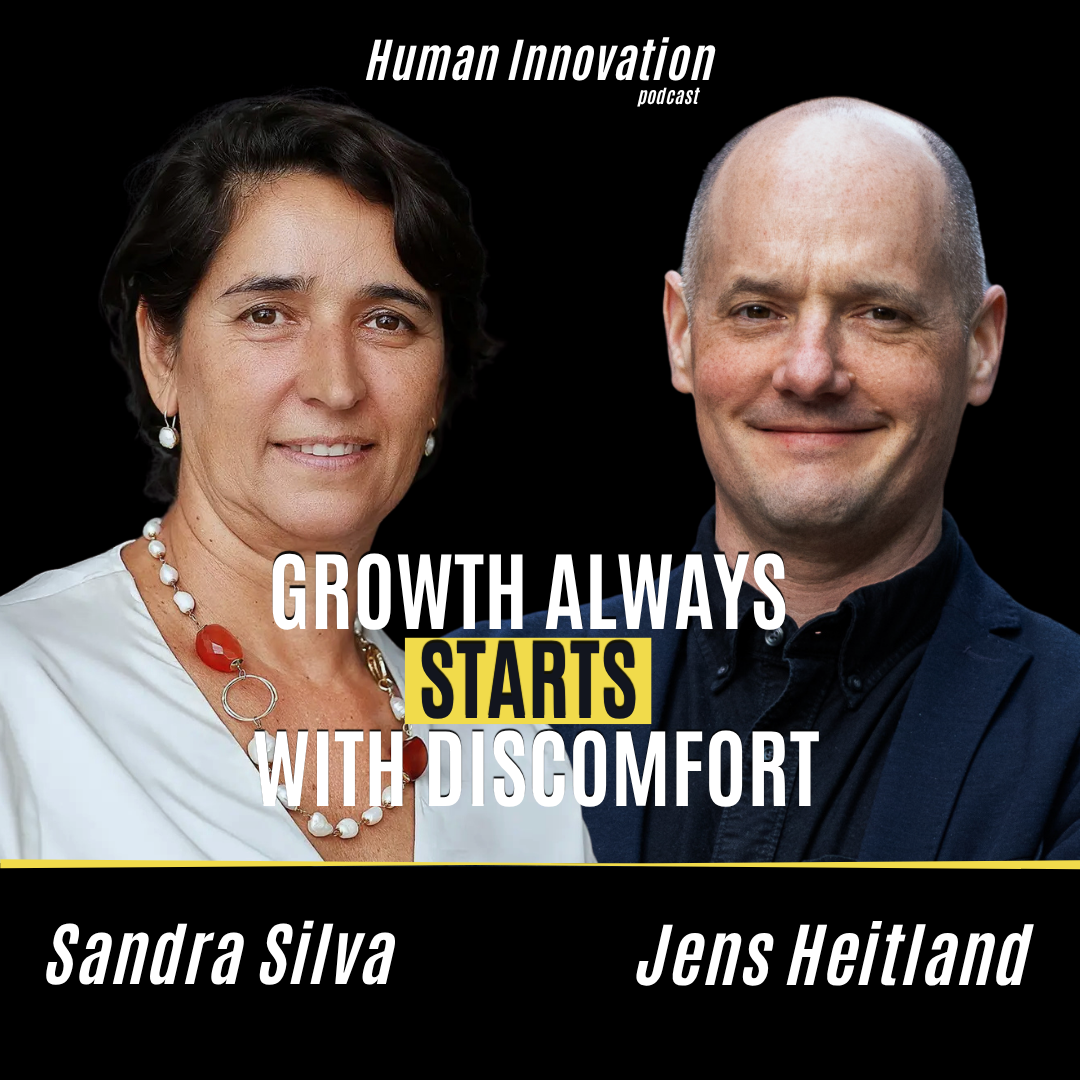
Sandra Silva, CEO of Veolia Portugal, joins Jens Heitland on the Human Innovation Podcast to talk about how leaders grow through uncomfortable moments, why a manager once told her to make herself dispensable, and how Veolia builds that thinking into its trainee program, its employee shareholder model and its approach to new managers. The conversation also covers ecological transformation across water, energy, and waste, the growing importance of resource sovereignty in Europe, and how Veolia is piloting full automation with HR involved from the start to protect the human skills that efficiency could otherwise remove.
Youtube Podcasts
The Discomfort Organizations Quietly Remove
In large organizations, growth rarely announces itself. It usually arrives as a moment of discomfort that someone chose not to avoid: a new role in an unfamiliar area, a language nobody around you speaks yet, a decision taken with less information than you would like. My recent conversation with Sandra Silva, CEO of Veolia Portugal, returned to that idea from several directions, and it changed how I look at the systems leaders build around their people.
Sandra described her own career as a sequence of uncomfortable moments. Early on, she moved into a management role surrounded almost entirely by engineers, while her own background was in management. The vocabulary was different, and so was the way people reasoned. Looking back, she sees that period as the place where she learned what every later step required. At twenty-five, a manager told her to work in a way that made her dispensable, because nobody moves on from a role only they can perform. At the time, holding on to information was a common source of power. That advice pointed the other way.
At scale, organizations reward comfort without meaning to. People get promoted for technical excellence and then find themselves managing others with little preparation. During that transition, people notice mistakes more readily than the growth behind them. Over time, people learn that staying where they are carries less risk than stepping forward. Sandra was precise about the consequence. When the difficult moment of growth gets punished, people stay in their comfort zone, and the organization slowly loses its capacity to develop its own leaders.
The structures she described at Veolia work against that pattern. Trainees rotate across water, energy, and waste so they know the company and its people before silos form around them. She spends time with them personally, since newcomers tend to be honest about what could be done better, and they often notice small problems before those problems grow. Every year, employees are invited to become shareholders on favorable terms, and employee shareholders can stand for election to the board. Purpose, ownership, and access to the top of the company are connected in a way people can see. None of it depends on a single leader’s personality, which is what lets it last over time.
Our conversation about artificial intelligence added another layer. Sandra is optimistic about what the technology can do, yet she sees a quieter risk alongside it. Growth depends on being pushed, and AI makes work smoother and easier, so people may simply stop being pushed. Her teams are running pilots on plants that could technically operate without a single person, and they bring HR in from the start to identify which competencies would disappear with full automation. The aim is to keep training engineers who understand the fundamentals well enough to think critically and connect ideas in new ways. Without that, today's efficiency gains become a shortage of experienced people in five or ten years.
What I take from this concerns how organizations shape growth in general. Discomfort has always been part of how people develop. Leaders rarely remove it on purpose. It fades through incentives, how mistakes are handled, and now through tools that make difficulty optional. Sandra put it simply near the end of our conversation. Companies exist to serve people, and part of leadership is making sure those people keep growing while the systems around them become easier.
Timecode:
00:00 Ep.271_Podcast_Jens_Sandra Silva
01:25 Leadership & Career Growth
09:25 The Trainee Program
12:43 Ecological Transformation
28:46 Employee Shareholdership
32:53 Leadership Philosophy
38:17 AI & The Future of Work
Guest links:
Connect with Sandra Silva
LinkedIn: https://www.linkedin.com/in/sandra-silva-a582905/
Website: https://www.veolia.pt/
Transcript:
[00:00:02] Jens Heitland: Sandra, great to meet you again and interviewing you on my podcast. I'm really looking forward to learn from you today. And I would love to start with a question that goes into your past. You started as a CEO in Portugal, responsible for whole Portugal. And how was that getting into that CEO role for you?
[00:00:28] Jens Heitland: What was the personal side of getting into that?
[00:00:31]Sandra Silva: the result of a sequence of uncomfortable moments and great decisions, at least, it is how I see it now, the beginning of my career. So as far as I remember, time I had the feeling that I was growing up to this new position, feeling that I was uncomfortably well on the previous role, and at the beginning, and really uncomfortable on the new role.
[00:01:15]Sandra Silva: So I can say that this is a sequence of uncomfortable moments lead me over here, but very exciting moments.
[00:01:25] Jens Heitland: So o-o-one of the things in my experience is often you, you start in a role and you're-- If you're a CEO, you're the, the leader of a whole organization and everyone looks up to you and you're kind of stepping away, further away from some of the people on the front line of the organization. What people often don't see is wha- your sacrifice and the hard work that got you there.
[00:01:53] Jens Heitland: How is that for you? How do you see this for yourself, but also for the leaders that you have had in your past?
[00:01:59]Sandra Silva: That's a little bit what I said, meaning that when we grow and to corner career, we absolutely grow. We really need to take some decisions for the unknown because, of course, based on something that we already are comfortable, we trust on what we know. But to grow, we need to go for areas that we really don't know. I move from a final role in the beginning of my career to a more management role on an area that he was-- I was surrounded only by engineers, and my background is management. So it is, and it was at the time very uncomfortable because the language is different, the way people think is different. But it's exactly this movement for the unknown brings uncomfortable at the same time. But uncomfort, but at the same time, it brings the new knowledge that we need to have in order to improve again, again, and to grow again. So, there is no other way to grow rather than this. and there is no one that reach the top without these steps.
[00:03:23]Sandra Silva: They will be different for each one. They will be in different roles, with different feelings, but there is no other way to grow rather than this sequence of situations and go from comfortable to uncomfortable, comfort to uncomfortable, and trusting And trust a little bit in yourself, then trust again and reach what we are.
[00:03:51] Jens Heitland: Was it for you, like if I look back for me in, in, in certain moments when I took steps into the unknown, into, into the next role, I, I, I was lucky having a mentor that was helping me and kind of almost pushing me into a direction. How was that for you? Did you have mentors or do you have mentors in your, in your life that help you?
[00:04:10]Sandra Silva: I think I didn't have mentors with that specific name, but somehow there were always people that at a certain moment told me something or teach me something make the difference for take, to take the decision or to understand the situation. I remember on my second, job, had a direct manager that told me, so...
[00:04:41]Sandra Silva: And I was twenty-five years old, that told me, "Sandra, you should always, act and work in a way that makes you dispensable on the role that you are. It's the only way for you to grow." At the time, and we are talking about close to thirty years ago. At the time, the common way of being in the business was the
[00:05:13] Jens Heitland: Ja
[00:05:14]Sandra Silva: because controlling information was power. Control the way things were done was power. So this, for me, was real an open eye saying, in fact, if If my manager thinks that I'm the only one in the world that can do what I'm doing right now, I will continue doing what I'm doing right now for the rest of my life. I really need to teach others and make others grow in order to have someone that replace me to allow me to go for unknown zones again. So things like this, I had a lot. And lucky or not, the feeling that I have is that it was always on the right moment. So after a while, I have these kind of conversations. There was an opportunity, there was a decision, there was something makes the difference know this before and apply it in that moment.
[00:06:24]Sandra Silva: So yes, other people are very important on our evolution and on our career. And right now, as I don't think I reach the top, I have a lot to grow yet. I'm going for a more professional way of that support because I really need that. I feel that is important. So I will have, in fact, coach sessions to help me grow on a more systematic way.
[00:06:58] Jens Heitland: Nice. How do you do that with the people that you're leading in your organization?
[00:07:02]Sandra Silva: Both sit-- two situations, two different options. Or I try to be the mentor myself because sometimes, I think I can be the right person for that because I know the job, I know the company, I know the person, so sometimes I can be the best mentor that that person can have on the moment. Or, and we do that on a systematic way in our company, we hire coaches and mentors for our people because... And this is something that I learn later in my career, it's more important in nowadays, that we usually promote people that are good technical people, good commercial people, and we promote technicians to managers. And this is very difficult to learn because learn with experience. But we can accelerate and make it easier for the new managers, and each time you grow, you are a new manager. I, even myself with thirty years old of career, when I became CEO, it's for me, I feel like a new manager because new situations, new roles, new challenges, new things to decide, it's a new learn. on the lower levels of the company, it's essential that we make the life easier for our new managers because they will start to be on the new role, to be more effective on the new role sooner. so we do in these two situations, on these two
[00:09:04]Jens Heitland: Yeah. One of the things that you mentioned last time, which I liked very much, that you spend time with trainees of the organization in a very specific way, which I think is not normal that CEOs do that. Can you explain that story and what you do with trainees?
[00:09:24]Sandra Silva: Yes. So, we do several things, one more formal and another one more personal. more formal is that we have a trainees program that we use to get new ideas and new people in our organization. The program that we defined is a way that we find to break silos in the organization because our new trainees needs to stay during, three months, one month in each area of the company, water, energy and waste, in order for them to know what we do and to know people across all the organization, so when they enter our organization, they already break their own silos, and they will help the company to break the silos. Then they see things on a different
[00:10:25]Sandra Silva: perspective. And it's very important for me to put questions to them and be questioned by them they help me to see things differently by the way they put the questions. Because when they put the questions, they show how they are thinking, and most of the time they are thinking differently. And then, another more personal way, and I feel, and this is my experience, it's not a study, of the time these new trainees are very authentic. So when I ask them, something about how the company is going, we are doing things, well or not, usually they are honest when they say, "We could do better here. We could change this," and so on. And of the times they are not one hundred percent right because they have
[00:11:32] Jens Heitland: Ja
[00:11:33]Sandra Silva: about the company or about the things, but they identify things that should be done differently. Okay? And with their honesty, because this is for me a key point, with their honesty, for me it's a big help to identify things that most of the time they are not a big problem yet, but they can become. for me, trainees and newcomers on the, on the company are a great opportunity to challenge myself.
[00:12:08] Jens Heitland: That's, that's su- super interesting how you do that. And I can imagine, and I don't know about Portugal specifically, but I can imagine that, like, waste, water, and energy is not the most sexy job that people are looking for when they, like, finishing university. So I guess it's also, like, a shortage of the best talent out there and, and, and one of-- Like, your program will help them to understand the company better, and then with that, you have the possibility to most probably pick the brightest minds that perfectly fit to the company.
[00:12:43]Sandra Silva: Yeah, that is right. And I think, if you look at water, energy, and waste, yes, probably that is not sexy. But when we transform it our purpose, our purpose is, the fancy name, I will say this way, is ecological transformation. in fact, what this means, and this change the way the newcomers and even the people that are already in the company, the approach, is that we want that the evolution and the progress of the humankind, we can s-- we want to support the evolution of the humankind to happen without sacrifice the conditions that our world has for us to live. And I like to say it this way, and not to take care of the environment because... Or to take care of the world, because the world was here before we arrive. There was the dinosaurs' era, they disappear, and the humans were not there. Then we came. So for the first time, the humankind is the first specie that is, growing, is developing, and is contributing at the same time for its own extinction.
[00:14:18] Sandra Silva: Okay? So we are not taking care of the planet. We are taking care of ourselves. And when you talk to young people that, think, "I'm gonna be here for a long time because my life will be very long," and you say, "We need to contribute to make our planet the best place to live because we are not doing that on the proper way," this change the mindset because they want to be part of it, okay? to be honest with you, I think that right now the momentum is already change because most of the newcomers are pushing already in the same direction that Veolia is
[00:15:03] Sandra Silva: pushing,
[00:15:03] Jens Heitland: Yeah,
[00:15:03] Sandra Silva: and it's, it helps a lot
[00:15:06]Jens Heitland: Yeah, I have seen this. Like we talked last time when I was in Portugal with the students this summer and helped them to, like, build entrepreneurial ventures and startups. There were a lot of them interested in these topics, looking into how do we, how do we work with decarbonization?
[00:15:25]Jens Heitland: How do we work with energy, water, waste, and other topics around the environment? They're all aware, and in my-- we have seen it this summer, the heatwave. It's-- That's all climate change that's happening and, like the, the reduction of water that is available and so on, it's super difficult and it's only getting worse if we don't take care of it
[00:15:47]Sandra Silva: Yes. And, and in fact, when we talk about, we talk about our three areas, water, energy, and waste, but we combine them to do what? To depollute, to decarbonize, and to have resources available. And in fact, this is the result of what we do. Meaning if you decarbonize and if you depollute, you are taking care of the heating waves, and you are taking care of the air pollution and everything. When we talk about regeneration and about new materials, we are talking about, recycling, we are talking about sovereignty, we are talking about make sure that we will have enough resources for our way of living. We are talking about water, of course, is always the first that come on top of our mind because without water we cannot live. it's the same thing for energy, and it needs to be energy that is not polluting, and it's the same for, other materials and raw materials. Because if we think that we are, electrifying our world in order to decarbonize because we can produce renewable electricity and, reduce the fossil fuels because there will be, pollution.
[00:17:14]Sandra Silva: But to electrify, we need raw materials and critical raw materials for the batteries, for the PV panels, for the elo- eolic generation, generators. And for this we need this, critical raw materials are not available everywhere in the world, and some of them are real, scarce, materials where we have scarcity. So To continue developing, we need real-- we really need to taking care of these resources are not anymore, nice to have, are a must
[00:17:58]Sandra Silva: to have. We are growing a lot on, AI, so we need... and digital capabilities. We are replacing paper by digital. For paper, we need trees. For digital, we need water and energy. So we really need to think this way and to make sure that we have the resources, and we have the resources where they are needed. So we talk about sovereignty, we talk about and with the war that we have right now, but it's the second if we think on the war of Ukraine and Russia that has
[00:18:41] Sandra Silva: started already in 2022 and we still, feel the, effects because the world, in fact, is
[00:18:49] Sandra Silva: changing. and all the value chain and all the supply chains and the problems associated with this are creating way of thinking, and that's where sovereignty comes on the first point, so as a priority, we can stay without the resources. So sovereignty comes to be, one of the most important things these basic areas: water, energy, and
[00:19:22] Jens Heitland: resources If we talk about companies in Portugal, how, how does-- how do you see the focus shifting for them as well if we take, like, big companies? Are they already deep into that? Do they understand that they are getting problems in the future and changing their mindset? Or is that still... Because change is always difficult, um, even that is slowly coming.
[00:19:45] Jens Heitland: But are we already thinking about these things in large organizations?
[00:19:50]Sandra Silva: Yes. definitively yes. Big org-- Mainly in big organizations. think the shift is bigger, it's, it's, more, effective on bigger organizations because for, for several reasons. First, because most of these big organizations are multinationals, they are feeling the same problem or, ... Yes, the same problem in different parts of the world. So there is real impact. Then the big companies are more influenced by the public opinion and by social media and, things like that, meaning that, if big companies don't go on the right track, there will be a, a, a problem for their own markets and for the commercialization of their products and, and their services. So I think yes, but of course, some decisions are not, easy to take because, sometimes they are more costly and less economically efficient. So it's a balance that needs to be, be implemented in order to go on the right track, not too soon and not too late. But definitively, yes, and, the growth, the success and the growing that we are having here in Portugal would not happen for sure. Because we are implementing solutions to decarbonize, to depollute, and to, regenerate resources. So as as we grow, I us- usually I say internally to, to my teams that really need to grow because if we want to our purpose and have the impact, the good impact that we want to make in the world, the only way we have to do this is
[00:21:58] Jens Heitland: Ja
[00:21:59] Sandra Silva: Okay? So our success and our growing is aligned the good things that we want for, for our, for our world, and we are growing, in fact, so this means that a lot of companies are making this
[00:22:14]Jens Heitland: Yeah. If we look at that from a, from a personal perspective, we talked about it from a leadership, but we also talked about it from a change perspective. In the end, change is always hard for individuals, and that can be career change, that can be different changes that are pushed from the outside, and this can be change that we, we have on our learning jour- j- journey where we're getting, let's say, not lazy, but we're, we're getting into our comfort zone, then it's hard to step up to the next step.
[00:22:48] Jens Heitland: How do you see that from your perspective inside of organizations but also for yourself?
[00:22:53]Sandra Silva: I think it's a daily chain-- challenge. More for the organization rather than for myself. for myself, as with the career that I have already, already learn, and I already have the confidence that is good. It hurts,
[00:23:14]Sandra Silva: but it's good. Okay? At the end it's good. So no longer afraid to change, and I really like to change because I know that in the end it will be good. On, on the company, it's a little bit more difficult, and it's a daily, a daily issue that, we need to, to, to face. So we really need to create, and this is easier to say rather than to do. We really need to create the environment allow people be punished try to grow. Because we need to make everybody believe, as I believe right now for myself, everybody believe and feel, because you need to feel it, that when you change, you'll make mistakes, but you grow, and it will be better for you and for the company. So we really need to create an environment that allow people to grow safely. Because if the... when each one start to grow, the uncomfort moment and the hard moment is punished, they will stay in the comfort zone
[00:24:39] Jens Heitland: Ja, true
[00:24:40] Sandra Silva: Okay? Again, this is very easy to say. It's not as easy to, to make, but possible to do. It's really possible to do, and we are on that way, with, uh, quite a good
[00:24:58] Jens Heitland: Yeah. How, how do you do that for yourself? So you said you're, you have learned that change is painful. I think if it's not painful, then it's not really a change. But in, in, in the end, what, what I always experience for myself but also with the, the team members, sometimes you kind of need to push them a little bit so that, that they go into the pain because it's almost like because I, I do long distance running.
[00:25:25] Jens Heitland: You can always run easy and it's good and it doesn't hurt. But if you want to get faster, if you want to grow as a runner, then you need to go into the pain and then you need to sprint a little bit in between. So how do you do this with the people around you, and how do you inspire other leaders in, in your organization, but most probably as well on client side to go the extra mile, do a sprint, and go a little bit into the pain where it hurts but the change will be there?
[00:25:51]Sandra Silva: So sometimes you really need to push for it and challenge people directly and, challenge, the customers directly. and, I think that is the, the, the, main, the most important thing, showing clearly where they can, where they can, be, where they can reach. so, show, show them a little bit behind pain because when you change, you only see the first line that is how difficult it is
[00:26:30] Sandra Silva: going to be, and you start to think, "Oh, now I need to change this.
[00:26:35]Sandra Silva: Now I need to learn this again." And you put your, your focus on the difficult part of the thing. my role is really to show them is just a small part because what you are going to reach is this, and this is possible, and this can happen. I already have in my, in, in my past two, two situations, two specific situations that only because I believe on the person, I told, one him and one her, I told them, is really possible and you can do it." And they went, and they succeed. And in fact, if I didn't show them where they could go, they would never move, and they would never change. So this can be implemented on a more widely way that is really identifying the people that have potential, how they can grow. We need... We really need to know our people because we can fail, okay. We need these, these movements, these movements. Sometimes we do it, we make mistakes, and we get one, one person, and in fact it will not be the best option. In that situation, we need to correct as soon as possible, not punishing, but correcting. But in fact, we can do this. We ca-- need to know the organization, and right now-nowadays, we have tools, for this. Identify the poten-- the, the, the people with higher potential and make sure that we put them on track. Because once you feel change is good, it's difficult to
[00:28:24] Jens Heitland: Yeah. Agree. So o- one of the fascinating things that I found out about your company is that you're one of the few companies that I have heard about, at least in the whole world, where the employees have a majority share of the company. Tell us more about that
[00:28:45]Sandra Silva: Okay. So that is part of our multifaceted performance because, to implement our purpose, we are not alone. We have stakeholders, and we really seriously our stakeholders. And our employees are one of our, five main stakeholders that we identified. And we really believe that, employees are taking care of the company, are aligned with the purpose of the company, and are aligned with good results of the company. So we have a program, and it is not local, it's not in Portugal, it's worldwide, program where we every year, we give the opportunity for our, for our employees to become shareholders of the company in, very favorable conditions. And right now, we-- the, the, the employees have nine percent... It was the, the number last year.
[00:29:52]Sandra Silva: This year, I still don't know because the campaign already finished, but I don't have the final numbers. The employees represent nine percent of the, of the capital of the company, the Justa capital. And, there are two, members of the boards that are, from the employees. And any employee shareholder, can apply be a board member. And there, there is, each, each time the mandate ter- finish, there is a new election, and the employees vote for the employee shareholder that, is the candidate for, for the board.
[00:30:40] Sandra Silva: So employees that are shareholder can become a board member of
[00:30:45] Jens Heitland: Yeah. Which, which for me is fascinating. I've never heard about a structure like this. Do, do you know the origin story and, and how did it come to, to that?
[00:30:55] Sandra Silva: I am not
[00:30:56] Jens Heitland: Ja
[00:30:57] Sandra Silva: because I joined the company only in twenty twenty-two, and th-this was a plan that already exists. I think it will becomes, it becomes a reality after we implement, uh, our purpose and our multifaceted performance with this, uh, five, uh, five, um, stakeholders that were identified, and this was a way walk the talk.
[00:31:26] Jens Heitland: It's, it's such, such a good example.
[00:31:29] Jens Heitland: I,
[00:31:29] Jens Heitland: I
[00:31:29] Jens Heitland: really like
[00:31:30] Sandra Silva: Yes.
[00:31:31] Jens Heitland: it. Uh, because it, it gives, uh, uh, it gives the people that work in the company a, a, a reason to stay longer, not just having, having the purpose, but also having kind of skin in the game if, if we call it like this.
[00:31:46] Sandra Silva: Exactly
[00:31:47] Jens Heitland: "Hey, I have invested myself, and if I put my work and my, my brain and my passion into my job, I will win twice."
[00:31:57] Jens Heitland: One part I'm getting,
[00:31:58] Jens Heitland: like, a promotion maybe. I have a career in an organization. The other part is I'm getting paid for what I'm doing, and then long term I have the opportunity for, like, shares and everything. I think it's, it's fascinating to, to, to hear that. It's, it's really cool. And specifically, uh, because I'm engineer, in, in a more engineering...
[00:32:19] Jens Heitland: You hear this from startups quite a bit, that they get shares and so on, where it's normal, but, like, in an engineering company for me is fascinating. It's, it's really cool
[00:32:29] Sandra Silva: Yes, thank you. I, I feel the same.
[00:32:34]Jens Heitland: So one, one of the things that we, we talked quite a bit about when we talked last time is, is really your, your passion for leadership and, and the way you, you look at the, the, the humans and the human capital of an organization. Where does that come from?
[00:32:53]Sandra Silva: That was something that was not in me at the beginning of my career, okay? the beginning, I, said to myself many times, "Why people are not like machines that we really know what is the button that we press?" Okay? But with the time, with the experience, I find out, I find out that people are amazing because contrary of my first feeling and my first thinking, don't give us good surprises. They only give us bad surprises. If they work properly, that's okay. Sometimes they don't work, and, we have a bad surprise. people by other hands, we can have great surprises, and the best part for me is that we can influence a lot those big surprises. if we create the right environment, the, the right... If we put the right people on the right place, if we give them the skills, if we, we do our job properly as leaders, can have great surprises. Most of the time, people give us much more than we anticipate, I learn more than I teach. So since I understood that, and I really learned that by experience because I did some things by feeling without, being aware of the consequences of what I was doing, then I realized, "Wow, this happened, and it's much better than I thought." I really learn, and after that, I really start to implement a different way of leading is creating the conditions for people to surprise me. And, this is something that we will never, will never be able to
[00:35:02] Jens Heitland: Ja
[00:35:03] Sandra Silva: because it's, like, addictive, you know?
[00:35:05]Jens Heitland: Last time you mentioned, an interesting story where some- someone told you the effect that you had on the other person
[00:35:14] Sandra Silva: Mm-hmm.
[00:35:14] Jens Heitland: What was that about?
[00:35:15]Sandra Silva: yes, that was, a specific situation that, an engineer, was at the operation, and, need him to do something relates with, European funds and a very, very more bureaucratic and administrative thing. But the only person that could do that needs to know the, the operation very well, and he was the only person, that could do that.
[00:35:49]Sandra Silva: And I told him, "Please, I need you to, to do this, and, I think you are the right person." And later he told me that he was so afraid when I ask him, he thought, "Okay, if Sandra believes me that I can do this, I'm sure I will do it." in fact, he overcome that... his thoughts, and the end everything was absolutely perfect.
[00:36:17]Sandra Silva: So he grow a lot and, only after that, and that was one of the situations that make me learn that, in fact we can make the change on the people. In fact, for him and for the company it was absolutely great and it was like a reward for me to understand that that person had the feeling that he did something that he thought it was impossible for him on the first
[00:36:50] Sandra Silva: moments.
[00:36:51] Jens Heitland: It's, it, it's so nice to get this feedback as a leader as well, because often you don't hear that feedback, especially when you're the CEO, I guess
[00:36:59] Sandra Silva: and
[00:37:10] Jens Heitland: Ja
[00:37:14] Jens Heitland: Ja
[00:37:30] Jens Heitland: Ja
[00:37:41]Jens Heitland: N-not always, not always, not always leaving the company. But I think, f-for me, a learning in that is doing the small things, like asking people to do the w- do the work in a different way, step out of their comfort zone because it will help them, like, like we talked about the, the change part. I think that's, that's something also a responsibility for a leader, not just leading the people to get the job done, but also leading the people to grow them and enable them to do the next step going forward.
[00:38:17] Jens Heitland: Talking about the big changes, technology. AI is in everyone's, like, thoughts on the table, in discussions, in, I guess, already in strategies everywhere. How, how is that for you and for your organization? How do you tackle technology changes? Because most probably it will touch as well all your clients or the clients will come and ask you, "What are you doing with, with artificial intelligence?"
[00:38:47] Jens Heitland: and so on. So how does that play a role for you as a CEO leading the company?
[00:38:51]Sandra Silva: It's a big, big challenge. But I'm very optimistic about AI because I think AI will be really revolutionary because it breaks a lot of boundaries that up to now, were a limitation for us. Now, the knowledge and, the capacity to, to have access to information and to process information is no longer a restriction. We are on the opposite way. We need to, to deal with excess of knowledge and with excess of, information available and what to do with it. And, for me, the biggest challenge is how to make sure that we implement AI, avoiding the less good part of AI.
[00:39:53] Jens Heitland: Ja
[00:39:53] Sandra Silva: And what, what I think we really need to take care is not how to implement and how to be more efficient and because that is natural, is how we don't lose the human capacity to continue to be creative, to continue to think differently, to make sure that we don't forget that we continue working for
[00:40:25] Jens Heitland: Ja
[00:40:26] Sandra Silva: we don't we don't work for companies. we we work through companies for people. We produce services for people. We produce products for people. The reason for our companies to exist, all of the companies in the world, are to serve people. we really need to make sure that, we don't compromise the objective, why we are so why we are working for. And another thing that for me is very important because if we look only for, efficiency We will replace a lot of people and we will put AI all over the place. And then within five to ten years, when we will need experienced people on job, we will not have experienced
[00:41:27] Sandra Silva: people because we didn't train it. We didn't train them. Okay? So that is something that, in my opinion, our company is working very well because we are creating pilots in, infrastructures that can be one hundred percent automatized, a wastewater treatment plant, for instance. We can nowadays with AI and robotics, we can, put all our plants without one single person. That is technically possible. Okay? But what we are doing is creating pilots with HR on the team To identify which are the competencies that we are losing with this complete automatization that we need to keep, we need to train order to continue to have engineers that have the basic knowledge, the capacity to think, and the capacity to be, um, critic on the process order to make sure that we are not, um, thinking on the short term for efficiency and losing the medium long term with the human capacities that we'll continue to have. to, to evolve and to develop, we need to be creative, and to be creative, we need people. is not creative. AI just combine historical things on different ways that we never thought. But AI is not really creative. To be creative, we need humans. to be creative on these areas where we work that are very technicals, we really need to have people with basic, basic but strong knowledges in order to connect the dots and develop new ways of doing things, and then yes, put, put AI doing the things. this is for me the biggest challenge. Don't lose the human capabilities. Don't lose the capacity to continue to be creative and to don't be
[00:43:42] Sandra Silva: lazy because it's a risk. It's a real risk that we take because AI will do anything. And we start this conversation saying that to grow, we need to suffer, AI does the opposite, make us so comfortable and make everything so easy that we feel that we don't need to grow,
[00:44:06] Jens Heitland: Ja
[00:44:07] Sandra Silva: and because we grow when we are pushed. If there is nothing pushing us to grow, I'm afraid we stop to grow. So we really need to balance these two things and get the best that we can get from AI, which is a lot, taking care that we continue to be humans and we continue to work to humans.
[00:44:32] Jens Heitland: That's a great example. I think that's something a lot of other companies are, are in the same boat with. It's, it's just very difficult to find out de- depending on obviously in which industry you're in. But, um, leveraging a technology like artificial intelligence but then still focusing on the human and keeping the capabilities and, and like we started out with the trainee program, you need the, the young people coming into the organization bringing fresh wind, fresh air into it with new ways of thinking because they will...
[00:45:08] Jens Heitland: I mean, I'm just looking at my daughter, she's eight. She will grow up with AI in school in the future, and for her it will be normal. Like we only know it now a couple of, couple of years, and I would say even let's maybe 12 months where it's really getting intelligent and before it was more like copy-paste.
[00:45:28] Jens Heitland: But I think it's, it's an opportunity for organizations but also for societies to look into what is the future of education, how does that work, so that we don't lose the human capability, the, the things that you mentioned where we learn from each other and, and really focus on what is, what is the essential being a human and then using and, and focusing more on that and maybe not sitting there and doing calculations or copy-pasting in an Excel table.
[00:45:57]Jens Heitland: Not, not... It sometimes helps because it hurts when you do it because... But, but, but I think it's, it's, it's more if it, it's more interesting for, for, for the humans as well to work with things that are interesting where they can learn and really apply human, knowledge, human thinking and then get into the topics.
[00:46:17] Sandra Silva: Yeah, it, yeah, it's a big challenge for our schools and for our universities and for our educational system. Really, really a challenge.
[00:46:27] Jens Heitland: Ja
[00:46:28] Sandra Silva: and in fact, at the end, a challenge for us as a society
[00:46:33] Jens Heitland: Yeah. I think we, I mean, we all need to figure that out in the, in the short term because...
[00:46:41] Sandra Silva: Really short because it's
[00:46:42] Jens Heitland: Exactly. Exact- With, with that, Sandra, thank you very much for spending the Friday afternoon with me. It was a pleasure talking to you and interviewing you, and I promise when I'm coming next time to Portugal, I will say hi and have a coffee with you
[00:46:58] Sandra Silva: Yes, for sure. You'll be very welcome, and I'm the one who say thank you for the invitation to be here with you. It was really a
[00:47:05] Sandra Silva: pleasure