
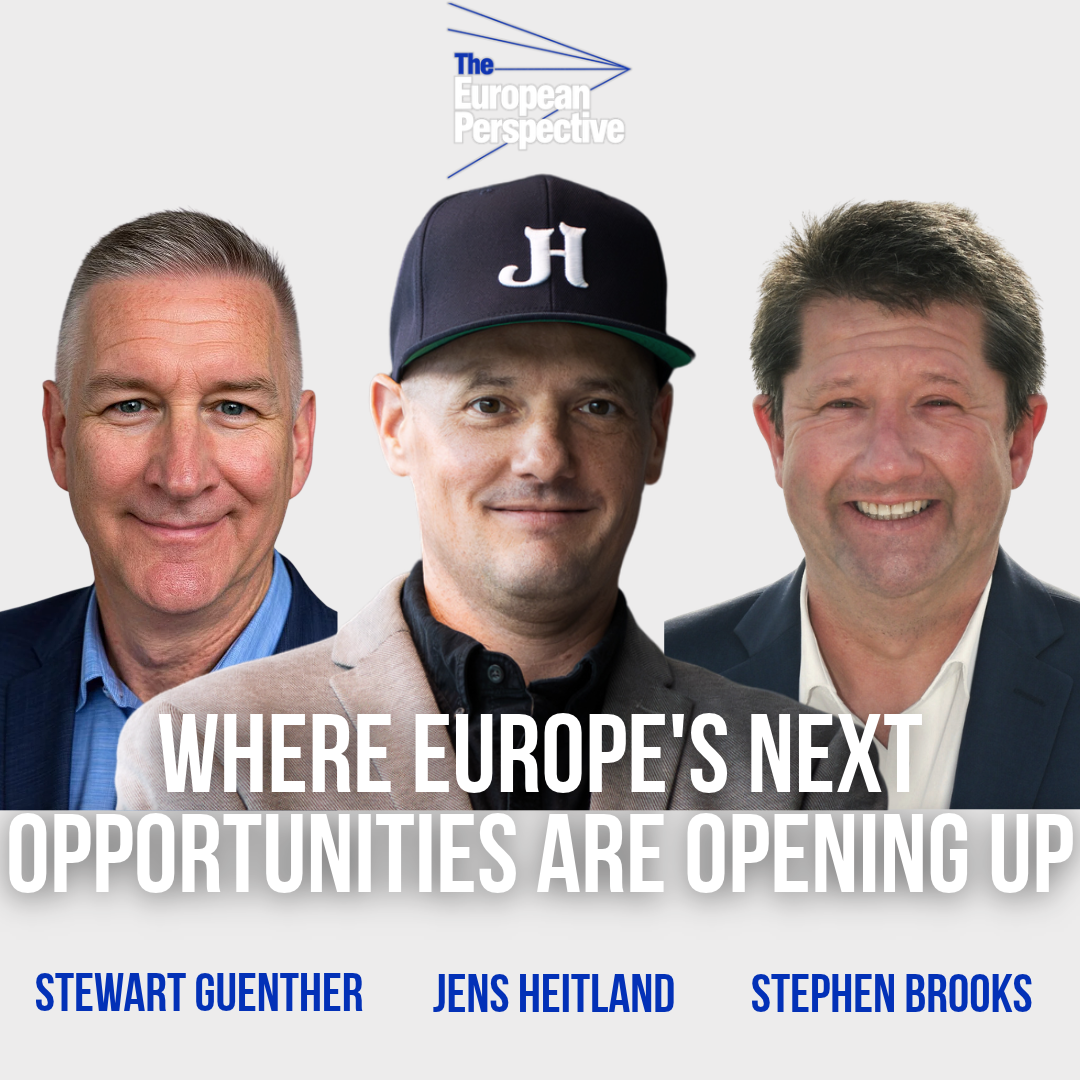
In this episode of The European Perspective, Jens Heitland, Stephen Brooks and Stewart Guenther examine four developments shaping European business: the leadership change at the European Central Bank and why stability in communication matters for markets; the growing alliance between Canada and the European Union and what it could change for supply chains and critical materials; the rising cost and limited capacity of energy and water infrastructure across Europe; and the rapid growth of the defense industry and its effect on talent, suppliers, and operating businesses. The episode closes with a discussion on AI investment cycles and why large organizations struggle to transform when incentive structures stay unchanged.
Listen on:
Spotify
Apple Podcast
Amazon Music
RSS
Youtube Podcasts
Europe Is Being Asked to Operate Under New Conditions
Over the past weeks, the European business environment has shifted in several directions at once. The European Central Bank is preparing for a leadership change. Canada and the European Union are discussing closer cooperation. Energy and water are becoming harder and more expensive to secure. Defense spending is rising faster than many industries can absorb. Each of these appears as a separate headline, yet inside organizations they tend to arrive together as one continuous experience of pressure.
Stewart Guenther made an observation about the ECB that applies far beyond central banking. In uncertain periods, markets look for a steady hand more than a particular direction. A leader who communicates a clear and stable approach gives everyone something to plan around, while constant adjustment tends to create more risk than it removes.
The same logic shows up in the Canada discussion. Stephen Brooks pointed out that an alliance only becomes real for a business when it changes landed cost, customs clearance time or delivery dates. Until then, it remains a conversation between governments. Stewart added the longer view. Canada holds critical minerals, energy and a sophisticated technology sector, and it has strong reasons to diversify its trade. Connecting those assets to Europe will take years of consistent investment. Both agreed that Europe will need to take the initiative if the relationship is to produce results.
Energy and water follow a similar pattern. For decades, investment in this infrastructure was postponed because the system still functioned. Data centers, electrification and rising costs are now exposing how little spare capacity remains. Stephen described how the real cost rarely sits in the energy bill alone. It shows up in slower production, wasted material, urgent freight and extra stock, often concentrated at one site or in one product line, where the group average hides it.
Defense adds a further layer. Capital is flowing into the sector, and it draws on the same engineers, technicians and suppliers that civilian businesses depend on. The pressure appears in hiring plans and contractor rates long before any contract is signed. Stewart noted that Europe's experience in volume production could matter as much as specialist procurement.
When several constraints arrive together, organizations tend to respond to each one separately. Finance looks at rates, operations looks at supply routes, HR looks at talent, and nobody owns the full picture. Over time, the mix of work drifts. Low-margin orders displace valuable customers, and specialist roles get pulled into new projects without anyone deciding it deliberately.
In my experience, the hardest part of change sits in the human system. Recent conversations with senior executives showed a consistent picture. Leaders at the top understand the opportunity, and teams on the ground are often ready. The incentive structures in between still reward the old way of working. When those stay unchanged, transformation becomes a sequence of programs, and the strongest people eventually leave.
Europe has real advantages right now. It has production know-how, logistics capability and engineering depth. Poland already shows what sustained infrastructure investment can do for economic activity in a region.
Across all four topics, stability is becoming a competitive asset. The organizations that gain from this period will be the ones that make their trade-offs visible and their direction predictable. That holds for central banks, for alliances between continents and for every leadership team working inside a large company.
Timecode:
00:00 Welcome and Agenda
00:19 Lagarde Steps Down
03:31 Successor Candidates
05:33 Leadership and Market Stability
08:51 German Growth Outlook
09:26 Canada EU Alliance Begins
09:46 Trade Friction Reality Check
12:42 Strategic Resources and Infrastructure
17:05 Talent Exchange and Commonwealth
22:10 What Businesses Should Do
28:34 Supply Chain Matrix Planning
29:38 Europe Operating Constraints
31:29 Infrastructure as Growth Engine
33:10 Energy First Water Next
34:29 Business Continuity Costs
36:27 Eastern EU Investment Proof
38:24 Efficiency Basics and Innovation
40:18 Grid Supply Chain Bets
42:22 Defense Industry Boom
46:01 Talent and Capacity Crunch
48:44 COTS and Dual Use Shift
53:25 Closing Europe Watchlist
Guest Links
Stewart Guenther: https://www.linkedin.com/in/smguenther/
Stephen Brooks: https://www.linkedin.com/in/stephenabrooks1/
Transcript:
[00:00:05] Jens Heitland: Welcome to the European Perspective. Steven Brooks and Stuart Gunther again in the house. Gentlemen, welcome. We have a lot of topics today. Let's, let's right jump into it. First announcement, Christine Lagarde is stepping down as the European Central Bank leader. what does that mean to the European economy? are already two people in the race. I think one was a Spanish former banker and one was a Netherlands, a Dutch former banker.
[00:00:45] Jens Heitland: So still all open, but she announced fairly early she's stepping down in February. So does it mean? What, what are your perspectives to that? Let's start with Stuart first.
[00:00:58] Stewart Guenther: Sure thing. We, we are not a political show, this, event has political ramifications, and the politics, the current state of politics in Europe, I believe also strongly influenced her timing. Legrand has made it pretty obvious that she has a vested interest in what's happening in France, therefore for her to have a free hand to try and get involved in French politics as she can't drag the ECB with her.
[00:01:31] Stewart Guenther: So it is really noteworthy that she's leaving early, and that she's leaving early to-- but it's not specifically to, allow the, herself to participate in the French, elections, but rather to allow her replacement to be above and separate from the election calendar that is in situ right now and through next year. it appears to be that the electorate is open to change, and the electorate is going to be making some changes in different European countries. That is going to shape how the ECB is going to be able to function and what's going to be expected at the state level, and therefore how implies how it's gonna set rates. So if I'm planning my long-term financial, if I'm looking at my balance sheet, if I'm trying to understand how this is gonna go for, I see her move on the front end as an attempt to try and smooth and allow pricing of the different, successor options, and ultimately, we will probably know well before the vote who both the market prefers and who likely is going to win, so it'll allow more pricing of that change into the markets. though, how much is that going to truly shape and smooth the rate over the next year to Two, years when we increasingly are moving into a high dungeon political environment, a need for rebalancing the overall budgets of the economy of Europe and how it looks to further support Ukraine, the organiza- the changes within the trade relationship with China?
[00:03:14] Stewart Guenther: My point here is there are some significant macro influencers on the rate schedule in which changing out this person is not going to be of equivalence, but who's holding the tiller while we navigate those will.
[00:03:31] Jens Heitland: Thijmen
[00:03:32] Stephen Brooks: two two candidates very, very different. Pablo Hernández de Cos, the former, Spanish governor, of, of the, of the Bank of Spain, largely viewed, I think, as the leading candidate right now. And then you've got Klaas Knot, who's the former president of the Dutch Central Bank, who's actually tougher on inflation and interest rates.
[00:03:58] Stephen Brooks: So to your point, Stuart, just, just now about what might happen financially, maybe, maybe not, might be a, a, a better candidate, but they're not looking to make the appointment, I think, until mid-December, 17, 18 December, I think, at, at, at a summit. But, you know, Klaas, Klaas could be a, a late contender in this, but I think the smart money right now is on, Hernández de Cos, purely because I think politically he, he, he resonates with a lot more people
[00:04:31] Jens Heitland: For me, I'm always looking into how do they communicate and how, how do they lead, at least what you can see from The, outside. and I think she was a strong leader or is a strong leader in the, way that she communicated and that she has established, let's say, her power in a wider context. So will be interesting if there will be a vacuum that she's leaving or if the... others are able to step in straight away. as Well, like, like Stuart, like y-you were saying, like how does that all then interchange or I, links to all the other things that are happening in the other countries if she's really going into politics in, in France or not, to be seen. But then as well, what does it mean for, for the companies? Then let's, let's look really from a, from an executive perspective. So what do you think does that mean for the organizations that are looking at that right now in Europe?
[00:05:33] Stephen Brooks: the French political landscape, and, and again, we don't like to get into too much politics on this, but it, it is, is changing, I think, quite dramatically. So, Le, Legrand wanting to get involved in that I think is, is, is, is probably a given. I mean, I don't know a lot about these guys, and maybe that says something about, the rest of, the rest of Europe.
[00:05:54] Stephen Brooks: You know, when, when Mark Carney was the, was the governor of the Bank of England, he was very visible, very great at communicating. But I, I, I don't know a lot about these two guys. Europe, Europe does need strong financial leadership at, at, at this time. Uh, that's clear. Whether these two guys have that communication skill, I know there's some other, other vacancies on the ECB as well, that need to be filled.
[00:06:27] Stephen Brooks: So, so maybe, you know, there's a, there is a, a, a new broom coming in, sweeping clean and making some, some drastic changes. Who knows?
[00:06:35] Stewart Guenther: Nature abhors a vacuum. a throwaway line, but that is never as true as it is, especially in these type of situations. I completely agr-agree with you, Steven, in terms of, of the impact of the different potential candidates and what they can bring and the importance of a steady hand, in terms of controls and effect. I would say the market, especially over the coming two to three quarters, putting on my prediction hat, is going to be looking increasingly for surety. gonna... As the market continues and the overall global economy and global macro positions a sentiment of uncertainty, someone who can come into the ECB and take a steady hand and communicate a stable approach, something you can plan around, whatever direction that is, whether it is compression or expansion, whether it is aggressively anti, inflation or actually monetary easing as a way to try and take some of the social concerns away.
[00:07:37] Stewart Guenther: Whichever direction they choose to go, what's gonna be important over the next year to two years is how clear they are at communicating that mission and how stable they're communicating and taking action to achieve those outcomes. I would say that trying to be responsive or to try and thread the needle is going to be the higher risk profile, and that's what we should be looking for.
[00:08:00] Stewart Guenther: Is someone gonna try and nuance this? And I would say part of the reason why those positions might still be open is let's hope that it's a recognition that this person probably needs to bring in additional team members to execute their vision. Can they identify what that is? Can they demonstrate that they have control over the different organs of their remits and then be able to start to apply that into the market?
[00:08:24] Stewart Guenther: If they can achieve that, and how much time do they have? They need to start communicating it even before they get the job, as soon as if the leader is, is identified, and they have roughly ninety days. They have one quarter, and during that one quarter, they need to demonstrate that they can actually enact these change.
[00:08:40] Stewart Guenther: Not, not press releases, not a big move to... No, but they're demonstrating stability. That is going to be very powerful for the European Union and European business.
[00:08:50] Jens Heitland: Yeah. what is interesting, I mean, this is-- I, I haven't really d-dove in-i-into it today was the announcement from the, the German economical board, called Wirtschaftsweisen. And, and they're, like, they're forecasting that economy will grow, more than they predicted before. So maybe that's also part of, part of that, that they see there, there are opportunities coming.
[00:09:18] Stewart Guenther: The parts of the economy they see as leading the growth
[00:09:22] Jens Heitland: Ja Let's get to the next topic. So Canada-EU alliance. So there was, uh, an announcement that there are agreements between Canada and U- EU to work closer together and, supporting each other in different ways than, than in the past. Thoughts, gentlemen?
[00:09:46] Stephen Brooks: so look, what does, what does Canada and the European Alliance actually change in landed cost or customs clearance time for, for critical materials, right, and minerals? Dual use components and the digital services, and how much friction remains because of the regulation of the CBAM.
[00:10:09] Stephen Brooks: That's the Carbon Board Adjustment Mechanism, in case you didn't know. That sounds technical, but the business test for me is simple, right? Does it make the order cheaper, clear customs faster, right, bring the, the project forward? If not, it has not yet improved the operation. Very clear. Starts with the inputs that really matter, the highest spend, the longest lead time, or the greatest risk to stop production.
[00:10:39] Stephen Brooks: Compare the current route with Canada, including price, freight, insurance, duties, compliance, custom times, and the cost of extra stock. A cheaper route is not always a cheaper answer. I think that's very clear. If paperwork adds three weeks and forces you to carry more inventory, the saving can very quickly, very quickly disappear, right?
[00:11:03] Stephen Brooks: Paying a little more may be sensible if it protects a, a, a production line and it gets a customer project moving sooner. The output should be product by product decision, switch now, qualify a second supplier, or leave it alone until the remaining friction is removed. For me, th-I mean, it's, it's still an alliance.
[00:11:28] Stephen Brooks: Nothing's happening, is it? You know, it, it's a lot of talk. It's a lot of what ifs. It, it's a lot of wouldn't this be great? But until we actually see it in motion, I, I, I think we've, uh, we've just got to approach this alliance with some caution. Also, is the fact that, that Canada's pushing Europe, Europe's pushing Canada, trying to, to disassociate themselves from the US, and, and maybe for the next two years, that's what they wanna do.
[00:11:58] Stephen Brooks: But what happens in two years' time when, when things might change and the political landscape again might change in the l- the US? I, I think there is far more to this than just a, a very simple alliance that could prove, uh, great for Europe, could prove great for Canada, might not be a great idea for the US
[00:12:17] Jens Heitland: Ja
[00:12:18] Stewart Guenther: So at, at the risk of restating the obvious, excellent summary, Stephen. And, and I think what, what's really, interesting is that we're f-- the clearest initial A plan of attack is how do we remove friction around regulatory processing to allow greater flow of, of economic value? And that is needed. But what does Canada offer the European Union? As the globe changes, it gives access to critical resources, especially for the industries that are still within Europe that are still moving atoms. It provides access to critical resources, whether that is the easy ones are rare earth minerals and, and high demand minerals. This is incredibly important.
[00:13:06] Stewart Guenther: Access to gold, access to things like this. This is incredibly important. Another one is access to fuel and fuel stocks. Access to potash. As things that we've lost because of the Middle East, things that we've easily lost access because of Ukraine, they can be replaced by Canada. The challenge that we have and the challenge that Canada has is its trade flow has been north-south. It goes from the north to the south, from the south out to the global markets. And so the decisions of the last roughly twenty years to prevent pipelines, East-West pipelines out to Vancouver to provide changes in infrastructure and, and transatlantic, uh, shipping access and port management within the Great Lakes. We can't go back in time, and f- removing those-- that paperwork friction is gonna be important, and it'll be meaningful in the near term from a story perspective. But when we start to see real investment to allow Canada to become a net strong, secure exporter, because that investment will increase cost. But if I only have to go from the central lakes across the North Atlantic into Africa-- I'm sorry, into Europe for bringing in these supplies, that is tremendously helpful compared to either going around the Horn of Africa, dealing with the challenge with the Straits, or trying to find resolution in Ukraine.
[00:14:33] Stewart Guenther: It's a very smart long-term investment, and it's going to be successful. What does Europe offer Canada? The f- flip side of that trade. They desperately need to reorient a significant portion of their economy away from the U.S. so that they at least become the little brother and not America's hat. Forgive me for being, brutal in that description, but that's how they're being treated, and they're being treated that way because of the economic disparity. They can change and rebalance this relationship. It's gonna take five to ten years of very dedicated, consistent work. And as we see supply chains increasingly, as you said, Stephen becoming much more about assurity and security of access than about pricing, this is gonna be perfect for them There's another part of the Canadian market as well that also is well-suited here. They're a barbell. They've got the classic commodities market, and they've got a very large amount of commodities, but they also have a very, very talented, very sophisticated economy that Can build software. Ca-- Is-- Waterloo is known for creating AI and AI-related, uh, uh, technology stacks. There is a large amount of, of real value that Canada has created. It needs to find additional markets. The question then becomes, does Canada, is Canada distanced enough from America that it allows Europe to take advantage of those technology stacks and be able to negotiate with each others, and that they can provide that large market access, meaning Europe, to the Canadians to make it bilateral? I think that's gonna be... I, think there's tremendous opportunity here. I would be investing time regardless of the geopolitical situation, regardless of who the politicians are. This is structural. This is worth looking at from a longer-term play. The one area that I would be concerned about, and that is China and the China factor, and that is, does Canada inadvertently become an entry point as a workaround for Chinese goods as Europe starts to build more regulatory environment to try and create a more free-flowing or a more equitable trade with China? Does China then backfill Canada to then backfill Europe? Is that gonna be enough to move the needle for the European economy? No. But could it create some real headaches in the news cycle around the integration? Definitely.
[00:17:05] Jens Heitland: I was fo-focusing a little bit more on, on the human aspect, as always. I, I think what, what is Definitely.
[00:17:13] Jens Heitland: good is they're, that they're, they're discussing like how can we exchange talent? How to-- how can we work together in different ways? Because th-that's, at least from my perspective, it's always net positive for everyone. more talent and cultural exchange you have, as more things are going to happen, which then allows the understanding between each other to, to, to be better and then long-term partnerships, like you said, Stuart, um, will help to, to bring economics into the countries as well. So just that part I think is, is, is already positive. Looking into how do they sort out visa processes for students to go either or in, in, in either or direction, I think is already positive. Even if it's small comparing it to the econom-economy, but I think it, it opens up talent flow which, which is always possible positive
[00:18:11] Stephen Brooks: I, I think Canada's open for business, right? I think we're all agreed on that. Canada's open for business. It's got to be Europe that pushes this alliance. It, uh, and I, I take on board what you're saying, Stewart, about the, the Chinese backfill situation, but Europe's got to take the initiative in this.
[00:18:29] Stephen Brooks: Canada want... Canada's up for it. Mark Carney, you know, spoke about it very, very passionately. So I think Europe's got to push this alliance to make it work, not just wait for it to happen
[00:18:40] Stewart Guenther: Stephen, I wonder if there's an opportunity for us to dust off the Commonwealth. We-- The s- the structures are still in place.
[00:18:48] Stephen Brooks: Vi ses. Vi ses
[00:18:50] Stewart Guenther: When I s- when I see Eu- when I hear Europe, I really hear EU, but in all honesty, perhaps this is a two-step process. Uh, again, I'm not picking sides, I'm just working the system, and that is dust off the Commonwealth that already has visa, transfer, personnel, all of these things in place. That's not just Canada. That actually expands the ability, uh, to include, uh, the rest of the Five Eyes as well as the rest of the original Commonwealth. That pulls the power base actually back to London, which then allows London to have yet another card, another access point as it seeks to find reintegration with the European continent
[00:19:27] Stephen Brooks: No, I think, I, I think that's, that's very smart, Stewart. The, the Commonwealth's become a, a, an old boys club in recent years and, and if you go back to what, what it was all about, it was about building trade with, with that, uh, British link, you know, from London disseminating out across, across the Commonwealth.
[00:19:49] Stephen Brooks: Think it's a really smart idea
[00:19:50] Stewart Guenther: Yeah. Y-y-- The, the systems and the-- 'cause it's, it's the visa processing, it's the vetting, it's the access, it's the, the capital flows, it's the intellectual property flows. There, none of that went away. It's all there. It's
[00:20:04] Stephen Brooks: Ja
[00:20:04] Stewart Guenther: point, it became a moat as opposed to a highway. Let's turn that back into a highway and then see if that re-changes the, the integration story
[00:20:13] Stephen Brooks: Yeah, yeah
[00:20:14] Jens Heitland: It will be interesting to see over, in the end it's over the next couple of months what comes out of the negotiations and how the leaders are driving it. I, I agree with you, Steven. I think, um, need to, really push for it because for, for, for me it's like European Union should obviously work better together in the boundaries of, of Europe, but as well look into global opportunities, build alliances, and I think in general, uh, globally it helps us to bring diversity in.
[00:20:51] Stewart Guenther: What does the EU drop to pick Canada up? It's a focus question, right? So I'm, I'm agreeing with you. Europe needs to push this. Part of the reason why I'm advocating that there might be an end around with Britain is 'cause Britain has an incentive to try and find additional carrots, the current government at least, as incentives to find additional carrots for reintegration. The European Union, I think, sees tremendous value, but the risk they have is there's less than forty million souls within Canada. There are the original infrastructure challenge and the shipping challenge that I said. They need a hit that's gonna affect the bottom line in the next 18 months. They can get some powerful stories.
[00:21:37] Stewart Guenther: They can remove some friction stories. But without the Commonwealth element or without something else that we're not yet seeing, they're not gonna get the hit to the next eight-- next six quarters of bottom line the way they need. And my f- my fear is, where are they gonna go? They're gonna shift their focus to where they can see a larger impact, and they're gonna allow this opportunity to simmer, thinking that it can wait. And my rationale for that is because that's kind of been the historical norm since the formation of the alliance.
[00:22:10] Jens Heitland: Let, let's talk about business. So that was country level. What does it mean from a business perspective? So if we look at like mid-sized businesses to large scale businesses, but even entrepreneurs, what does it mean to them opening up these discussions right now on, on, on country level, political level, but the-- what does it mean for the companies operating in both countries?
[00:22:37] Jens Heitland: I mean, Stuart, you have been working quite a bit in the ecosystem in Canada. Maybe start with that.
[00:22:43] Stewart Guenther: At, at its most simplistic level, if you want access to North America a European, it's going to feel a lot easier, it's gonna feel a lot more comfortable doing it through Canada at the moment than it is through the United States. And as much as there's been a change within the Congress, that is not going to-- that doesn't help us with our feeling of sentiment. So you have a, a, a more cosmopolitan market and a more cosmopolitan counterparty in Canada. I think that's gonna last. I think we're gonna see a bias towards wanting to engage with, uh, uh, Canadians to access the n- overall North American market, and that's a positive. So what am I doing at a business level? As I'm building out my supply chain and as I'm building out my market, uh, stability and market depth within my business, I absolutely should be spending cycles in Canada as it relates to my supply chain and my access points. It may... That doesn't necessarily mean they become my primary focus, but they should be a top three, and they should definitely be a top three on my backup.
[00:23:46] Stewart Guenther: And then the next piece to it is, if you are in agreement that we are going to need to move more into a secure at all costs than a cost reduction at all cost framework, then that will change the way you think to invest, and that is another reason to do this now with Canada for two reasons. Canada is incentivized to try and integrate with Europe for a host of reasons, that you are in a stronger position to find a willing counterparty to make the friction reduced for you and maybe even find some JV or some public-private partnership activities to facilitate and accelerate this integration, whether it's economic growth or whether it is regulatory alignment.
[00:24:31] Stewart Guenther: But most importantly, they're incented on all levels to work with you. Don't wait for the, for the, uh, uh, economic, uh, missions to go to Canada. Go to Canada now, and don't wait for the economic missions. If you have got any level of access into the Canadian government, they're clearly willing to do business. And as we get ahead and we talk about things like defense, as we talk about strategic, uh, uh, strategic, uh, assets, you will find a very, a very c- uh, compliance is the wrong word, a very welcoming to discussion, uh, c- set of counterparties. Definitely come. on the Canadian side, um, you've been trying to break into Europe for seventy years. That challenge and that opportunity has not fundamentally changed. So leverage your government, leverage the different resources within your government to work with them and follow behind them and have them set up the right levels of meetings when you go to Europe to try and find your card at counterparties.
[00:25:32] Stewart Guenther: The Canadian government is very good at that. And I, I, yes, to Jens' point, got about fifteen years under my belt. You know, best is what you do, but if you gotta work with a government your government's doing a good job
[00:25:45] Stephen Brooks: I, I think you've got to look at the financial headline first, right? But, uh, and the day-to-day effect on business that, that, that can mean even more to them. If, if this relationship isn't resolved as we move into Q1, meaning the first quarter of the year, businesses have to decide whether they can safely promise customers delivery.
[00:26:07] Stephen Brooks: Most customers will accept a price review if that's what need, i- is needed. But, it's much harder when they have to start putting back delivery dates and keep moving permits that never arrive and so on. And, I think this is where uncertainty starts costing real money. You either hold a price for longer, than you would like, build a bigger safety margin or delay taking the order, and, none of those choices are free.
[00:26:37] Stephen Brooks: Permits create the same problems. Deposits can be paid, stock reserved, people are working on the project, but the revenues haven't started. Cash is going out while the timetable slips. Same, this, could very easily happen. What I would do is I would put three dates on one page. The last date that we can sign the customer up without repricing, the last permit date that keeps the project on track, and the point where the cash is tied up and becomes uncomfortable.
[00:27:10] Stephen Brooks: And given each date, each owner and agree in advance what happens if it's missed. This is a far more useful way than trying to predict what's going on in politics, and it tells us what we need to know and how we need to change as a business. Th- th- Businesses don't control the politics of what's going on.
[00:27:30] Stephen Brooks: Let, let's be honest. But what they can control are their costs, their relationships with their clients, their deliverables, and, and that's the way that they become successful
[00:27:40] Jens Heitland: I think to that, I, I, I agree. I think the, the, the key part is starting the relationships or warming up the relationships, keeping the relationships and look-- mean, like you said, Stewart, and things we did years ago when, when we went to, to the US for, let's say business trips to meet businesses and look how we can engage with each other.
[00:28:04] Jens Heitland: I think that's now the time for businesses to get started and build alliances, build, let's call it community around certain topics and exchange ideas to, to really build a, uh, an opportunity stack that you can then develop into partnerships, joint ventures, and, things that will help you to be successful
[00:28:26] Jens Heitland: together. And if you, if you start with l- looking at it with a win-win perspective, it's, it's always going to work out somehow
[00:28:34] Stewart Guenther: I just wanna underline, uh, and double-click on what Steven was saying as well. Hundred percent, Jens. But I also wanna underline and I would extend it, and that is the very same recommendations and the framework that you are, the process framework that you're laying out there, Steven, one hundred percent. That should be standard operating procedure, and I would do that outside of Canada. That should be against your, your basic supply chain matrix. A, you should not have a supply chain. You should have a supply chain matrix on a go-forward basis. And then the question becomes: How do these new opportunities like Canada stack against your current matrix?
[00:29:11] Stewart Guenther: And what can you start, to Jens' point, what can you build in now where your friction of switching between supply chains within the matrix minimizes your effect on your customers and therefore your effect on your bottom line? I'm telling you what your operations team is telling you. I'm telling you what your, your finance team is telling you.
[00:29:30] Stewart Guenther: But these have been theoretical. Again, another prediction. These will stop being theoretical, and they will be applicable within the next three quarters
[00:29:38] Jens Heitland: Let's move to the next topic. So next topper-- topic is operating constraints. So we have a lot of operating constraints in Europe anyhow, but now comes on top of that, that we have increasing cost And increasing availability of resources. One is water, one is electricity. I was interviewing a CEO from a large telecom company, I think it was this week.
[00:30:09] Jens Heitland: Yeah, earlier this week. what he was saying that there is a lot of infrastructure, but the infrastructure is not capable to do certain things, and there hasn't been investment into the infrastructure so that it cannot quickly switch to something new. that is AI, that is a, a, a lot of other things.
[00:30:31] Jens Heitland: And energy is one of the examples. Water is one of, one of the other examples. So I think we in Europe need to look into how, how do we drive this forward so that we are set up for the future, but also how do we do that in a way that existing businesses can still, like, get access to it? And I think that's, that's equally business opportunity for companies figuring out and innovating around it, but as well for a large organization to look into that right now before it's even more expensive. Let's start with Stewart on this one
[00:31:09] Stewart Guenther: And use a, an analogy. When, uh, we shifted from horses to automobiles, one of the things that came along with that was the formation of the highway system. And the highway system fundamentally changed the way logistics and commerce worked across Europe. had a very strong, uh, uh, network of logistics for a thousand-plus years. We are still using roads that the Romans formed, but it was the creation and the investment into the highway system and what that means around the asphalt that actually further helped accelerate and expand, uh, logistics and commerce within Europe. I would say that water and electricity are the exact same thing. And now while we have shifted, here's a situation where it doesn't have to be a negative, but can actually be a positive. Data centers are bringing back into focus this need to address the water situation and this need to address the power situation. It is politically charged, but it is also significantly economically viable and impactful. If there can be a way that we can find other rationale to actively invest into these areas of the infrastructure, that has a fifty-year payback period that allows for upward capacity of economic growth across Europe. One of the challenges I hear is that if we're seeing a scenario in which the demographics are expected to change dramatically over the next twenty-five years, we're gonna need to have folks step in and say, "Regardless of the demographic change, the investment is worth it.
[00:32:56] Stewart Guenther: We're going to do it to enable the economic growth." And I predict from that we'll actually see a reduction of that demographic slowdown and actually back to an uptick. And what does that mean? Water and energy are your two longest term bets, and I will put it in reverse order. Energy number one.
[00:33:16] Stewart Guenther: You wanna place bets where you know you're gonna get a meaningful return within Europe. You wanna focus first in the energy infrastructure. You wanna focus second in the water infrastructure because of its impact on the energy infrastructure. This is just a given, and focus your efforts on that. And then the question then becomes: Can we find people at the ECB, can we find folks at the regulatory levels who are willing to make those investments and build those cases to allow us to gain that fifty to seventy-five-year payback?
[00:33:47] Jens Heitland: Thijmen
[00:33:48] Stephen Brooks: Europe has turned its eyes away from its infrastructure in, in-- for decades. water infrastructure, power, have, have really been sidelined. a-and even in the world that we have now of rising costs, I think you're absolutely right, Stewart, now is the time for them to do something about it. Now is the time for them to build that infrastructure back in, that will bring more employment, more revenue into Europe, a-a-and, and secure, energy, for Europe itself.
[00:34:29] Stephen Brooks: But I think the other thing that you've got to look at as a business is, is what's that meaning in, in terms of cost of goods that you're selling, right? And, and how much downtime is now being caused by water and energy constraints, uh, and which product lines are losing enough margin that we, we, you know, we really need to be acting on and not, not today, but you know, this quarter for, for the quarters to come in the future.
[00:34:54] Stephen Brooks: Most management teams, of course, know their energy bill, and that's only part of the cost. Add slow production, wasted material, overtime after stoppage, urgent freight, and an extra stock needed to keep customers supplied. Look at this at by a site-by-site and product-by-product problem. A problem that barely moves the group average can still make one factory uneconomic and turn a low margin product into a loss.
[00:35:22] Stephen Brooks: And who wants that in their business? That is where the decision is needed. For me, the review is simple: which product can carry a price increase, which production can move to a, can move to a cheaper time, and where do we need another supplier or less volume, and which contract leave us carrying extra cost, all because of our water and energy constraints?
[00:35:45] Stephen Brooks: Separate spending that protects continuity from the spending that improves the quarter's margin. Backup power or more safety stock may hurt this quarter, but protect the year's profits and the customer's relationship. Make that a trade-off visible. and if, we're not doing that, then you know, power, energy constraints will just keep impacting on business and you won't be able to play catch up on It, it, will damage the business
[00:36:18] Jens Heitland: Stewart you're about To, react.
[00:36:21] Stewart Guenther: to specifically prove, Steven's point on a, macro level that then goes down to the business
[00:36:27] Stewart Guenther: look at how we are investing in the eastern states of the EU. Look at where we're placing it, and that we're, adding canals, we're adding water, we're adding power, we're expanding grid. And we were doing that to, in the beginning, to look to normalize the grid and normalize logistics across the EU surface. This im-- uh, as well has led in, in places like Poland, significant economic activity. It actually should be the cause célèbre that shows investing meaningfully into this infrastructure pays back dividends. As a business person, what does that mean? Where am I gonna move to? I'm gonna move to those places that can offer me offtake agreements in power and water, that give me access to ports so I can have secure access to commodities.
[00:37:17] Stewart Guenther: That's gonna be where I'm gonna be at, uh, I'm gonna be separating myself out. So if you are a smaller state, especially in the east, or if you are a sub-region within one of the big, bigger, older, uh, uh, European countries, you can differentiate yourself by saying, "Hey, we're doing this. Here's the investment.
[00:37:36] Stewart Guenther: Here's the plan. Here's not the promise of the money, but the mummy-- money set aside." That takes the risk out that Steven's highlighting, and that's gonna direct where businesses are gonna move their future growth or move their business because of the lagging logistics where they're at. This is, th-th-- this isn't hyperbole, this isn't predictive.
[00:37:55] Stewart Guenther: This is just what's happening.
[00:37:57] Stephen Brooks: I was in Poland earlier on this year, and you're absolutely right, Stewart. If, if you need to look at one of those Eastern, European members, Poland is a fantastic example the way in which they've, they've built that infrastructure and, and given businesses the opportunity to succeed. And I think that, that says a lot about how the Polish, government is, is viewing its own economy and the economy of Europe
[00:38:23] Jens Heitland: Yeah. What, what, what I think, is, key for all member states Europe is looking at it well as an opportunity. So taking the positive side of all of this. If you have constraints, then you need to innovate, then you need to find new ways how you can tackle the challenges. I still remember, and this is like super basic level, but it-- just to illustrate a point. When I was working in the real estate part of a very large retailer in Europe, it was not necessarily monetary-wise at that time, but we still did it. We, went into the stores, we went into the warehouses, and we looked into how can we save energy. And sometimes it was, switch off the light overnight. Like this basic level. And I think sometimesit's it's, really making sure that you do the basics before you, innovate, do the basics well and have reporting structures because the technology these days is there. I mean, you don't need to run around in most buildings to figure out, except they're really old and you haven't invested into them. But I think it's sometimes one part is doing the basics well, understand what are the capacity drivers for electricity. Do they all need to be switched on at the same time if you have a huge manufacturing plant? There are a lot of processes that you can go down details and make sure that the basics are working, but then the other part is really how do you innovate with the constraints that you have, and how do you bring people focused on that so that you have a direct either cost decrease or you, you, you find other ways in doing things.
[00:40:18] Stewart Guenther: for the family offices, for the conglomerates that have, capital deployment teams, you're probably looking at these, but please reconsider raising on your list, the following industries to invest in and invest in for a long-term, positive offtake. First, metallurgy. High-end metallurgy that is able to produce very large pieces of metal, shaped metal that service the electrical grid. Number two, the capacity to produce campus and grid-sized transformers all the way down to large building transformers. And finally, the, intellectual property and the, human capital constraints to build both of those two examples. If you can produce the metal that's necessary to go into the grid-capable transformers, and to Jens' point, deliver the energy regardless of what technology improvements you want to make, as long as the throughput of the energy meets the grid standards, there's a tremendous opportunity for implying-- applying technology and improving the overall system. The backlog of the demand for these different channels is now decades in length, multiple decades in length. And that is if we s- keep treading water and we have a scenario in which we are willing to accept these long lead cycles and accept these long shipping times for them. We are not going to be able to accept that.
[00:41:53] Stewart Guenther: In fact, we already cannot accept that. And so those businesses that can invest in creating this capacity within Europe will have not just a leg, they will be in the catbird seat on a go-forward basis. These are areas that are a la Chamath for the next twenty years. Anything to do with energy and energy delivery, and especially last-mile energy delivery, is just gonna be proven to be successful.
[00:42:20] Jens Heitland: Agree. move to the last topic, defense. So there's, there's a lot of happening in the defense industry, and we have covered that in a couple of European Perspective episodes, even in the first ones when we started to do the test episodes on the other podcast. There's a lot of investment going into that. There's a lot of business happening, and it's increasing Stuart, perspective on boom that is happening right now in Europe
[00:42:56] Stewart Guenther: There's two areas of, of meaningful opportunity we're already seeing, and that is the large incumbents. And incumbents now mean those c- uh, conglomerates who used to serve defense as a primary part of their business and gave it up are returning to this. So A, the governments across the board are communicating an appetite and a desire to procure defense-related products, whether it's for home defense, whether it's for home logistics or supplying to the eastern, uh, fringe. These are, are just... You, you can bank this to some degree. There's another piece to it as well. There, uh, especially at the conglomerate level, there's gonna be a desire to see these offtakes to be not short-lived, but long-term for two reasons: an expectation of a slightly more dangerous world and a desire to have m- uh, meaningful jobs that also have longevity behind them.
[00:43:51] Stewart Guenther: There is a need that the go-- that the, the state and the individual states have that justifies the spend, that therefore justifies the human capital or the voter support in this space. That's on the conglomerate level The other piece to it is we are at a point of transition within how power projection is being done, which means an entire new product set. Everything from moving atoms products to purely digital products are in need and are in motion. So if you are, again, request for startup, or if you're looking to spin up capacity within your existing family office portfolio or within your conglomerate, you want to think about how can you serve the larger conglomerates for specific long-term contracts.
[00:44:38] Stewart Guenther: But even more so, I would argue the real opportunity for, for both value creation and in premium capture is what are the products that allow you to do one of three things, allow your customer to do one of three things. First and foremost, materially cost contain that power projection or the defense against power projection.
[00:44:58] Stewart Guenther: How are you reducing that overall cost? Two, how are you creating fidelity and speed within your responsiveness? Can I build something now, and then if things change within the market, I can quickly elevate my capacity to be able to meet the demands of the market and be able to meet the demands of the market in a timely way that doesn't have a huge bunch of hiccups. And then the third element is you have technology impacts that are able to be very quickly, uh, um, addressed and made interoperable within the different systems, whether it's a defense system or a power projection system, not just for Europe, but globally. You deliver those three things. We're seeing this in drones.
[00:45:38] Stewart Guenther: We're seeing this in drone interceptors. We're seeing this in cyber. We're seeing this in a whole series of different need sets that we have that because of the change in technology and power, we cannot assume anymore over there is far away. So how are we serving this changing set in a, in a meaningful way and capturing economic value?
[00:46:01] Stephen Brooks: I'm gonna look at this from a, different perspective. there's an immense pressure on defense spending and defense growth, right? But what we've gotta look at before we even get there is what's the impact of that on an operating business? And that pressure appears long before that that contract is even signed, and you're gonna see it in the hiring plan, the contractor rate, and the work that you decide not to accept because the right people or the right equipment is already committed.
[00:46:32] Stephen Brooks: So I think you've got to start with the scarce roles, engineers, certified technicians, program managers, quality specialists, and experienced production staff, and track what you actually have to pay, how long the role's going to stay open, and the contractor premium, and which the customer delivery is at risk.
[00:46:52] Stephen Brooks: Dual use products, projects, for defense and applications draw on the same people and suppliers as do civilian businesses. So what gets pushed out? Low margin orders or recurring revenue from a customer you want to keep. Those are very different choices. The same applies to CapEx on equipment and facilities, and before you start moving machinery or an engineering team, compare the new work with what it displaces, including the time needed before the new contract becomes revenue.
[00:47:25] Stephen Brooks: I think you've got to protect civilian lines and specialist roles that matter most, then make every reallocation deliberate. The danger of allowing the mix to drift without anybody noticing the cost is at your own peril. So yeah, I, I totally agree. You know, you know, we're into drones, we're into cyber, but we need the people that are gonna create and, and, and produce these, uh, these products that we need in the defense industry.
[00:47:57] Stephen Brooks: I, I don't know if the talent pool's out there in, in the rest of the world. I know Europe has, has a plethora of, of engineers and, and specialty workers. But I think that's where you've got to start. That's... W- Look at the companies that are hiring correctly, look at the companies that are moving their equipment around to meet the need of, of what's happening in the defense industry.
[00:48:20] Stephen Brooks: They're the ones that you probably wanna track and invest in if you, if you're an investor in that way. But I think it, it, it's huge growth, but for an operating business, you've gotta sit down and look at what have you got, how can you utilize it, and if you wanna grow, what do you need and where are you gonna get it from?
[00:48:38] Stewart Guenther: I, I th-- y-y-you were much more eloquent and much more impactful than what I said, Stephen. Let me just, let me just sure. I, I wanna restate to make sure I understand it, 'cause I think you hit on something really, really important. And that is the conglomerate example I gave, uh, and that is the easy one is an automobile manufacturer then shifts to become a panzer manufacturer. And we expect that, 'cause there's a lot of commonality into it. But what we have done over the last roughly sixty years is defense has become an incredibly specialized, incredibly capable, very targeted small unit volume activity. And what we've learned over the last four years is that works phenomenally well in very specific time periods where peace reigns. We are moving into a higher conflict environment, which using an American term from the 1980s, COTS, consumer off the shelf, is absolutely the way you have to go. And so building on what you're saying, Stephen, this is what Europe has.
[00:49:45] Stewart Guenther: It has logistics people. It has production people. It has folks who understand how to c- build things and operate things for a consumer market. Therefore, you need to have interoperability. You need to have flexibility. You need to have understanding around how you can get volume and consistency across that volume. This must be returned to the defense industry. And as much as we need the F-35s and we need the next Eurofighter and we need the next frigate, we actually need significantly more of the equipment that's hanging off of these things at volume, at scale, and that doesn't need more specialist defense procurement people.
[00:50:26] Stewart Guenther: That needs COTS experts who understand how to take things out of your local, uh, hardware store and convert it into something that actually is helping defend the nation.
[00:50:37] Stephen Brooks: Mhm.
[00:50:37] Stewart Guenther: is a... Th-this is, this is not a, a, an academic exercise. This is a request for startup, request for conglomerate we've got to do. And here's where Europe's really, really well-positioned if it's comfortable making that transition
[00:50:52] Jens Heitland: Yeah,
[00:50:53] Stephen Brooks: Absolut
[00:50:54] Jens Heitland: for me is interesting, so if you look into the capital flow, capital flows into that direction, which means there are very, very large companies that are focusing on this, but it's also their whole supply chain will benefit from it. So if you're not supply chain of, of one of these big providers right now, how can you get in? If you're a startup that is doing something that could support this supply chain or could support players in that supply chain, you're going to win. If you are a talent in a different industry that's maybe not as well right now, you can look into what is your, the skill set that is needed in the wider ecosystem of the suppliers or in the big ones that are working in the defense industry, and how can you pivot your career towards that as well. And then the, the, the last one on that is more focused on startups and innovation. I think it's, it's equally important to understand, similar to what you said, Stewart, is if you have a product right now, how can I pivot that product to be defense close so that you have maybe a dual, dual case that you can leverage?
[00:52:10] Jens Heitland: So you can have a private version of this, and you can have a defense version of this. But you can leverage the, the know-how, and you can leverage, let's say, engineers, the skills that, that the team has, the, that the company has for, for both sides. And then really looking into how, how do you provide value to all the members of that supply chain and/or people that are involved and companies that are involved in the defense. And I, I think it's, it's, it's sometimes we, we as entrepreneurs or even as well large organizations, we're not focusing on that because of the history of the last twenty, thirty years. It was not in focus. It was not money printing, let's say it like this. You, you didn't-- It was not valuable to look at that. I think it's just being open and look into what could my business do for the defense industry, and then look into what are the different capacities, what are the different things that we have built internally that we could sell in, in, into that industry. And I think there are a lot of business opportunities because the capital is flowing.
[00:53:18] Jens Heitland: So back to that, if the capital is flowing, then there are opportunities to earn money for small and big businesses.
[00:53:24] Stephen Brooks: agreed
[00:53:25] Jens Heitland: So with that, we covered all our topics. We're done, gentlemen. May- maybe, maybe closing run. W- what are interesting things in Europe that, that next to all of these topics that you have seen over the last weeks
[00:53:44] Stephen Brooks: for me, I think it's Europe telling the UK, "You can't cherry-pick the bits that you want to take out of the relationship with the, with the European Union, and that you're either in or you're out." And, you know, I was never a fan of us leaving the European Union, and I'm, I'm... You know, I think it's probably one of the, the silliest things the British public has ever voted on.
[00:54:09] Stephen Brooks: Um, so it, it... I'm, I'm hoping that, that we are gonna move forward and immerse ourselves more fully into, into the European Union, that we d- we don't get caught up in silly discussions about what we want and what we don't want. You know, Europe, Europe has the best opportunity, I think, right now than it probably ha- has had in the last 30 years.
[00:54:36] Stephen Brooks: It... With, with so many opportunities out there, and, it's better to be inside the tent looking out than outside the tent peering in, as far as I'm concerned. So for me, that, that's one of the big, the big things. And, and Stewart, just to go back to your Commonwealth, comment earlier on, you know, the fact that, that King Charles has been actually out in the Commonwealth, talking about i- its strength and its resilience, and I would love, I would love the UK to take a lead on, on the business side of that.
[00:55:13] Stephen Brooks: a- and, and again, leading Europe, i- i- through, through the opportunities that there are. And, and I know that's the European perspective, but we are still technically part of Europe
[00:55:29] Jens Heitland: You have
[00:55:30] Stewart Guenther: I, think there's a, a series of So let's put it this way. The, the situation with artificial intelligence, with data centers is coming to a head. The technology waves of the last, of all years, but especially the last roughly forty-five years, have followed the Gartner Hype Cycle. each one gets to a point where it becomes overhyped and folks invest heavily within the technology because of the promise and the sheer momentum and the uptake of that technology is perceived as economic value.
[00:56:04] Stewart Guenther: And then there's a point where actually, is it actually delivering value? Is it actually providing ROI and IRR? Is it actually materially-- Is the creative disruption and the creative destruction actually net accretive to the bottom line? AI is at that point, and we have an interesting set of inflections on both sides of the pond. We now have much as we saw with nuclear, we have a reaction to the new technology, which is seeing a lot of fear associated with that, and there's cause. And we're seeing a lot of, "Damn the torpedoes, we must build this at all costs because of the impact it's having on the economy." And we're now seeing early metrics, especially in the Neo Cloud space, that's identifying that perhaps we don't have the ROI and IRR dialed in the way we've been telling ourselves for the last roughly three years. We're seeing Anthropic's IPO price resized. We're seeing the OpenAI IPO being reconsidered and reevaluated. This is not the end of the world, but we are one black swan event away for when we get to this toppy part of a large multi-industry-wide disruption. You have a black swan event that causes the capital markets to retract, which causes that economy to then temporarily collapse, and the key word there is temporarily, which then creates a contagion environment and where the question then becomes: What is the reaction to that contagion?
[00:57:38] Stewart Guenther: And therefore, how long does the recovery take? And how does the regulatory environment change? So what am I keeping an eye on as it comes to Europe, as it comes to the global economy? The Neo Clouds, I believe, are the canary in the coal mine for AI 1.0. AI 1.0, outside of the Big Four, there are examples at the enterprise level, and maybe in the next podcast we'll talk about this, showing meaningful bottom line value.
[00:58:08] Stewart Guenther: There are examples of this. But the ones everyone focus on are isolated to a handful, and they are getting the overwhelming majority of the revenue capture and the premium capture from it. This must be, using a, a term from, from others, diffused. AI must be diffused, and the profit premium must be diffused.
[00:58:30] Stewart Guenther: That is not going to happen in 1.0 because AI 1.0 is premium for token. It's not economic value capture. So we are going to see a change. I, believe it's gonna happen within the Neo cloud space, and then it's gonna matriculate into the supply chain. We're gonna see an overreaction within the capital markets. I believe it's gonna be a very, very tight V pa-- V shape recovery because of the impact and the addiction we already have on AI and the value it brings. That's my business case. Unless we apply regulatory environments and turn it into a U. are the things I see happening in the next ninety, no more than a hundred and eighty days.
[00:59:09] Jens Heitland: Yeah, thanks for sharing. of the things, m-maybe using that as a jump-jumping point, have had a lot of conversations just over the last 14 days with organizations that are in huge transformation, and I was always asking, "So how do you leverage AI and how do you look into these things?" And it, it was with top executives from this organization. it was across the board that is important, but we are not there yet. And, and very, very, very large organization. And what was fascinating and, and one of the things that happened to happen to me, I've had one social media post that was blowing up the last couple of days with hundreds of thousands of, people reacting to it, and it was literally around this topic as well, which was transformations are happening in every organization now more often than ever, and people are tired of transforming for the sake of transforming. And what was interesting, yes, AI was part of that conversation, but what was clear, at least for a lot of the big, very, very large organizations, that in the end it's the humans that are not empowering the organization to do that. So they're... Uh, like one sentiment was middle management is blocking the future, basically, translating it into my German English. It was, it was really about so the, the top executives understand the opportunities and driving the ship into the future and the, the, the workers of the organization, they're getting it as well, but mid-management is basically the, the, ugly middle that is l- that is not allowing it to happen because the incentive structures of many organizations are not aligned towards the future.
[01:01:12] Jens Heitland: So that was like a long way of saying And what is interesting to, to be able to transform organizations properly, at least my two cents to that, is you need to start with the top and the incentive structures to then allow the people to innovate in the organization and really drive the transformation. If you don't change the incentive structure, the, the change is not happening, and then you're, you're going from one transformation into the next transformation. And worst case, which is happening right now as well, the, the top performers are leaving. They take the packages. Like, uh, in the US there was just a huge announcement, um, that I think it was Microsoft, that they're, they're a- another package.
[01:01:58] Jens Heitland: And if you do this often enough, then y- like all the top talent takes the package, goes into other industries, goes into your competition, worst case, or building their own businesses with AI, and then you're left with the ones that are glued to their chair. My two cents.
[01:02:15] Stewart Guenther: No, no, 100%. Uh, actually, the only thing I would say is also we're at a point now where the technology is ubiquitous enough that it's also happening at the bottom layer. So if you're not actively involved in the transformation, then you're seeing a transformation through osmosis by the actual execution layer separate from your vision, separate from your goals.
[01:02:35] Jens Heitland: Ja, agree
[01:02:36] Stephen Brooks: I, was curious from your conversations, Jens, what's driving all this transformation with all these businesses at this point in time? It, it,
[01:02:48] Jens Heitland: pressure
[01:02:49] Stephen Brooks: Yeah. I mean, is it, is it that they're scared? Is it that they're, they're trying to play catch up? Is it that they're trying to innovate quickly? it, it, it's interesting that there's a lot of businesses out there looking at how do we, how do we change, how do we transform, transform into something better, 2.0, whatever it might be
[01:03:07] Jens Heitland: What, what, what was interesting, it's main- the, the biggest challenging organizations are right now the ones that have been super successful in the past. So they have been, like, resting on their laurest. No,
[01:03:21] Stephen Brooks: Mhm.
[01:03:22] Jens Heitland: Laurels
[01:03:23] Stephen Brooks: Laurels
[01:03:24] Jens Heitland: had that this week already. like, like they're, they're, haven't innovated, they haven't been pushed into, into the future because it was too successful almost.
[01:03:35] Stephen Brooks: Ja,
[01:03:35] Jens Heitland: And I
[01:03:36] Stephen Brooks: ja
[01:03:36] Jens Heitland: now they understand that the old way of working doesn't work anymore, but they still operate, and the whole machinery of the organization is built the old way. So it's not as easy turning it from left to the right as bigger it is. So that's, that pressure I think is now felt ever, more than ever, and that's why they're now trying to do it faster.
[01:04:00] Jens Heitland: But it's, it doesn't work fast. That's the tricky thing. Humans
[01:04:04] Stephen Brooks: Ne.
[01:04:05] Jens Heitland: changing fast. That's
[01:04:06] Stephen Brooks: Ja, zu mir
[01:04:07] Jens Heitland: what, what I have heard over the last 14 days quite a lot
[01:04:11] Stephen Brooks: it's a bit like trying to change the direction of a super, supertanker. It, that just doesn't happen, you know?
[01:04:16] Jens Heitland: you very much. This was fun again
[01:04:19] Stephen Brooks: episode. Great episode, guys
[01:04:21] Stewart Guenther: Yeah. Learned a lot. Thank you very much