
622 - Why AI Will Push CEOs Further Into the Role of Visionary and Public Leader
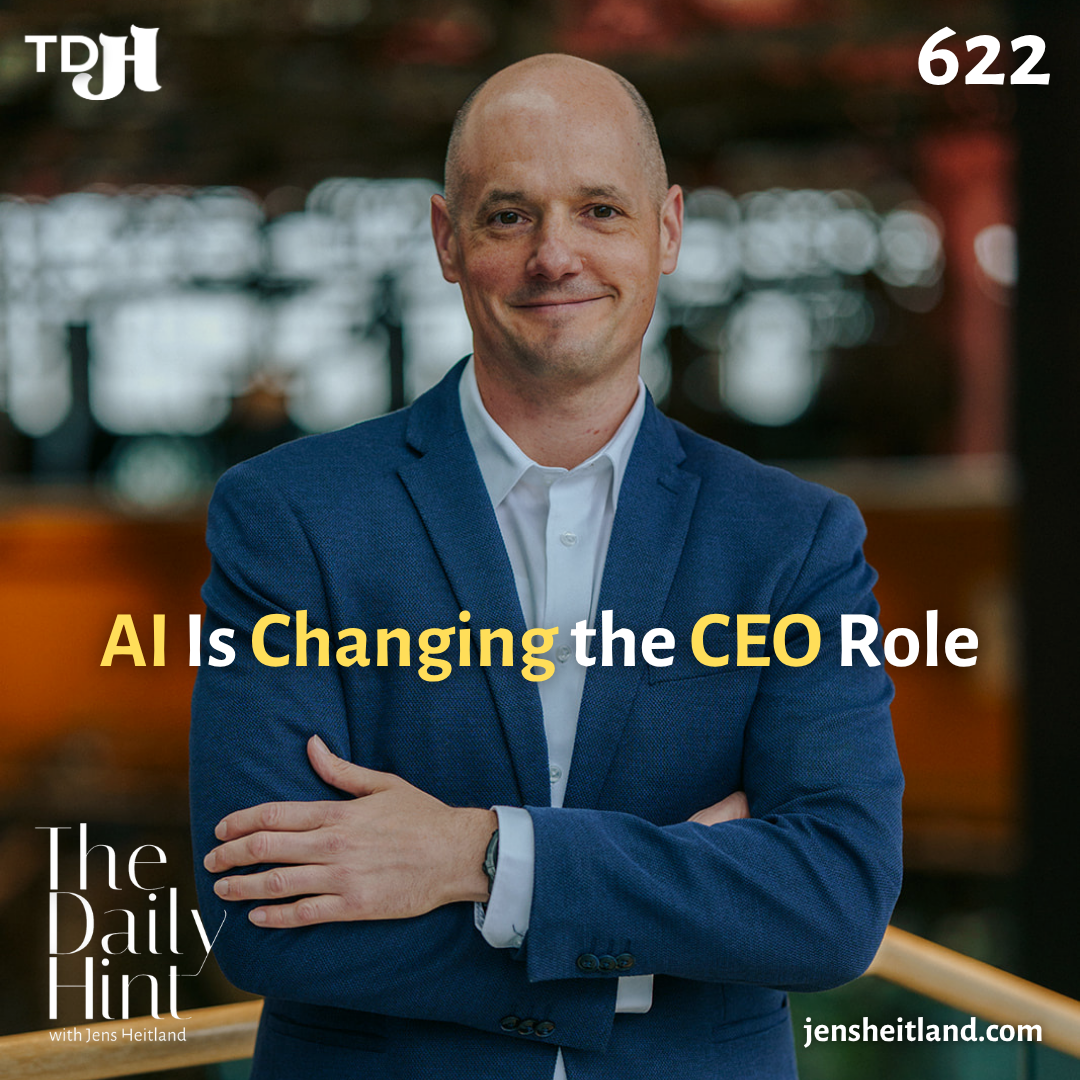
As AI reshapes organizations, the CEO's role is shifting from operator to visionary leader.
This episode explores why future CEOs will need to be more visible, more externally focused, and more central in representing the direction of the business.
Want to build your Personal Brand?
Join the free Rising Stars Community
Why AI Will Push CEOs Further Into the Role of Visionary and Public Leader
Artificial intelligence is no longer a side topic in business. It is beginning to reshape how organizations function, how decisions are made, and how work gets done across teams. While much of the discussion around AI focuses on productivity, automation, and efficiency, another shift is happening in parallel that deserves far more attention.
It is changing the CEO's role.
The vast majority of organizations today are still predominantly human organizations. Leadership structures, workflows, and decision-making models are still built around people managing people, with systems and tools supporting them. That model is now evolving. What is emerging instead is a more hybrid organization, where human talent is increasingly enabled by AI across core parts of the business.
This is not a small operational change. It has strategic consequences, and one of the clearest is that the CEO role becomes more externally significant.
The CEO Role Is Moving Beyond Traditional Management
For a long time, the CEO has been understood primarily as the person responsible for setting direction, managing performance, allocating resources, and leading the organization from the top. Those responsibilities do not disappear. But as AI takes on a greater role in enabling operations, analysis, and execution, the CEO’s attention is likely to shift.
The role becomes less focused on overseeing every layer of organizational mechanics and more on representing the company's future.
That representation matters internally and externally.
Within the business, the CEO is the person who helps employees understand where the company is headed in a time of rapid change. In periods of transformation, people do not only need systems and processes. They need orientation. They need clarity around what is changing, why it matters, and what the organization is building toward.
Outside the business, the CEO becomes an even more important signal to the market.
Why Visibility Becomes More Strategic
As organizations become more AI-enabled, many of the visible differences between companies may become less about internal capability alone and more about how clearly the company’s direction is understood from the outside.
This is where the CEO starts to play a different role.
In some organizations, this is already visible. The CEO is not only the executive leader behind the scenes. They are at the forefront. They are publicly visible. They serve as the first point of contact for the business. They help customers, investors, partners, and the broader market understand what the company stands for and where it is going.
That is not a communication preference. It is becoming a strategic function.
When technology shifts quickly, markets look for confidence, direction, and interpretive clarity. They want to know who is leading, what they believe, and how they see the future. In that environment, the CEO is not simply speaking on behalf of the company. The CEO is increasingly a factor in how the company is evaluated.
AI Raises the Value of Human Signal
There is an interesting tension in this moment. The more AI becomes embedded into the organization, the more valuable distinctly human leadership may become at the top.
That may sound counterintuitive at first, but it makes sense.
AI can help scale analysis, automate workflows, and increase speed across many functions. But it does not replace what stakeholders look for in a leader during uncertainty. People still want conviction. They still look for judgment. They still respond to someone who can connect capability with meaning.
Therefore, the CEO's role may become more visionary, not less.
The CEO becomes a translator between what the business is becoming internally and how that future is understood externally. That includes employees. It includes customers. It includes talent, investors, and partners. In many cases, it also includes the broader public.
The leader at the top becomes a visible reference point for what the company believes its future should be.
The Companies That Win Will Likely Understand This Early
Not every organization will respond to this shift in the same way. Some will continue to treat leadership visibility as optional or secondary. Others will recognize that as AI changes how businesses are built and run, the role of the CEO must also evolve with it.
The long-term winners will likely be the organizations that understand this early.
They will not only invest in AI as a means of operational advantage. They will also recognize the strategic value of a CEO who can articulate the business's direction with clarity, credibility, and consistency.
It does mean that being visible, being clear, and representing the future of the company will matter more than they used to.
In a more hybrid world, leadership becomes both more symbolic and more strategic.
Final Thought
AI is changing organizations rapidly, but one of the less discussed consequences is how it shifts the center of gravity for leadership itself.
As more of the organization becomes AI-enabled, the CEO role moves further toward vision, representation, and external trust-building. The leader at the top becomes more important in helping others understand not just what the business does, but where it is headed.
The future CEO may not simply be the person running the company.
They may increasingly be the person making the company understandable to the world.
Highlights:
00:00 AI Reshaping Organizations
00:15 From Human to Hybrid Teams
00:25 CEO as Visionary Face
00:40 Winning Long Term
Links:
===========================
Equipment and Software I Use for My Videos and Podcasts
Jens Equipment and Software overview:https://www.jensheitland.com/equipment
===========================
Books that I read and recommend.
My Book Recommendations: https://www.jensheitland.com/books
===========================
Here are the ways to work with me:
Speaking:https://www.jensheitland.com/speaking
Leadership Skills Assessment:https://www.wearesucceed.com/
===========================
Connect with me!
LinkedIn:https://www.linkedin.com/in/jensheitland/
Facebook:https://www.facebook.com/JensHeitlandofficial/
Instagram:https://www.instagram.com/jensheitland/
TikTok:https://www.tiktok.com/@jensheitland
X/Twitter:https://twitter.com/jensheitland
Newsletter:https://www.jensheitland.com/newsletter
===========================
Subscribe and Listen to The Jens Heitland Show Podcast HERE:
YT:https://www.youtube.com/channel/UCjuSGi1feauCNSER3IKuGWg
Web:https://www.jensheitland.com/podcasthome
Apple:https://podcasts.apple.com/us/podcast/the-jens-heitland-show-human-innovation/id1545043872?uo=4
Spotify:https://open.spotify.com/show/7H0GWMGVALyXnnmstYA1NL
===========================
Subscribe and Listen to The Daily Hint with Jens Heitland Podcast HERE:
YT:https://www.youtube.com/channel/UC2tLdutVh6b6nCBgWQ817eQ
Web:https://www.jensheitland.com/the-daily-hint
Apple:https://podcasts.apple.com/us/podcast/the-daily-hint-with-jens-heitland/id1722930497
Spotify:https://open.spotify.com/show/4T02uYPvcOrajPC6FgH64r?si=8aab1e7683204160&nd=1&dlsi=0f69c72af017454a
Transcript :
With all the things that are happening right now through ai, I believe the organizations are changing rapidly. So you have a CEO that is a leader of an organization right now is predominant human organizations. I think we will have hybrids of this where you have a lot of humans, they are working enabled by ai and that changes the role of the CEO
In the way that they're more going into the visionary and representing part of the business, which you see in some organizations already, that the CEOs at the forefront, the first salesperson and is very publicly visible. I think more and more that will be the case for the organizations that are going to win in the long term