
677 - The Real Work Behind Multilingual Podcasting
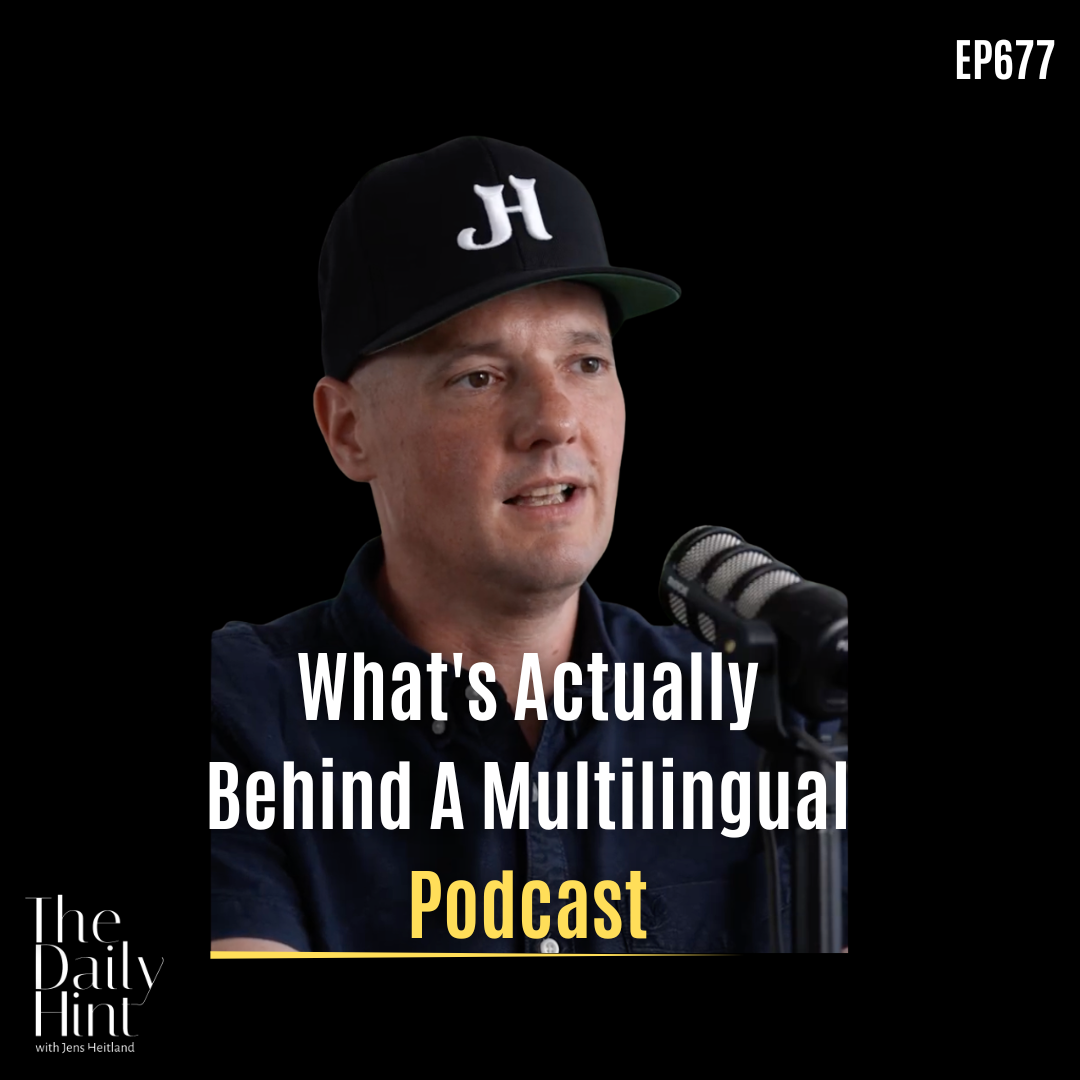
Recording podcasts across multiple languages starts with one requirement: the interviewer must be fluent in the conversation's language, not just functional. When Jens Heitland's team isn't conducting the interview directly, that fluency determines whether a conversation keeps its natural shape or loses momentum to translation delays.
This episode of The Daily Hint looks at what actually happens behind the scenes when a podcast production team works across several languages at once, and why the real challenge has little to do with vocabulary.
Want to build your Personal Brand?
Join the free Rising Stars Community
The Work Behind A Podcast In Several Languages
When a podcast is recorded in a language other than English, and we are not the ones conducting the interview, the person asking the questions has to be fluent in that language. Not conversational. Not assisted by notes. Fluent enough to follow a thought as it develops and to ask the next question before the guest has finished forming the last one. A conversation loses its shape the moment the interviewer is translating in their head while listening.
That requirement shapes how we build teams. With an international group of producers and editors, fluency is rarely the constraint. The constraint is something else entirely, and it shows up after the recording is finished.
Once the conversation exists, the work becomes understanding it. Not the words on the transcript, but the value sitting inside the exchange. Every guest says several things across an hour. Some of those things are texture. Some are the reason the episode exists. A team has to know the difference before it touches the material, because that judgment determines everything downstream: which lines become the hook, which moment becomes the thumbnail, which sentence carries the LinkedIn post.
When we prepare an episode as a team, this is where the real conversation happens, and it happens before a single asset is written. We talk through what the guest actually said, what a viewer with no context would take from it, and where the conversation's emotional or intellectual weight lives. That agreement becomes the reference point for everything that follows, across every language the episode is adapted into.
Adaptation is where the process gets tested. A phrase that lands cleanly in English can flatten in another language if translated word for word. The team member handling that language isn't just translating; they are re-finding the value in their own language, using whatever construction carries it best. This works only because the value was agreed on before translation started. Without that shared understanding, each language version drifts slightly from the others, and the episode stops being one piece of content with several versions and becomes several loosely related pieces instead.
The part we protect most closely is delivery across the full length of the video. It is easy to front-load the value, to put the strongest material in the first thirty seconds and let the rest coast. We try to avoid that. A viewer who stays until the end should find the same density of value they found at the start, whether they are watching in English, German, or Spanish.
None of this is difficult in the sense of requiring rare talent. It requires a team that agrees, early and explicitly, on what a conversation is actually about. Everything after that- the fluency, the translation, the pacing- follows from that agreement rather than compensating for its absence.
Highlights:
00:00 Multilingual Podcast Recording
00:06 Fluent Interviewers Matter
00:17 Adapting Production Across Languages
00:21 International Team Workflow
00:25 Capturing Conversation Value
00:36 Delivering Value Throughout
Links:
===========================
Equipment and Software I Use for My Videos and Podcasts
Jens Equipment and Software overview:https://www.jensheitland.com/equipment
===========================
Books that I read and recommend.
My Book Recommendations: https://www.jensheitland.com/books
===========================
Here are the ways to work with me:
Speaking:https://www.jensheitland.com/speaking
Leadership Skills Assessment:https://www.wearesucceed.com/
===========================
Connect with me!
LinkedIn:https://www.linkedin.com/in/jensheitland/
Facebook:https://www.facebook.com/JensHeitlandofficial/
Instagram:https://www.instagram.com/jensheitland/
TikTok:https://www.tiktok.com/@jensheitland
X/Twitter:https://twitter.com/jensheitland
Newsletter:https://www.jensheitland.com/newsletter
===========================
Subscribe and Listen to The Jens Heitland Show Podcast HERE:
YT:https://www.youtube.com/channel/UCjuSGi1feauCNSER3IKuGWg
Web:https://www.jensheitland.com/podcasthome
Apple:https://podcasts.apple.com/us/podcast/the-jens-heitland-show-human-innovation/id1545043872?uo=4
Spotify:https://open.spotify.com/show/7H0GWMGVALyXnnmstYA1NL
===========================
Subscribe and Listen to The Daily Hint with Jens Heitland Podcast HERE:
YT:https://www.youtube.com/channel/UC2tLdutVh6b6nCBgWQ817eQ
Web:https://www.jensheitland.com/the-daily-hint
Apple:https://podcasts.apple.com/us/podcast/the-daily-hint-with-jens-heitland/id1722930497
Spotify:https://open.spotify.com/show/4T02uYPvcOrajPC6FgH64r?si=8aab1e7683204160&nd=1&dlsi=0f69c72af017454a
Transcript :
When we record podcast for our clients, we have done that in several languages. And for us, a key part of that is that obviously the person that is interviewing, if we are not the part of the interviewing party, is speaking the language fluently. And then we can adapt the work that we do into many different languages.
That not that difficult with an international team that we have. It's all about understanding what the conversation is about and then understanding the value that needs to come across inside of that podcast conversation. And when we prepare that as a team, then we always focus on how do we deliver that throughout the whole video