
700 - Scripted Leaders Lose Their Audience
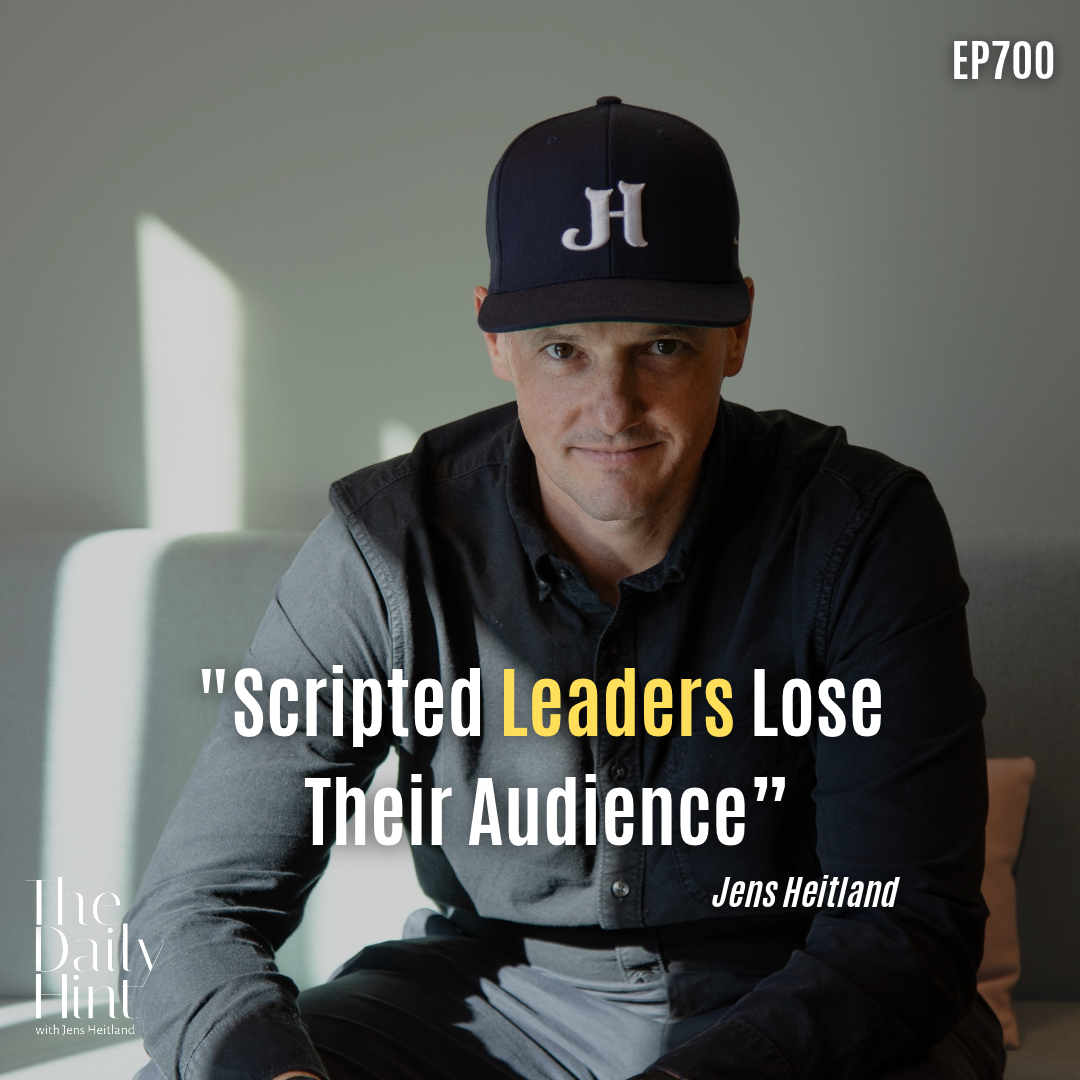
In this episode of The Daily Hint, Jens Heitland addresses a question many organizations face when launching a business podcast: whether the CEO or an executive should host it, or whether someone who communicates more fluently should.
Drawing on a recent example of a well-produced but teleprompter-driven CEO video, Jens explains why unscripted, long-form conversations build more trust and attract more listeners, and how a senior-led podcast becomes a communication engine that positions them in ways traditional marketing campaigns rarely can.
Want to build your Personal Brand?
Join the free Rising Stars Community
The Leader Behind the Microphone
In large organizations, the question of who should host a business podcast comes up again and again. The conversation tends to follow a familiar path. Someone suggests the CEO or a member of the executive team. Someone else points out that their calendars are already full, and that the communications team has people who speak more fluently. The decision usually lands on the safer option, and the executive steps away from the microphone.
The reasoning sounds practical. Executive time is scarce, and polished delivery feels like a sensible goal. Over time, though, the safer option tends to remove the one element listeners came for. People want to hear how the person at the top actually thinks.
Recently I watched a video from the CEO of a large home furnishing company. The production was excellent. The set was well designed, the lighting was careful, and the camera angles had clearly been considered. Everything around her was skillfully prepared. However, the words came from a teleprompter, and that showed in every sentence. The script carried the message while the person delivering it faded into the background.
Scripted formats place a quiet layer between a leader and the people listening. A teleprompter asks someone to perform their own thoughts as if they belonged to someone else. Viewers sense that distance quickly, even when they cannot name it. Trust forms in the small moments when a person searches for a word, changes direction, or responds to something unexpected.
A long-form conversation works differently. When an executive speaks with another person, there is no script to hold on to. The listener hears reasoning as it happens, along with hesitation, curiosity, and conviction. Audiences tend to grow when the voice at the center carries real decision-making weight, and trust follows because the listener can hear the person behind the title.
Another effect builds slowly. A regular podcast becomes a communication engine for its host. Each episode adds to a body of public thinking that marketing campaigns struggle to replicate. Campaigns describe a leader from the outside, while conversations allow people to meet that leader directly and form their own view.
The gap between the scripted video and a credible one was small. The same CEO, sitting across from an interviewer and answering real questions, would likely have come across in an entirely different way. The investment in set and camera was already there. What was missing was another person in the room. Organizations that recognize this tend to find that the voice they were protecting was the one their audience wanted to hear all along.
Highlights:
00:00 Who Should Host
00:19 Why Exec Hosts Win
00:47 Authenticity Beats Scripts
00:53 Teleprompter Fail Example
01:35 Fix With Interviews
Links:
===========================
Equipment and Software I Use for My Videos and Podcasts
Jens Equipment and Software overview:https://www.jensheitland.com/equipment
===========================
Books that I read and recommend.
My Book Recommendations: https://www.jensheitland.com/books
===========================
Here are the ways to work with me:
Speaking:https://www.jensheitland.com/speaking
Leadership Skills Assessment:https://www.wearesucceed.com/
===========================
Connect with me!
LinkedIn:https://www.linkedin.com/in/jensheitland/
Facebook:https://www.facebook.com/JensHeitlandofficial/
Instagram:https://www.instagram.com/jensheitland/
TikTok:https://www.tiktok.com/@jensheitland
X/Twitter:https://twitter.com/jensheitland
Newsletter:https://www.jensheitland.com/newsletter
===========================
Subscribe and Listen to The Jens Heitland Show Podcast HERE:
YT:https://www.youtube.com/channel/UCjuSGi1feauCNSER3IKuGWg
Web:https://www.jensheitland.com/podcasthome
Apple:https://podcasts.apple.com/us/podcast/the-jens-heitland-show-human-innovation/id1545043872?uo=4
Spotify:https://open.spotify.com/show/7H0GWMGVALyXnnmstYA1NL
===========================
Subscribe and Listen to The Daily Hint with Jens Heitland Podcast HERE:
YT:https://www.youtube.com/channel/UC2tLdutVh6b6nCBgWQ817eQ
Web:https://www.jensheitland.com/the-daily-hint
Apple:https://podcasts.apple.com/us/podcast/the-daily-hint-with-jens-heitland/id1722930497
Spotify:https://open.spotify.com/show/4T02uYPvcOrajPC6FgH64r?si=8aab1e7683204160&nd=1&dlsi=0f69c72af017454a
Transcript :
We often have the conversation when it comes to a business podcast, should the CEO or a executive leadership team member host the podcast? I personally think they should. A lot of organizations are saying, "Nah, we have someone who can communicate better," and so on, and they don't have the time anyhow. I personally still think the biggest leverage that you do if you have an executive team member, and best case, even the CEO doing a business podcast, the listeners will increase, number one, the trust will be higher, and on top of that is you're building a communication engine to position that person in a completely different way than you will ever be able to do with marketing campaigns. Because if you have long form conversations, they're not scripted. I've just seen it yesterday. It was CEO of, I think it was a furniture company or some home furnishing something company, Super scripted video of that person reading from the screen. It was terrible. The environment was good, the shooting was good, the camera angles were good,The background were good. But it was it was read from the teleprompter, and it was so bad because the person was not authentic, was acting as if they're reading, and it was terrible. And I think just posting this example as a huge company, I don't know how big they were, but I think it's quite big. It's so bad. A communication in a podcast setting of a real person to another real person will help a person like this person, it was a female in this case, to stand out completely different because it's not read from the screen and the authenticity did not come across. So they could have done just a tiny tweak by having an interview setting where the person is not just reading from a teleprompter, and it would be hugely different.