
692 - Measuring Thought Leadership in Revenue
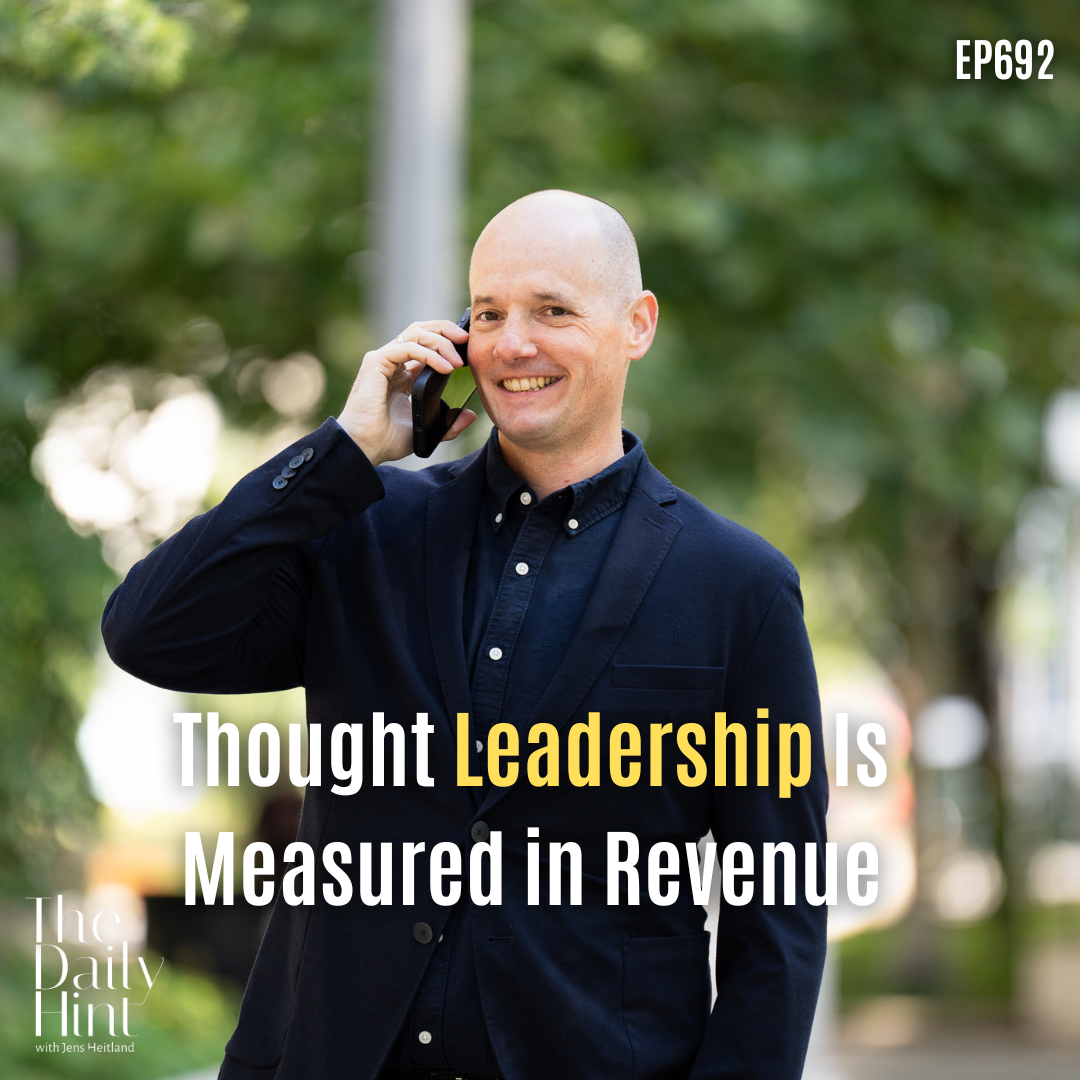
In this Daily Hint, Jens Heitland reflects on how thought leadership is measured inside organizations, looking beyond likes, reach and social media metrics toward the relationships and revenue it creates for the company, why programs built around representation and marketing activity are often the first to be cut when costs come under pressure, and how thought leadership designed as a business system tends to grow alongside company profit over time.
Want to build your Personal Brand?
Join the free Rising Stars Community
Measuring Thought Leadership in Revenue
In large organizations, thought leadership often begins inside marketing. It gets a budget line, a content calendar, and metrics that are easy to report. Reach, impressions, followers, and engagement rates move upward on a dashboard, and for a while that movement feels like progress. Over time, the program becomes associated with visibility rather than with the business itself.
In my experience, the question that decides these programs' future is rarely asked at the start. It arrives later, usually in a budget review, when someone responsible for the numbers looks at every line and asks what each one returns. A program measured in likes has very little to say in that room. The figures are real, yet they do not connect to anything the finance function recognizes as value.
What happens next is predictable. When costs come under pressure, the first to be reduced are the activities closest to representation and furthest from revenue. The decision is rarely personal, and it is rarely about the quality of the content. It follows the system's logic. Anything that cannot show its contribution to the business becomes discretionary, and reductions begin there.
The consequences go beyond a paused campaign. Years of effort disappear with the budget line. The audience that was built loses its rhythm, the executive who carried the voice loses momentum, and the organization concludes that thought leadership did not work. In reality, the work was measured against the wrong outcome from the beginning.
A different pattern emerges in organizations that build thought leadership as a business system. There, the dashboard looks at relationships. It tracks which conversations started because a leader shared a perspective, which of those developed into trust, and which eventually became partnerships, clients or revenue. Success is measured by the quality and number of relationships the program creates and how directly they connect to company results.
When a program is set up this way, its position inside the organization changes. It stops competing with other marketing expenses and sits alongside the activities that generate growth. Over time, it grows with the company and with its profit. A finance leader reviewing that line sees a contributor to the business, and contributors tend to be protected when budgets tighten.
None of this requires unusual complexity. The mechanics are well understood today, and the tools exist to connect visibility with relationships and relationships with revenue. What is often missing is the decision to design the program as an engine from the start, with the business outcome at its center. Many organizations have the ingredients and leave them unconnected. The programs that last are the ones built to be measured in the same language as the rest of the company.
Highlights:
00:00 Revenue First Metrics
00:16 Relationships Drive Results
00:29 Why Marketing Fails
00:40 Cost Cutting Reality
00:49 Build a Growth Engine
01:03 Make It Sustainable
Links:
===========================
Equipment and Software I Use for My Videos and Podcasts
Jens Equipment and Software overview:https://www.jensheitland.com/equipment
===========================
Books that I read and recommend.
My Book Recommendations: https://www.jensheitland.com/books
===========================
Here are the ways to work with me:
Speaking:https://www.jensheitland.com/speaking
Leadership Skills Assessment:https://www.wearesucceed.com/
===========================
Connect with me!
LinkedIn:https://www.linkedin.com/in/jensheitland/
Facebook:https://www.facebook.com/JensHeitlandofficial/
Instagram:https://www.instagram.com/jensheitland/
TikTok:https://www.tiktok.com/@jensheitland
X/Twitter:https://twitter.com/jensheitland
Newsletter:https://www.jensheitland.com/newsletter
===========================
Subscribe and Listen to The Jens Heitland Show Podcast HERE:
YT:https://www.youtube.com/channel/UCjuSGi1feauCNSER3IKuGWg
Web:https://www.jensheitland.com/podcasthome
Apple:https://podcasts.apple.com/us/podcast/the-jens-heitland-show-human-innovation/id1545043872?uo=4
Spotify:https://open.spotify.com/show/7H0GWMGVALyXnnmstYA1NL
===========================
Subscribe and Listen to The Daily Hint with Jens Heitland Podcast HERE:
YT:https://www.youtube.com/channel/UC2tLdutVh6b6nCBgWQ817eQ
Web:https://www.jensheitland.com/the-daily-hint
Apple:https://podcasts.apple.com/us/podcast/the-daily-hint-with-jens-heitland/id1722930497
Spotify:https://open.spotify.com/show/4T02uYPvcOrajPC6FgH64r?si=8aab1e7683204160&nd=1&dlsi=0f69c72af017454a
Transcript :
When we look at the dashboard of how do you measure thought leadership, it's all about business, business, business. And what I mean with that is how much did you increase the revenue through thought leadership? It's not about how many likes you have, it's not about any social media stuff, it's all about how many relationships have you built that really drive business results into the company. And any thought leadership program that is just focusing on representation and focusing on marketing efforts is not going to succeed long term. As soon as the company is cutting costs, that's the one you cut. And then every effort that you have put in before is going to be gone. If you built it that it's driving company success, it's driving revenue, which is all possible these days, then it's going to grow the company and grow the profit with it, and then no CFO will ever cut it. And that's just something to understand how you set it up, how do you build a system, and how do you build an engine that is really cranking it up over time and that's not that difficult, but a lot of organizations don't leverage it.