
646- Made Redundant in Three Days: What Forced Change Actually Teaches You
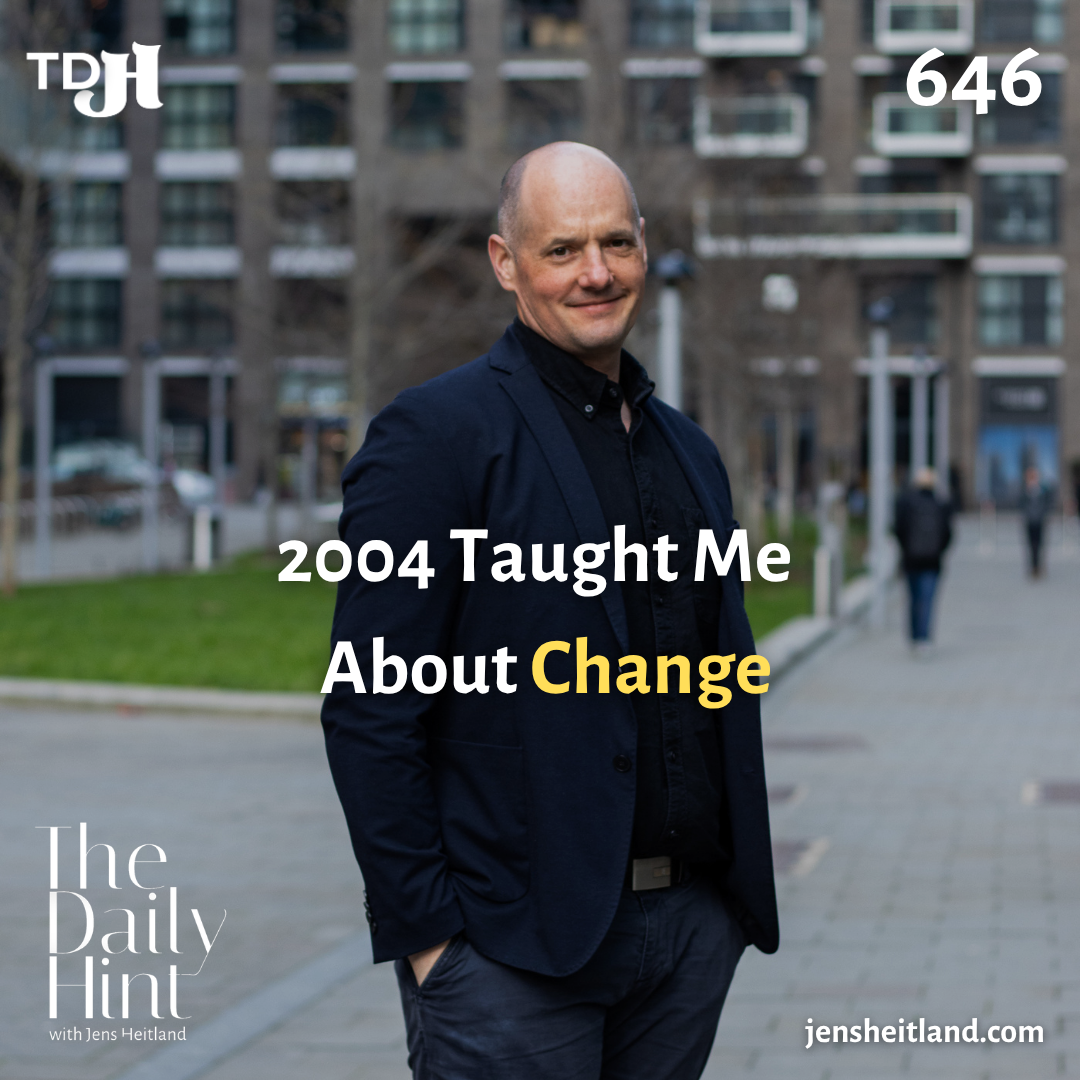
Forced change arrives without warning and rarely at the right time.
Jens Heitland reflects on being made redundant in 2004 and what that experience revealed about the pattern most people recognize only in hindsight: the next step was always available, the difficulty was in seeing it as yours to take.
Want to build your Personal Brand?
Join the free Rising Stars Community
Made Redundant in Three Days: What Forced Change Actually Teaches You
Forced change does not feel like an opportunity when it arrives.
There is a version of change that is chosen. A decision made with time, with intention, with some sense of where things are heading. That version is manageable. What is harder is the change that comes from the outside, the kind no one scheduled and no one wanted.
In 2004, I was made redundant. The construction industry in Germany was struggling at the time, and I was called into the company owner's office and told I had a month. That was the conversation. I had gone into that role thinking it was long-term, the way people still thought about careers in the late nineties and early 2000s. A place you could see yourself staying in for decades. So when it ended that way, it did not just feel like a job loss. It felt like a structure collapsing.
The rest of that day was difficult. The weekend was worse. There was a period of sitting with something that felt genuinely disorienting, and no part of that period felt productive or purposeful. It just felt like a loss.
And then something shifted.
Three days later, I had another job.
What I took from that experience was not a lesson about resilience in the abstract. It was something more specific. The moment I stopped reacting to what had happened and started moving, things changed. The external force had pushed, but what happened next was mine to decide. That distinction between what arrives from outside and what gets decided from inside turned out to be one of the more durable things I carried forward in my career.
What tends to happen with forced change is that the difficulty is real and temporary, in a way that is impossible to see from inside it. The curve exists. The period of struggle is part of the pattern, not a sign that the pattern has broken. What makes the difference is not the absence of the hard period. It is how quickly a person recognizes that they are still in the driver's seat.
This is rarely something people believe when they are in the middle of it. The external push feels total. It can feel as if something has been done to you that deprives you of the ability to act. The job disappears, the structure changes, the plan no longer applies. In that space, the instinct is to wait for something external to resolve it, just as it was caused.
Over time, I have come to see that the action has always been available. The difficulty was in seeing it.
The careers that tend to move through change well are not the ones that avoid hard transitions. They are the ones where the person eventually understood that the transition was theirs to navigate. Not because the external force was fair or expected or well-timed. Because the alternative, waiting for external conditions to restore what was lost, rarely leads anywhere useful.
Everyone carries a version of this experience. The specifics are different. The shape of the curve tends to be the same.
Highlights:
00:00 Why Change Feels Hard
00:09 External Change Curve
00:26 Redundancy Story 2004
01:05 Turning Point Mindset
01:17 Take the Driver Seat
01:26 Closing Thoughts on Change
Links:
===========================
Equipment and Software I Use for My Videos and Podcasts
Jens Equipment and Software overview:https://www.jensheitland.com/equipment
===========================
Books that I read and recommend.
My Book Recommendations: https://www.jensheitland.com/books
===========================
Here are the ways to work with me:
Speaking:https://www.jensheitland.com/speaking
Leadership Skills Assessment:https://www.wearesucceed.com/
===========================
Connect with me!
LinkedIn:https://www.linkedin.com/in/jensheitland/
Facebook:https://www.facebook.com/JensHeitlandofficial/
Instagram:https://www.instagram.com/jensheitland/
TikTok:https://www.tiktok.com/@jensheitland
X/Twitter:https://twitter.com/jensheitland
Newsletter:https://www.jensheitland.com/newsletter
===========================
Subscribe and Listen to The Jens Heitland Show Podcast HERE:
YT:https://www.youtube.com/channel/UCjuSGi1feauCNSER3IKuGWg
Web:https://www.jensheitland.com/podcasthome
Apple:https://podcasts.apple.com/us/podcast/the-jens-heitland-show-human-innovation/id1545043872?uo=4
Spotify:https://open.spotify.com/show/7H0GWMGVALyXnnmstYA1NL
===========================
Subscribe and Listen to The Daily Hint with Jens Heitland Podcast HERE:
YT:https://www.youtube.com/channel/UC2tLdutVh6b6nCBgWQ817eQ
Web:https://www.jensheitland.com/the-daily-hint
Apple:https://podcasts.apple.com/us/podcast/the-daily-hint-with-jens-heitland/id1722930497
Spotify:https://open.spotify.com/show/4T02uYPvcOrajPC6FgH64r?si=8aab1e7683204160&nd=1&dlsi=0f69c72af017454a
Transcript :
The thing with change is always difficult, especially when it's from external force change. Obviously, it's always easy when you decide to change and you do something. But when we are getting the change forced on us from an external perspective, then it's always going to be difficult and struggle, but what I've learned over my career is like a curve. So the thing was, I give you just one example. In, I think it was around 2004, I was made redundant because the industry in construction in Germany at that time was really bad and I was asked to come into the office of the owner of the company, and then he told me basically that I will be made redundant. I have a month to go and and so on. was obviously not, not very happy about that decision, for me, a whole world broke down because I was thinking at that time, "I'm going to retire in this company," like it was in the, like, late '90s, early 2000s still. Today, it's completely different, but what I learned from that was that I was very negative the whole day and obviously the weekend, but then I got my things together and had another job in three days. That's a learning that I took with me that I am in the driver's seat of everything in my life, I just need to take decisions and get there. And that's what I took with me from that change, and I believe everyone has similar examples of change, it's just always difficult in that moment or in the time period when you get the external push to change