
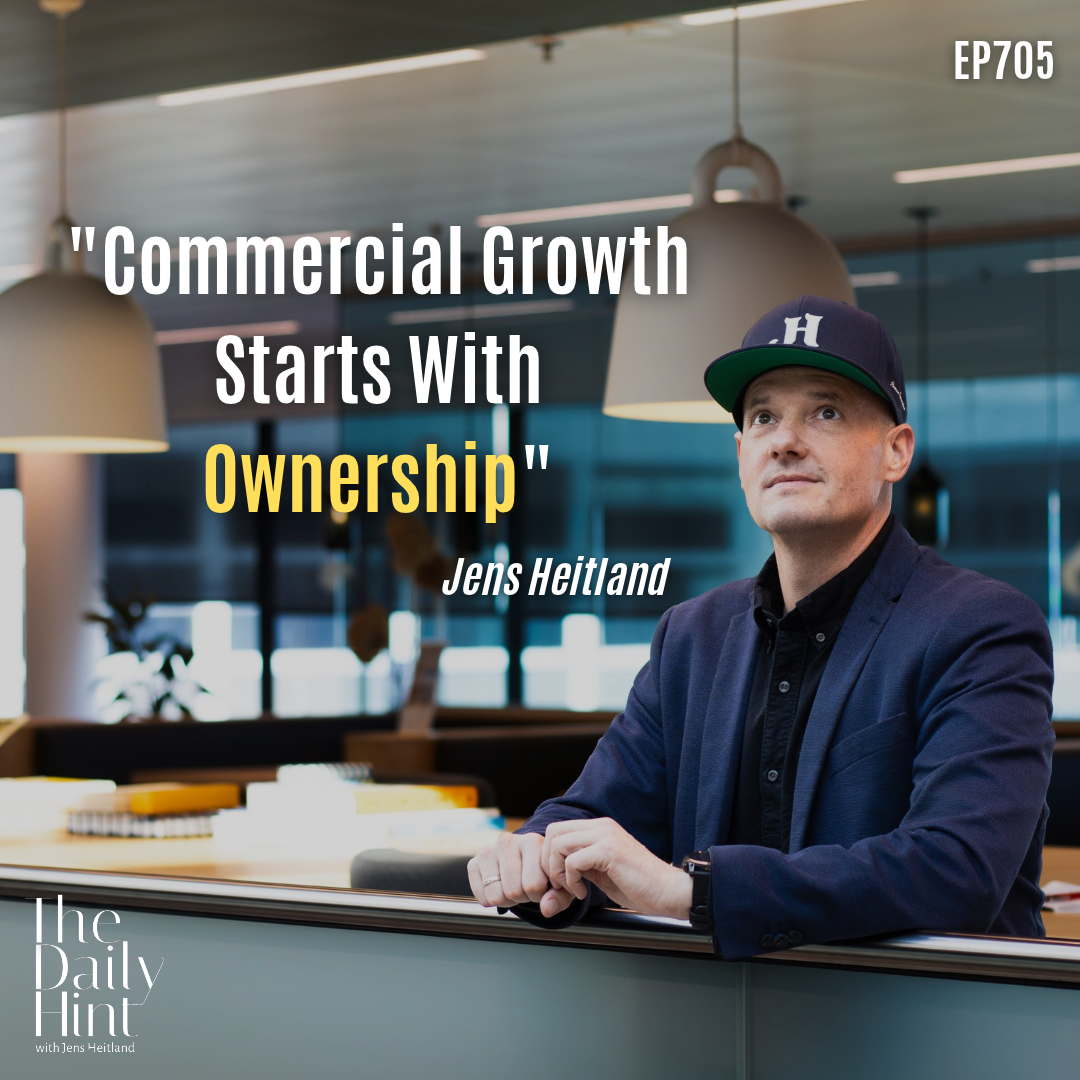
In this Daily Hint, Jens Heitland examines a company's commercial engine and why it works only when every part has a clear owner. Drawing on nearly thirty years inside large European organizations, he explains why responsibility for attracting customers and building relationships often becomes unclear in companies of five hundred people or more, and why that responsibility reaches all the way to the CEO. Jens describes how the CEO’s commercial role, from representing a product campaign on social media to speaking on stage with another CEO, works best when it is part of a strategy linked to clear responsibilities and accountability
Want to build your Thought Leadership
The CEO’s Place in the Commercial Engine
Every organization has a commercial engine, whether anyone calls it that or not. It is the way a company attracts customers, clients or partners, and the way those first contacts grow into lasting relationships. In smaller companies, that engine is usually visible. The founder usually sells and speaks for the company, so it is clear who carries each part of the work.
As organizations grow, that clarity tends to fade. In companies of five hundred people or more, I have seen the commercial engine spread across departments without a clear owner for each part. Marketing runs campaigns, communication manages the message, and sales handles the conversations. Each team does its work, yet nobody is responsible for how the pieces connect.
A useful way to look at this is through the idea of a funnel. People are attracted to the organization; they enter different kinds of relationships with it, and some of them become customers. Each stage of that movement needs someone responsible for it and someone who acts on that responsibility. When a stage has no owner, the movement slows down, and the gaps between teams start to show in ways customers notice.
The least-noticed part of this picture is the CEO's role. In many large organizations, the CEO is seen as someone who oversees the commercial engine from a distance. The structure is designed around departments, and the CEO sits above them. In practice, the CEO is often one of the company's most visible assets, and that visibility is rarely planned.
Consider a marketing campaign for a specific product. The CEO can represent that campaign on social media, talk about it in an interview, or discuss it on stage with another CEO. Each of these moments carries weight because people tend to trust a leader who stands behind the work. Without a plan, those moments remain occasional appearances. As part of a strategy, they become a steady part of how the organization attracts attention and builds relationships.
Over time, the difference becomes clear. Organizations where the CEO’s commercial role is defined tend to show more consistency in how they present themselves. The message on stage matches the message in the campaign, and the people inside the company understand where their own responsibility begins and ends. Where that role is left open, the CEO’s presence depends on chance, and the commercial engine runs with one of its strongest parts disconnected.
At board level, the conversation often stays with whether the organization has marketing, communication, and sales in place. Those functions are almost always there. The more important conversation is who owns each piece of the funnel, including the pieces the CEO carries personally.
What I have seen repeatedly is that commercial strength in large organizations follows ownership. When responsibility and accountability are clear at every level, including at the top, the engine tends to work as one system, and each team's effort adds up to lasting growth.
Highlights:
00:00 Commercial Engine Basics
00:18 Ownership and Accountability
00:41 Scaling in Big Organizations
01:05 CEO Role in Marketing
01:29 Strategy and Responsibility Links
Links:
===========================
Equipment and Software I Use for My Videos and Podcasts
Jens Equipment and Software overview:https://www.jensheitland.com/equipment
===========================
Books that I read and recommend.
My Book Recommendations: https://www.jensheitland.com/books
===========================
Here are the ways to work with me:
Speaking:https://www.jensheitland.com/speaking
Leadership Skills Assessment:https://www.wearesucceed.com/
===========================
Connect with me!
LinkedIn:https://www.linkedin.com/in/jensheitland/
Facebook:https://www.facebook.com/JensHeitlandofficial/
Instagram:https://www.instagram.com/jensheitland/
TikTok:https://www.tiktok.com/@jensheitland
X/Twitter:https://twitter.com/jensheitland
Newsletter:https://www.jensheitland.com/newsletter
===========================
Subscribe and Listen to The Jens Heitland Show Podcast HERE:
YT:https://www.youtube.com/channel/UCjuSGi1feauCNSER3IKuGWg
Web:https://www.jensheitland.com/podcasthome
Apple:https://podcasts.apple.com/us/podcast/the-jens-heitland-show-human-innovation/id1545043872?uo=4
Spotify:https://open.spotify.com/show/7H0GWMGVALyXnnmstYA1NL
===========================
Subscribe and Listen to The Daily Hint with Jens Heitland Podcast HERE:
YT:https://www.youtube.com/channel/UC2tLdutVh6b6nCBgWQ817eQ
Web:https://www.jensheitland.com/the-daily-hint
Apple:https://podcasts.apple.com/us/podcast/the-daily-hint-with-jens-heitland/id1722930497
Spotify:https://open.spotify.com/show/4T02uYPvcOrajPC6FgH64r?si=8aab1e7683204160&nd=1&dlsi=0f69c72af017454a
Transcript :
If we talk about the commercial engine of a company, it always starts with how do you attract more customers, clients, whatever you go for into the business. And if you don't have ownerships in these different pieces as a commercial engine, it's not going to work. And that's super, super clear when you have, let's call it a funnel, where you attract certain people that get into the different relationship angles of the organization. But if you don't have that, if you don't have a specific person being responsible and then acting in that way as well, it's not going to work. And if we look at large organization, it's not there. Even if you have, let's say, a size of five hundred people plus, it's required of the CEO and the commercial team to have that divided even on top level who is responsible for which piece of that funnel. And I'm not talking about, hey, we have marketing and we have communication and we have sales or whatever it is. I think it's really looking into how does the CEO play a role in the commercial activities that are detailed happening right now, and that can be a marketing campaign of a specific product. How does the CEO step up and is representing that marketing campaign in a social media context as one of the many examples, or on stage in a conversation with another CEO? It's really all of that needs to be a strategy and linked to responsibilities and accountability.