586 - CEO Thought Leadership Is About Framing the Future, Not Predicting It
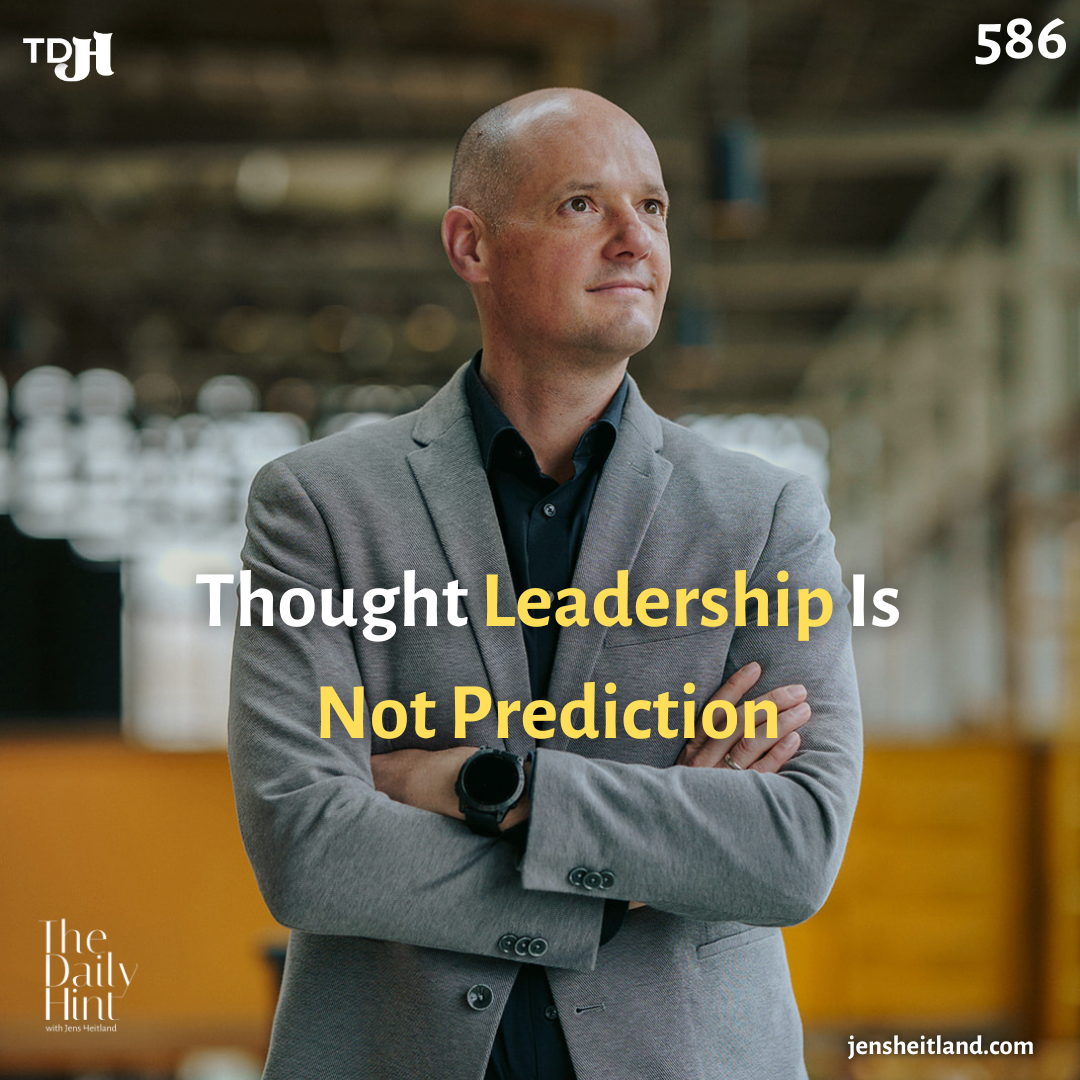
CEO thought leadership is not about predicting what comes next.
This episode of The Daily Hint explores how effective CEOs frame future trends through present action, creating clarity, trust, and relevance inside complex systems.
Want to build your Personal Brand?
Join the free Rising Stars Community
CEO Thought Leadership Is About Framing the Future, Not Predicting It
In many organizations, CEO thought leadership is expected to answer one question.
What is coming next?
This expectation places leaders in an uncomfortable role. They are asked to predict outcomes in systems defined by uncertainty, complexity, and shifting forces.
Over time, this pressure distorts the role of thought leadership.
At scale, effective CEO thought leadership does something quieter and more durable.
It frames.
The Difference Between Prediction and Framing
Prediction attempts certainty.
Framing creates orientation.
When CEOs focus on prediction, communication becomes fragile. Messages are tied to forecasts, assumptions, and timelines that rarely hold. When those predictions change, credibility erodes quietly.
Framing works differently.
Framing takes emerging signals and places them into context. It does not claim to know exactly what will happen. It explains what matters, why it matters, and how the organization is already responding.
This distinction changes how leadership is perceived.
How Trends Lose Meaning Inside Organizations
Most industries generate an endless stream of trends. New technologies. New behaviors. New risks. New opportunities.
What tends to happen is predictable.
Trends are named. Futures are referenced. Language becomes abstract.
Without translation, meaning thins out.
When trends are discussed without connection to current action, people fill the gaps. Interpretation hardens. The gap between leadership communication and operational reality is widening.
This is rarely intentional. It is a system effect.
Framing Connects the Future to the Present
What I have seen repeatedly is that effective CEO thought leadership begins by breaking trends apart.
Not to simplify them, but to understand their commercial and organizational relevance.
Which parts of this trend actually affect how the business operates? Where does it create pressure? Where does it create leverage?
Once that connection is made, the future becomes tangible.
The CEO is no longer describing what might happen in the future. They are explaining what is already changing today.
This is where framing replaces prediction.
Why Framing Builds Trust
Trust inside complex systems does not come from certainty. It comes from coherence.
When CEOs frame the future through present action, communication feels grounded. People understand how the organization is thinking, not merely what it expects.
This creates predictability.
Not the predictability of outcomes, but the predictability of leadership behavior.
Over time, this consistency becomes a stabilizing force. It reduces noise. It lowers interpretation. It strengthens alignment between the person and the organization.
Thought Leadership as Orientation, Not Performance
CEO thought leadership is often treated as a performance. Strong opinions. Bold statements. Confident forecasts.
At scale, this approach rarely holds.
The leaders who endure are not those who claim to see the future clearly. They are those who help others understand how the organization is navigating present-day uncertainty.
This orientation creates credibility that does not depend on being right. It depends on being understandable.
The Quiet Advantage of Framing
When thought leadership is framed rather than predicted, something subtle happens.
The business feels prepared. The CEO feels anchored. The message feels human.
Commercial confidence follows, not because of persuasion, but because clarity reduces friction in trust.
This is the quiet advantage of CEO thought leadership done well.
Not a prediction.Framing.
And over time, that difference compounds.
Highlights:
00:00 Introduction to CEO Thought Leadership
00:05 Building a Thought Leadership Strategy
00:23 Formulating Future-Oriented Strategies
00:25 The Importance of Thought Leadership for CEOs
Links:
===========================
Equipment and Software I Use for My Videos and Podcasts
Jens Equipment and Software overview: https://www.jensheitland.com/equipment
===========================
Books that I read and recommend.
My Book Recommendations: https://www.jensheitland.com/books
===========================
Here are the ways to work with me:
Speaking: https://www.jensheitland.com/speaking
Leadership Skills Assessment: https://www.wearesucceed.com/
===========================
Connect with me!
LinkedIn: https://www.linkedin.com/in/jensheitland/
Facebook: https://www.facebook.com/JensHeitlandofficial/
Instagram: https://www.instagram.com/jensheitland/
TikTok: https://www.tiktok.com/@jensheitland
X/Twitter: https://twitter.com/jensheitland
Newsletter: https://www.jensheitland.com/newsletter
===========================
Subscribe and Listen to The Jens Heitland Show Podcast HERE:
YT: https://www.youtube.com/channel/UCjuSGi1feauCNSER3IKuGWg
Web: https://www.jensheitland.com/podcasthome
Apple: https://podcasts.apple.com/us/podcast/the-jens-heitland-show-human-innovation/id1545043872?uo=4
Spotify: https://open.spotify.com/show/7H0GWMGVALyXnnmstYA1NL
===========================
Subscribe and Listen to The Daily Hint with Jens Heitland Podcast HERE:
YT: https://www.youtube.com/channel/UC2tLdutVh6b6nCBgWQ817eQ
Web: https://www.jensheitland.com/the-daily-hint
Apple: https://podcasts.apple.com/us/podcast/the-daily-hint-with-jens-heitland/id1722930497
Spotify: https://open.spotify.com/show/4T02uYPvcOrajPC6FgH64r?si=8aab1e7683204160&nd=1&dlsi=0f69c72af017454a
Transcript:
CEO thought leadership is not about predicting the future, it's about framing it. When we built a CEO of thought leadership strategy, what we look into is what are the different industry trends, and then we take them apart and then look into what are commercial components where the organization can utilize that industry trends to position themselves as a leader in the industry.
And then what we do with the CEO. We formulate specific strategies that we translate future point of use in today's time, so that when this CEO communicates, they explain things that happening in the future, but how they tackle them today, a third leadership strategy is not that difficult, and every CEO should have one.