
EP242: The Quiet Cost of Unstructured Hiring
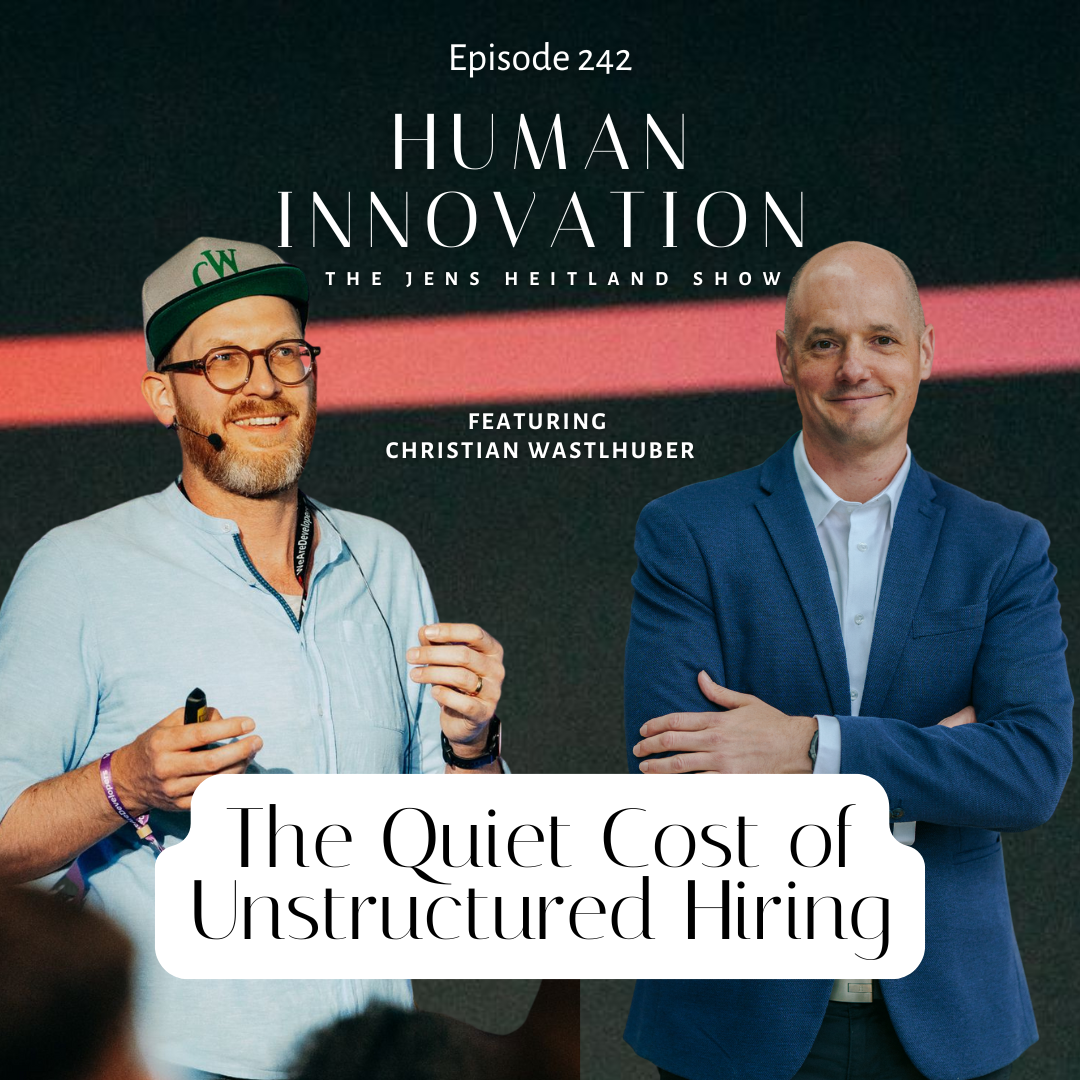
A calm look at why hiring becomes slow and biased without structure.
This episode explores data-driven recruitment, role intake discipline, comparable interviews, fast evaluation rhythms, and why the human factor remains central even as AI enters the process.
Youtube Podcasts
In this episode, I spoke with Christian Wastlhuber about recruitment as a human system, not an administrative one. Christian brings an unusual perspective shaped by his background in Egyptology and years spent inside complex organizations, observing how hiring decisions actually form.
We explore why unstructured processes slowly replace clarity with interpretation, and what happens when judgment relies on memory, instinct, and delay. The conversation looks at data-driven recruitment beyond dashboards, focusing instead on role clarity, comparable interviews, ownership, and the quiet consequences that emerge when structure is missing.
This is a reflective look at judgment, systems, and why small shifts in hiring rhythm can change outcomes over time.
Data-driven recruitment and the quiet cost of unstructured hiring
In large organizations, hiring rarely fails loudly. It fails quietly.
A role stays open longer than expected. Interview rounds multiply. Stakeholders repeat questions in different rooms. Notes arrive days later, then get treated as the truth. The candidate experiences inconsistency and interprets it as uncertainty. The business experiences a delay and calls it “the market.”
This is not usually intentional. It is a pattern that appears when no one owns the system.
Recruitment is often framed as a set of tasks. Scheduling. Sourcing. Interview logistics. Offer management. The work gets done, but the process does not hold. And without a process that holds decisions, they drift toward familiarity.
Over time, gut feeling becomes the dominant metric.
Not because leaders are careless, but because unstructured systems force people to decide with what they have. Memory. Impression. Story.
The system behind “gut feeling.”
In the conversation, Christian Wastlhuber describes a shift that many executives recognize. Early recruiting decisions were often made based on instinct. The hires were “fine.” Competent. Acceptable. But exceptional talent was rare.
That is a telling outcome. Gut feeling does not typically select for excellence. It selects for resemblance.
When the process lacks structure, the mind fills the gaps. People compare candidates against one another rather than each candidate against the role. The strongest narrative wins, not the clearest match. And the clearest match exists only when the role is defined with discipline.
The issue is not judgment. It is the environment judgment that is forced to operate within.
A structured process does not remove human decision-making. It gives it better ground.
Data is not just numbers
Data-driven recruitment is often misunderstood as being limited to dashboards and funnel metrics. Those matters. Time in stage. Conversion rates. Offer acceptance. They reveal friction and predict capacity. But Christian highlights a deeper form of data that most companies overlook.
Qualitative data.
Consistently captured interview answers are mapped to a defined role scope and evaluated against shared criteria. This is where objectivity becomes practical. Not perfect. Practical.
To get there, the process needs two elements that are often missing:
• A proper intake meeting that defines the role in its entirety
• A consistent interview and evaluation methodology
The intake is not a formality. It is where alignment is created.
What does success look like in the first 6 to 12 months?
What are the non-negotiable skills?
What collaboration style best strengthens the existing team?
What does the business actually need, beyond a job title?
Without this, the interview cannot be designed to test reality. It tests the assumption.
Comparable interviews reduce bias
A simple but uncomfortable observation sits at the center of this episode. If interviewers ask different questions, they cannot compare candidates. They compare impressions.
That is where bias becomes structural.
Christian describes a disciplined alternative. Use the same questions and the same case for all candidates in the same role. Create categories for evaluation. Write down findings in a structured way. And close the evaluation quickly, while recall is still intact.
One detail stands out because it is so operational. If interview feedback is not written down within an hour, a large portion of the conversation is already gone. After a day, candidates blur into each other. The organization thinks it is being thorough, but it is becoming less accurate.
Distance grows, then interpretation hardens.
Ownership matters more than volume
Another recurring pattern appears in many companies. The business believes recruiting “owns hiring.” Recruiting believes the hiring manager “owns hiring.” Responsibility becomes ambiguous, slowing the process.
Christian’s distinction is clean.
Recruitment owns the process.
The hiring manager owns the hiring decision.
This separation is not political. It is functional.
When talent acquisition owns the process, it can design the sequence, reduce duplication, enforce timelines, and protect candidate experience. When the hiring manager owns the decision, accountability remains with the leader who will live with the outcome.
This is rarely how organizations behave by default. But it is how high-trust systems behave.
The real cost is not the open role
Executives often ask for a number. What does it cost to hire wrong?
Christian points to a common benchmark: a failed hire can reach several multiples of the annual salary once lost productivity, replacement effort, and team disruption are included. The precise multiple varies by role and context. The more useful point is what it reveals.
The cost is not the mistake. The cost is the ripple.
When a bad hire exits, work redistributes. Stress rises. Sickness increases. Attrition risk spreads. The organization pays twice, then pays again in morale.
This is why data-driven recruitment is not an HR improvement initiative. It is an operating system choice.
AI will automate, but it will not replace judgment
The episode also touches on the future of recruiting. Christian’s view is unfashionable in a good way. He sees a strong human factor remaining.
Technology will automate scheduling, coordination, and parts of the sourcing process. It will help smooth the process. But defining roles, interviewing, and evaluating people are still subject to bias and false certainty when outsourced to tools. In Europe, regulations such as the EU AI Act add pressure to remain human-centered and deliberate.
The point is not fear. It is clarity.
Tools can increase speed. They do not create alignment.
A final reflection
Recruitment is often treated as a service function. At scale, it behaves more like infrastructure.
When the infrastructure is unstructured, every leader improvises. Every interviewer asks what matters to them. Every candidate experiences a different company. The business calls it inconsistency. Candidates call it culture.
Once the infrastructure is in place, the process stabilizes. Comparable. Predictable. And decisions become easier to defend, especially at the CEO level, where proof matters and narrative alone does not.
Working inside large organizations taught me that the most expensive hiring problems are rarely dramatic. They are the quiet ones who repeat.
Over time, systems either learn or they calcify.
And recruiting is one of the few places where a small change in rhythm can alter the entire organization’s future.
Guest Links:
LinkedIn: https://www.linkedin.com/in/christian-wastlhuber/
Business: https://www.unleashppl.com/de
Jens Heitland Links:
Website: https://www.jensheitland.com/
Business: https://www.heitlandmediagroup.com/
LinkedIn:https://www.linkedin.com/in/jensheitland/
Facebook:https://www.facebook.com/JensHeitlandofficial/
Instagram:https://www.instagram.com/jensheitland/
TikTok:https://www.tiktok.com/@jensheitland
X/Twitter:https://twitter.com/jensheitland
Newsletter:https://www.jensheitland.com/newsletter
YouTube:https://www.youtube.com/@jens-heitland
Subscribe and listen to The Jens Heitland Show Podcast here:
YT:https://www.youtube.com/channel/UCjuSGi1feauCNSER3IKuGWg
Web:https://www.jensheitland.com/podcasthome
Apple:https://podcasts.apple.com/us/podcast/the-jens-heitland-show-human-innovation/id1545043872?uo=4
Spotify:https://open.spotify.com/show/7H0GWMGVALyXnnmstYA1NL
Transcript:
Christian, welcome to the Human Innovation Podcast, the Inside Line Show. Awesome to have you and awesome to have a fellow German.
Yeah, so really looking forward to have an awesome conversation with you. For everyone that is joining us live, if you have questions around the topic of recruitment, Christian is the expert in. The German speaking, and most probably as well global market, uh, when it comes to recruitment. And we dive of course into recruitment.
But before we look into recruitment, Christian, tell us a little bit more about yourself. How did you get to where you are today?
That's a long story. Um, yeah. Yes. Thank you very much for, for having me. Um, let me start with a very small correction, uh, at the very beginning and, and you know, what's, what, what's coming, right?
I am only chairman on a second level. Firstly, I Bavarian. Um, and that basically, yeah, that's two. Also explains a lot what I've done, why I've done things and, and where I come from. Um, to start from the very beginning, um, I grew up in a pretty small village with roughly 800 inhabitants close to the Alps between Rosenheim and Salz.
Um, I had a very nice childhood there. A lot of outside activities. Um, back then, uh, that was basically the norm. No mobile phones, no internet, nothing. Um, and somehow. I always was a bit different. Maybe I, I felt different. I behaved different. Um, I wore different clothes, uh, as soon as I had glasses. I never had those standard glasses, but some fancy, fancy stuff, at least as soon as I could pick D rooms myself.
Um, and that kind of defines my, my complete. Life, so to say. Um, when I went to high school, um, firstly I did not want to go to the same school as my brother did. That was the first reason to, to pick, uh, a specific high school. Uh, and then I decided for, for school that was offering Latin as first language, then English, and then ancient Greek as third language.
Um.
Like everyone would do,
like everyone would do on the countryside in Bavaria. Yes. Why not? Um, the class was rather small, uh, specifically then when we, when we moved into the Greek, uh, into the Greek episode. Um, and as soon as I. Decided on Greek, my parents knew there is no way we can persuade Christian to do anything we want him to do.
Um, and they stopped nagging. Literally. It was then the time where, where they said, come on, do whatever you want. Whatever we say you, you won't take it into consideration anyway. Um, well partially I did, so I did not com take complete own decisions. Um, but the. Path was set, um, from, from what I wanted to do.
Um, and then well, normal high school, university, um, starting to work, uh, and, and, and different, um, different aspects on that. And then at the. A certain point in time I met you. Um, that's also one and a half years ago. Uh, and, and, and here we are. That's the short story. Um, the not so short story, um, is my studies and I, I know I'm kind of answering a question that, that has not yet been asked.
Um, but um, having. Had Latin and ancient Greek in school. There is only one area that, uh, would, would be interesting for me, uh, in terms of, um, studies. So I decided for Egyptology. Um, again, my parents, I could see their shock. It was really shocking. What the hell is he doing again? Um, but they. Didn't argue at all.
They said, well, he knows what he's doing. Um, and I really studied Egyptology in Munich, um, mainly because I wanted to stay at university. So the classical career doing your, your masters, uh, PhD and then become a professor. That was my, um, my idea when I started, um, studying Egyptology. Um. Well, it never happened that way.
Um, but the studies themselves are super interesting. Um, not only because I learned, um, 1, 2, 3, 4 more dead languages, um, but also, sorry, um, but also because of. The, the things you learn about humanity, archeology, and then everything related to, to ancient history basically is a study in human interactions, uh, from a kind of distance.
Um, but you still need to learn why people do things. Uh, and people never do things because, um. They are, let's say, easy or, or the most obvious thing. Um, people do things because they need to survive. Um, and that's very, very important even for my job today, all the sociological aspects. Why, why people behave in a way, uh, and, and why.
Persons treat other persons in a, in a specific way. That was basically laid out for me in my, um, in my studies. And yeah, it was also a very good time. I went to Egypt twice. Uh, I did not excavate in Egypt because that was, uh, kind of clashing with my half year in Australia. Um, and. Apparently I decided to go to Australia over going to Egypt, um, which was also very mo very, uh, smart move in hindsight because like learning a language for real, um, is much more important right now, um, than.
Staying five to six weeks in Egypt and doing some, some excavation stuff. Um, in the end I did my masters, um, I did my PhD. Um, but during my, um, PhD studies, um, I was now, I would say lucky, um, to be part of the group that decided on the next. Head professor for my department. Um, my doctor Ter, I have no clue what's that in English.
Um, the person was h taking care about my PhD thesis. Um, uh, was, uh, retiring and um, as a PhD student, you are allowed to be part of the committee that is choosing the successor. And honestly, I have. Never seen a more biased selection process than this one. Um, not only in, in terms of diversity and, and specifically gender diversity, but also in terms of.
Whom are we going to recruit for this role? Um, slash we need the weakest person possible, um, in the department to make sure that nobody is challenging our own decisions. Um, and that was the end of my academic career. Um, literally the end because I decided. Hell no. I will not stay at university and for sure I will not become a professor.
Um, so I decided to, um, change, move out of Egyptology and start a proper job, um, which has, has had some impediments. First impediment was my dad, um, who said If you do not finish your PhD thesis, I will ask for. Every single euro that I invested in you for those studies. So please, there was no, please, you finish your PhD.
Um, and then the, the professor said, Christian, you are so far down the road, so please finish your PhD. So I did that. Um, but still, uh, I, I decided to move out of, uh, out of university. Uh, and there, let's say the disaster of, of my future career began. So not knowing anything about normal work and normal economy, I was under the impression that the German, um, word personality, um, is more or less the same as a normal consultant like strategy consultant.
Um, and so I. Somehow ended up in, um, recruiting agency because I did not know what they're doing. Initially I learned during the interview process, yes. Um, but then it was already too late and I somehow decided, well, let's, let's give it a try and then see what's coming out of that. Um, and here I am, I still work in recruiting.
Um, so apparently it was the right decision and. It's the only profession when it comes to professional services, um, where you really have a tangible outcome. And that was the thing that triggered me in the end. Um, a bit similar to you, Jens. I was working as a carpenter for very long years in parallel to my, to my high school years, but also during my studies.
Um, and I could have, uh. Made the, the, the exam for being a, a gi, whatever that is in
English. Sorry, professional carpenter. Yeah,
professional carpenter. Um, I decided against, but still I have, I have had a lot of manual work in my, in my previous life, um, and working in recruit. Gives you an outcome, it's a person, but still it's, it's an outcome that you can touch.
Um, it's not only a smart book or some, some, some weird ideas that might work, or most times probably not. So that was one of the reasons why I also decided to stay, uh, in, in that, or to give it a try at least. Um, and. Please stop me if I talk too much. Right? It's all good. I, I said I'll start monologuing at the beginning, and apparently I do.
Um,
it's, it's good. I, I'm, I'm double clicking on Egyptology. Define or explain Egyptology for those that have never heard about it, and then link it to. Recruitment.
Ha, that's a good one. Um, Egyptology is an archeo archeological subject and is part of humanities. Um, so basically you learn everything related to ancient Egypt, and that is archeology, language, religion, art.
That's the, the big thing. So I, I used to know everything about the, the ancient ancient Egyptian guards. Um, I could read hieroglyphs, uh, in its three main, um, language, uh, steps. I knew pro probably pretty well that the archeological landscape of Egypt, so excavation. All of that stuff. Um, and for sure you learn history.
So which Pharaoh is range from this year to that year, yada, yada, yada. Um. That was the basis that, that you learn. And I specifically also focused on the intercultural collection, uh, connections through the Levant, um, and, and near East. So today's, um, Israel, Lebanon, Syria, uh. Partially Iraq, Iran, uh, and South Southeast Anatoli.
Um mm-hmm. And that's where I have the connections to sociology as well. Um, so that's, that's Egyptology. It's super interesting to be very honest. And, um, reading the texts in, in the original language is even more interesting because that's, that's pretty cool. Um.
Yeah. And may, maybe just, just to interrupt, sorry for that.
When we had, I, I still remember when our last beer, when we met in Switzerland, I think we had like an hour conversation about pyramids and Egypt with a group of people that, that were just interested about this topic and, and then you, it was kind of a live podcast with you around that topics, because that's something like me coming from a engineering background.
It, it's still super interesting to think about like a pyramid and, and talking to someone who knows more about that stuff than like me as a basic electrician. It's, it's super interesting what that did
not have electricity there that, that No, I know. So no power tools, no grinders, nothing that had to do it manually.
Um, but yeah, it's, that's one of the big, um. Let's say riddles that are still out there, we still do not really know how they were being built. Um, we have some ideas. Uh, some are more probable than the others. Um, but still we do not have 100% proof that our ideas are actually correct. The only thing we know is that there were no slaves.
Um. None. And that it was not 20,000 workers working for 20 years, uh, like day for day. Um, that's a myth. That's it was.
So it, let's link it back to recruitment. Yeah. So,
um, link it back to recruiting. Uh, here I have to quote my first boss, um, because. I did not really remember what I said during one of those interviews at my first company.
Uh, and, and Wan uh, told me several time times afterwards, so he asked the same question more or less. He said, why the hell do you want to move from Egyptology to recruiting? And apparently I said, well, basically it's the same in Egyptology. I search for dead people and now I have to search for people who are still alive.
Um, and that's the connection. So I'm still looking for people. Luckily, they, they, they, they breathe again and, and are still alive. Um, now as I said, it was coincidence because I did not know what that kind of business was doing. Um, and in the end. Um, I decided to give it a try, um, because that's one of my beliefs.
If I do something, I usually do not have a plan B. Um, because having a plan B means that you do not fully concentrate on the thing you want to do because, you know, if it doesn't work, I can do something different. So you are not fully invested. Um, so I am, uh, a very. Prominent, uh, plan a person without any other plans around.
Uh, luckily it worked out. Um, but yeah, that's, that's the reason why I kind of moved to, um, to recruiting.
So one of the things that you are very, very detailed into and talk about a lot, and that's what I love about your videos, if anyone that is watching this or listening to this check out. Christian on all social media, but specifically LinkedIn.
The videos where he goes really deep, they're all in German, or most of them at least. But really going deep into one topic that you talked quite a bit about is data driven recruitment. And like couple of months ago you did as well a session in, in one of the communities that I'm, um, curating where you explained the whole thing and I've never seen someone.
Going so detailed when it comes to recruitment because I mean, I have worked in very large corporations. I have hired many, many people over the last 15, 20 years, and I can only say from my experience, it was never done with data. And that's why I, I want, I want to learn more about this. So maybe explain a little bit how data driven recruitment and why data driven driven recruitment.
Yeah. Um, so that's the next 60 minutes. Um,
we have time, the whole night,
the whole night. Uh, my wife will kill me if I don't come back at nine ish. Let's, let's this night. Um, I was not always into that kind of deep data-driven recruiting approach. Uh, specifically when, when, when I started in recruiting. Um, data was.
Not, not there. Uh, it was not part of the, uh, of the whole show. Um, and basically you always took a decision based on gut feeling, which most times work. Um, so you do not mishi someone. Um, but you also do not hire the best person possible because gut feeling means. You hire a person that is pretty much you in a different hair color probably, or whatever.
Um, so, so you're only hiring minis, which, um, does not create a high performing team. Now I'm at the very end of the whole story again. Um, but I. I learned it the hard way that all the hires were okay that I did in the past or until a certain, um, point in time. Um, but I never. Had exceptional talent hired, so to say.
Um, that is the one piece. The other piece is, um, moving from an agency to, uh, in-house recruiting on, on the company side, um, and then moving up the letter from normal recruiter to a leadership role. Um, I somehow found myself, um, not initially not reporting to CEO. Closely collaborating with the CEO and then a short way later, directly reporting to the CEO.
Uh, and working for a CEO means gut feeling doesn't count anything. So basically, if you do not have proof for the stuff you're doing, and then proof is numbers, um, whatever you say does not exist, it's not accepted at as a real. Reason for, for any decision. Um, and that was then that the latest point in time when I just kind of found out for myself if I really want to be successful, uh, and if I really want to find the right person for our openings, I need to focus on data and.
Data is not only numbers, like whatever, how many candidates do I have in the funnel, conversion rates. Um, but data is also, um, qualitative data out of interviews. Um, what was the answer? How does the answer compare to the chop we are recruiting for? So you need to have categories, you need to have a lot of structure in your process to be able to.
Find the most suitable person. I deliberately say, uh, deliberately don't say the best person, um, because there is no best person. Uh, and I also avoid those A player, B player things, um, because it does not fit into recruiting at all. It's a military term, uh, from a completely different, um, way of working and also evaluating people.
It has nothing. In, uh, in recruiting or human resources. Anyway, side story. Um, so I started looking into data, like, and, and recruiting is the easiest part of human resources when it comes to data, because you can track a lot of stuff, at least. Along the process, you can track how long people are in the process.
You can track conversion rates, how many people make it from one step to the other. You can track offer acceptance rates and so on. So you already have a lot of data, um, which can help, but not necessarily must help your, uh, your recruiting approach. Um, and then, uh, I figured out that there is a lot more stuff that you can really.
Make into objective criteria and objective criteria is what I already mentioned. You need to have. The same questions and the same case study for all candidates that you recruit for one specific role. Um, and you also need to have a certain way of writing down your findings. So it needs to be also very structured, uh, and, and you need to have a quite strict methodology in evaluating interviews and that enables you, um, to compare.
Candidates, and that's the trick. You do not compare candidates with each other because that is just, um, that it feeds into your biases if you compare people. Um, but if you have a proper. Description of your role, uh, if you have had a proper, uh, kickoff meeting where you define the complete scope of the role, including, um, what skills do we need?
What personality do we need? Um, what are the goals for the first six to 12 months? Uh, and everything in, in that, in that, um, area, you have a very good way of evaluating the answers of the candidate. Towards your, um, your perfect role. And then you can decide which candidate is the best candidate for, or the most suitable candidate for that role.
Um, if you do that, and if you have a proper kick of meeting, you can also, um, sorry, you have to focus on the team setup, um, because a brilliant individual might do a good job. A slightly less brilliant individual that collaborates perfectly with, um, the rest of the team will create something even bigger because they lift productivity significantly.
Um, and you do not have that big hole if, if one person leaves, um, you do not have to, um, replace, uh, Einstein. But, uh, some minor, uh. Person, minor person as uh, uh, not being Einstein, right? So, yeah. And, and that leads to a completely different approach, plus, um, and that's also something I learned with the close collaboration with C level and, and, and the CEO recruiting needs to own the whole thing.
It needs to be fully responsible for the process, for the evaluation, but recruiting is not responsible for the Hireup. That's very, very important. Hiring is the responsibility of the hiring manager. Um, that person needs to decide who is the best person for his or her team. Um, but recruiting needs to do everything to make that decision super, super easy and objective.
Um, and to be able to do that, you need to fully understand the business. You need to understand what that team is doing. You need to understand what. Business unit, what the department is doing, and you need to fully understand the purpose and the mission of the company because only then, um, do you have, uh, you have the chance to really.
Pick those persons who are aligned the most with the complete set of values, mission goals, um, that feed into company success. If you don't do that, you're just an administrator. Uh, and if you are just an administrator, um, you will be replaced by AI rather sooner than later because those folks just do. Um.
Yeah, scheduling interviews and, and, and some, some calls back and forth, but they do not bring added value to the whole thing. And as soon as you bring added value, um, the impact is, is much bigger. And then back. Um, if you do not have those qualitative data points, uh, numbers, data points, um, you are not able to take a sound decision and you are not able to predict the future because, and, and that's the beauty of data, right?
If you have a lot of data, um, you can predict a lot of of things for similar roads in the future, you can predict how long it's going to take. You can predict. Salary you can predict, um, where those people most likely will come from because you know where to find that specific talent. Talent, whether it's in Germany, Netherlands, Bulgaria, India, Japan, who cares, you know, and you can say, um, you can be of much more help to the hiring managers and to the business because, you know.
No, in a way because you have enough data that is, um, backing your, um, your prediction. Pretty, pretty much,
yeah. One of the things that you do now as a business owner yourself helping obviously. With your company, other companies to do that and structure that and, and, and really build that process. What is your experience from other companies that you have helped and worked with when you start?
Just my experience coming from bigger corporation. It's not existing.
No.
What is your experience with that?
It depends. Um, but. Having a really structured approach is pretty rare. Unfortunately, some companies have small bits and pieces, um, that. Are good, uh, in themselves, but they did not connect the dots.
Um, so they do not link one piece with the other piece. Uh, and they, they also still stay in their silos. And that's the biggest problem, at least in, in human resources. It's super siloed. You have payroll, um, and they just speak with payroll. You have recruiting. We do not speak with anybody else. We have learning and development, so all of those things, um.
They are very, very strongly interconnected and if I know much more about learning and development, compensation and benefits and everything else, I can do a much better job in attracting candidates because I know. Their path. I can say you start here, that's the next step. That's the, that's the next step.
Salary. Mm-hmm. Salary will develop in, in this, um, direction, and I can be of much more, uh, help towards everybody. And as a not so small side effect, um, candidate experience increases significantly because out of a sudden they have the full bundle of information already. In the first conversation, uh, and, and they can take a much more, um, a much better decision whether they want to join the company or not.
So that's, that's the thing that, um, most companies still don't see. Um, and what I also experienced is that those, the main changes that I bring to companies, they don't cost a thing. Yeah, it's just a small tweak in the process here. A bit of change of communication there. Um, a bit of an adaption and internal trainings and, and, and knowledge sharing.
Well, that costs time. Yeah. But you do not have, um, spend a lot of budget on that. And Yeah, as soon as people realize that and they say, oh, that actually is, is super cool. Uh, and also when, um, I did a, a. Very small one day workshop in a, in a smaller company, help to help them kind of improve their recruiting approach.
And after half a day, they said, well, that's amazing. I never thought about that. I never thought that my decision is biased if I do not have it properly structured. Uh, I did not know that I can be so fast. Um. If I, uh, if I do small changes and the most stunning thing, that's, it's still mind boggling to me that people still give interviewers more than one day to fill in their score cards slash evaluation sheets because honestly, if you do not write down everything within an hour after the interview.
It's gone. You start forgetting things like after one hour, basically 40% of the interview are already gone. And then imagine doing two interviews per day and, and wait for 24 hours. You don't know which candidate said what. So if you improve on that, uh, and if you, that's force, you need to force people in a way to.
Immediately do the interview evaluation. After the conversation, um, you increase the quality of your documentation significantly and out of a sudden you have much better, um, criteria you can, you, you can base your decision on. So it's small bits and pieces, but in combination, um, they make a lot of sense and really improve your recruiting approach.
Yeah. Do you have statistics on the. Let's say cost saving improvement and or let's say revenue perspective from restructuring that.
I have some hints, bits and pieces. I do not have a real statistic unfortunately. Um, but you have general numbers, um, and, um. Let's, let's use the, the, the easiest example. You do a mishi, um, and, um, you need, uh, that person leaves or you have to kick out that person due to whatever reasons.
Um, then the costs actually explode, um, because you pay for, um, you do not generate revenue. During the time the person is not there, um, you have to pay everybody. Um, that. Um, needs to work double. Um, you need to pay recruiting. If it's a really tricky situation, you might have to pay an agency or some external support.
But let's, let's leave that out. Um, and if you take a look at costs, the calculation goes up to three times the annual salary of the person you want to hire specifically in sales. So in sales, if you want to hire someone that costs you 80 k, um, you have 320,000 K of loss, um, or money you, you actually lose because of that.
Um, and that's only the money value, um, because you also have to take into consideration, um, a person leaving for whatever reason will create unrest in the team. Um, yeah. You need to spread the, the, the tasks into the team again. So they have to do more work, um, which, um, usually results into, um, a lot of stress burnout and an increased
sickness, right?
Churn. Yeah. People need,
yeah, people start reading. So you lose even more money because of one bad hire. Um, and that is the, the, the calculation you have to, um, you need to have, uh, at the back of your mind if you hire people. Um, and you also need to, um, be aware of the fact that a really structured and proper hiring, uh, process will.
Decrease the time, uh, that is needed to bring a new hire up to full productivity. So basically, if you hire someone and, and you need to join that person, you need to onboard that per that person, and you don't have a proper process in that as well. That might take up to three to six months, uh, if you have everything settled before, including goals and tasks and everything.
Um. Basically you, the, the, the person can start to be productive from day one, not fully. Um, but people can start working on their tasks, on their goals already. So, um, you, you have a much higher chance of, of reaching your company goals, shipping, product, what, whatever.
Yeah. So in the end from, let's say, if you see it just as a business and from a financial perspective, it's a no-brainer.
Implementing a data driven recruitment process. Yeah. So that one thing is you're saving money. On the other hand, you're, you're not spending money that in, in worst case, you, you need, you need to throw out of the window or you would in the end, plus you would most probably then as well increased turnover, like you said, like connecting it to the products or sales or whatever.
Yeah. So how, how. How to go about that as, as an organization. What are small things that companies can do to get into that direction
A lot. That's the fast answer. Um, the not so fast answer is, um, evaluate processes, look into processes, um, evaluate and analyze what you are doing in recruiting most times. Um, the process is so unstructured that they need four interview rounds and every interviewer is asking the same questions. Yes. Um.
Which, well, you know, it's a waste of time, uh, of everybody's time and, and the candidate even run through this process myself.
Yeah. So that's, that, that's the thing. And my first, and, and, um, most important advice, basically always is to really implement a very strong intake kickoff meeting where everybody discusses the role in its, yeah. Entirety so that everybody is fully aware of what we are, whom we are looking for, not what, sorry.
Um, and that requires also quite well-trained recruiters because they need to ask a lot of questions, but that can be done very, very easily. It's not a big, a big thing, um, to do that. Um, and it really helps you a lot to speed up things. And also it's corporate. I'm a huge fan of SLAs. Implement a proper service level agreement between recruiting and the business that defines responsibilities, timelines, everything.
Um, because if you have that, you can move forward super fast because it's all agreed on and you can, you can also, yeah. Be a bit more aggressive. Uh, and in saying, well, you know, we need that answer within that business day. We need the scorecard within that business day. Um, yeah, that increases like pace, like automatically because you, you just have, you have your answer fast and you can move forward fast.
So, um. That's, that's the first thing. And then it's basically, I was thinking about that earlier this week. Um, it brought me back to my first role. I was recruiting for, um, a six Sigma specialist for a bank. Um, and I had to learn what Six Sigma is. Um, but in the end, that D MIC process define, measure, analyze, improve control is what you need to do on a regular basis.
Do not settle on the status quo. Define a new goal, measure, analyze, improve, control your outcome, and then start from scratch again, maybe, maybe not from scratch, but you will always find stuff that's not working properly and then start with those things and do the whole thing again and again, and again.
Um, that is an easy thing to do if, if you're used to it and it'll help you. A lot because you will, you will always be ahead of the game. Um, and, and you will always, um, yeah, be faster than your competition if you do that. And, and being faster than your competition, um, in today's recruiting world means a lot because you find those good folks much faster than the rest.
Yeah. That's one of the challenges that I see, especially with, let's say, entrepreneurs and smaller organizations. They have the possibility to do it faster, but it's not always the case.
Yeah, that's, that's a, a different story. Um, yeah. Uh, but it can be solved quite,
quite, yeah. A hundred percent easily. A hundred percent.
So, I mean, one of, one of the things, what, what I hear from you is, so there's a link to collaboration in a completely different way than you. At least what I have experienced. Yes, there's always somehow talent acquisition, HR involved, but in the end is the process is driven, if I understand that right, by the talent acquisition team and then everyone else is part of that collaboration.
Yeah. Yeah. So the process owner is, is talent acquisition. Um, we are in charge of everything related to to recruiting. Um. Yeah. And if it's not happening automatically, we are also in charge to bringing everybody on one table to discuss stuff. Yeah. Um, to make sure that everybody is on, uh, on the same plate.
That everybody has the same understanding of what we are doing. Um, and that everybody knows why we are doing things. And, and that's the collaboration piece. And that's also, um, something. That needs to be learned. And, and I was different at the very beginning as well. I did not care what the, the business is doing on a daily basis, but I, I learned pretty fast that if I don't understand, um, I will not bring the right people to the interviews.
Yeah. Um, and time is. Super valuable right now, and when you recruit for more senior role, you have leadership interviews, right? And yes, I could plan 10 interviews for them each lasting two hours, or, um, I set it up in a way that they have to do two interviews with them. Kind of best persons in the process and they can, uh, I am super confident that they want to hire both.
So, um, and all of a sudden you, you kind of save them a complete workday, um, that they can spend on other things. So, um, that's, that's the beauty of it, uh, on a, on a different level.
So where do you, where do you see. Getting us to, to, uh, close with the podcast, where do you see recruitment going and the necessity of recruitment in the future from your experience?
And then maybe introduce a little bit as well, what you do as a business connected to that.
Where do I see recruiting? That's a good one. Um, unlike so many other persons in my profession, um. I see a very strong human factor in recruiting still. Um, AI is a tool that can be used but only to a certain extent, mainly for, um, automating things and, and, and, and smoothing out thingss in the process.
Um, when it comes to defining the role, interviewing, evaluating, um. AI right now and in the midterm future is not able to do the job properly without biases or without coming to the complete wrong conclusion. Um, on top of that, um, in Europe, um, we have the EU AI Act that many people don't like. I'm a huge fan of it because it actually.
Forces us to have a very, very thought of way, uh, of working with ai, uh, that is human centered and not tool technology centered, which is super helpful. Um, and what I am doing, um, me specifically, uh, is I prepare recruiting organizations, um, to leverage, um, technology as much as possible by. Creating proper structured processes that are the basis of everything they're doing.
Um, and, um, as soon as that is, is accomplished, um, I focus on training people of, uh, enabling people to really, um, become that, um. Recruiter TA partner that is on eye level with the business and who can, um, really bring the benefit, the added value, um, that is needed for the company strategy that is. My specific role, uh, in, uh, in my company and as a whole, um, we basically do the same for all human resources processes, um, with a focus on learning and development, compensation and benefits and performance management.
Um, because the three are very. Strongly interconnected. And if you have that right, um, you really create a super high performing workforce, uh, and, um, rule. You increase engagement and decrease attrition.
Love that. So, Christian, how, how can people reach out to you and where can people find you?
The easiest way right now is LinkedIn.
Um, so just reach out to me on LinkedIn. Uh, connect with me, drop me a message. Um, you can also book an appointment directly out of LinkedIn with me, but please try to make to, to, uh, at least. Tell a bit about the subject, um, because otherwise I, I just don't know what's happening, but you can reach out to me.
Um, we are in the process of redoing our homepage. That will be much better in, let's say a few weeks. Um, but the best way to, to reach out to me is by, uh, is LinkedIn. That's where I'm present the most.
Yeah. I'll put that link as well into the show notes. So ev anyone that is interested to reach out to Christian.
Check out the show notes or check him out on LinkedIn. Christian, thank you very much for spending your evening with me. Data driven recruitment is a fascinating topic and I think, uh, we, we maybe need to do a round two in, in the future where we go even further deep, deeper into it. Maybe use like a, a use case or something because I think there's so much room for improvement in the companies that I've worked that I would love to highlight that even more.
Christian, thank you very much for being on the show.
Thank you for having me. It was a pleasure to speak with you and sorry for monologuing so much. That's part of
it is good.