
EP265: From Using AI to Influencing AI, with Ross Rafahël
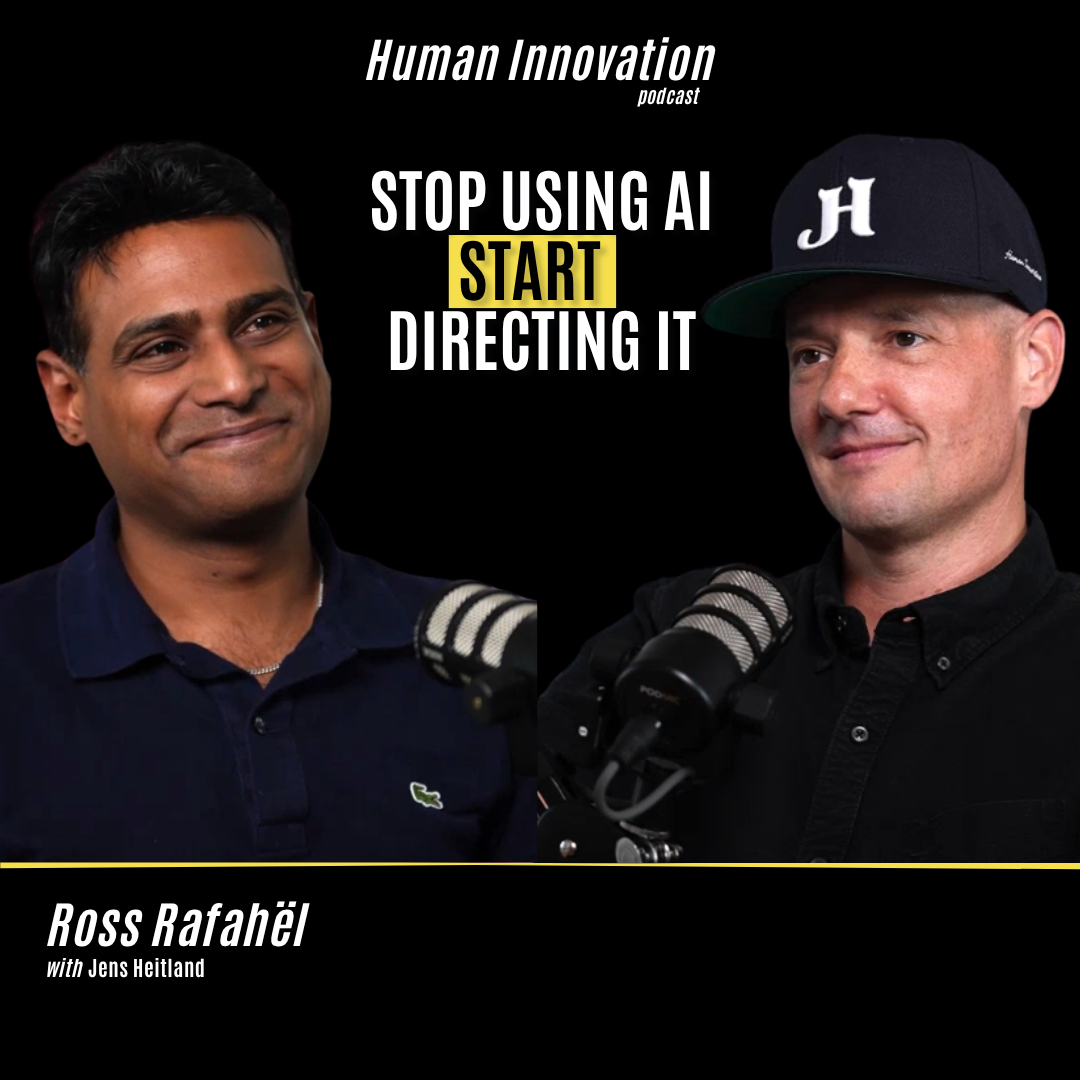
Ross Rafahël joins Jens Heitland to explore human decision infrastructure, structured unlearning, and why influencing AI matters more than simply using it.
Youtube Podcasts
The Quiet Cost of Using AI Without Directing It
I sat down recently with someone who has spent twenty years moving through organizations, countries, and disciplines. Ross Rafahël trained as a chartered accountant in Johannesburg, built a career across South Africa, Australia, and the Netherlands, and now runs a program built around a question most organizations have not yet learned to ask. What happens before an AI system produces its output?
In most organizations I have worked inside, AI has become a fixture rather than a tool people think about. It writes drafts, filters candidates, ranks risk, and produces reports that look complete. The system works. The output arrives on time. Nobody stops to examine what shaped it.
Ross described: AI is no longer scarce or specialized. It is everywhere, and the market for it is flooded. What is missing is not more access to AI. What is missing is a relationship with it, one where the human sets the intent, and the system executes it, rather than the reverse.
The pattern underneath this is what Ross calls the difference between a user of AI and an influencer of it. A user asks a system for an output and accepts what comes back. An influencer asks a different set of questions first. Who will receive this? What will they ask in response? What does success actually look like once this lands? These questions sound simple, but they change the shape of everything that follows. Ross describes this as structured unlearning: stepping back from the instinct to accept an output and instead interrogating the thinking that produced it.
He calls the resulting infrastructure Human Decision Infrastructure. The idea is that every policy, every hiring criterion, every filtering rule an organization builds has conditions behind it. Who was involved in shaping it? What intent guided the decision? Whether clarity existed at each stage. Organizations audit the policy itself rigorously. They rarely audit the conditions that produced it.
The consequence of skipping that audit is not abstract. Ross pointed to work in the insurance industry, where AI systems filter customer risk before a human ever reviews the case. When the filtering criteria lacked clarity and proper judgment at the point of design, the result was measurable. Up to 20 percent of potential revenue was filtered out before anyone had the chance to see it. Losses accumulated in a space nobody was watching, because the system was trusted to execute intent that had never been fully examined.
This pattern shows up outside of insurance too. A student asking AI to write an essay, a CEO asking it to draft a strategy, a hiring team asking it to shortlist candidates. In each case, the output looks finished. The thinking behind the request is rarely tested. We are, as Ross put it, outsourcing intelligence and sacrificing long-term thinking for short-term solutions.
None of this means AI should be used less. It means the questions asked before and after each output need to carry more weight than they currently do. Ross's Future You program takes individuals through exactly that process over several months, learning to interrogate intent rather than simply generate it.
Sitting across from someone who has rebuilt his career and his thinking multiple times, I was reminded that relevance was never really about keeping up with the newest tool. It is about staying clear on what we are asking for, and why, before we hand the work to something that will execute it without hesitation.
Timecode:
00:00 Reunion and Setup
00:46 Brotherhood in Johannesburg
01:59 Global Moves and Career Leaps
05:36 First Steps with AI Tools
08:32 From User to AI Influencer
10:21 Market Flooded Human Gap
12:19 Relevance Jobs and Purpose
16:02 Human Decision Infrastructure
19:04 Structured Unlearning with AI
21:37 Organizations and Untapped Markets
27:33 Future You Program Explained
30:00 Governance and Decision Conditions
32:49 Benefits for Business and Society
35:05 Practical Tips and How to Engage
38:12 Closing Thanks
Guest Links:
Website: https://www.rossrafahel.com/
Transcript:
[00:00:02] Jens Heitland: Ross, great to meet you again in person. Before we go into how we go from working for AI to influencing AI and all the amazing things that you work with, let's start with something more personal. A year ago, you told me the story when you together started working with your brother first time after university.
[00:00:29] Jens Heitland: You lived together with your brother in an apartment in South Africa. Let's start there and, and go to the AI afterwards.
[00:00:37] Ross Rafahël: Okay. Thank you. thank you so much for having me. It's an always an honor to, to speak with you, Jens, and and do it so personally as well. yes, starting in Johannesburg, so I was born and brought up in Durban South Africa to start our traineeship towards being chartered accountants and completed our bachelor degree and honors degree in Durban.
[00:01:02] Ross Rafahël: We moved to Johannesburg to start with one of the big four companies and yeah, indeed, we had to share an apartment 'cause we were earning quite less as trainees. And of course, moving with the mentality of always living at home and now suddenly in a bigger city- Yeah ... Johannesburg is a new country compared to people coming out of Durban.
[00:01:27] Ross Rafahël: And it, it, it meant roughing it out indeed and pushing through because suddenly you were now 100% focused on your career and and, and indeed the board exams that came through. So living with my brother was at first a smaller family. As as I started, as we both started maturing and working it became a living hell for us Okay
[00:01:53] Ross Rafahël: which was, which was good because it showed maturity to the next next stage as well, where it led us to.
[00:01:59] Jens Heitland: So going, going from that point, you have worked several years in international organization, but you as well lived in different places. How did you get from living in Johannesburg at that time to in between in Australia to now being a Dutch citizen and living in the Netherlands but having a business in Dubai?
[00:02:21] Jens Heitland: Like, how does all of that, like, work together?
[00:02:24] Ross Rafahël: Um, when said out by this way, it does sound amazing. Thank you so much. Um, to be honest um, it, it was, it was more an approach of I need to learn as much as possible and I have the techniques and I always believed throughout my studying, throughout my years that I have the best available technology now than that was ever before me.
[00:02:51] Ross Rafahël: And that was always helped me to really leverage off whatever I had. Um, and- In doing so, I pursued opportunities. I, I looked at e- every opportunity I could take, and and I've grabbed it. Studying I've done continuously without stopping until my PhD was done. But working-wise and going into other countries, I've really let myself explore.
[00:03:19] Ross Rafahël: So from Johannesburg the move out was a throw in the deep end from Durban, out of family. Later it became easier because I was led now armed with my degrees and armed with my chartered accountancy qualification. The biggest motivation for me was that it allowed you to have an international card.
[00:03:40] Ross Rafahël: Um, I followed that through to, to when I continued with my PhD after I started lecturing at the University of Johannesburg. Um, I had a scholarship with the Vrije University in the Netherlands, and I have lived here then for a few months close to a year, and I've met my now partner. that was back in 2013.
[00:04:06] Ross Rafahël: Um, during that time when I returned back, I moved with my entire family, parents, brother, sister, everyone, we, we went to, to Sydney. I was able to get a high-skilled migrant visa with and permanent residency where I worked with Deloitte. Um, but the time did ca- come therefore where I had to decide for love, and I moved to the Netherlands following my life path and getting a job with EY.
[00:04:33] Ross Rafahël: Um we were married in 2017, and in 2019 I became a Dutch national. but I've opened my company in 2017 as well here in the Netherlands. When I look back at the last 10, 15, and now 20 years of work experience, I'm, um... I cannot say that I've planned everything, which is the greatest thing. I, I, I... All I can say is I, I...
[00:05:00] Ross Rafahël: It took a lot of bravery at many steps to, to take leaps. Even to take the leap for love and leave Australia and come to the Netherlands, which many people still don't understand today. Um, I knew if love doesn't work out, I'm armed there with a strong job and my qualifications. So I always moved with independence surety with myself and that got me to understand incredible amounts of cultures and people and international experience- Mm
[00:05:33] Ross Rafahël: as you say, and that's how I got here today.
[00:05:36] Jens Heitland: So let's start with AI. How did you- Get working with AI. I mean, AI, at least from a user perspective, we look the last five years, maybe six years, I don't know exactly. How did you start working with AI, exploring with AI, and getting, getting to the understanding that you have?
[00:05:56] Jens Heitland: Before we go into what you do today, I would love to see how you evolved in a relationship with AI, if we want to call it that.
[00:06:06] Ross Rafahël: It is uh... Indeed, there's, there's no other words for it other than a relationship with AI. we actually work with, and I will give the one that most people understand, ChatGPT.
[00:06:20] Ross Rafahël: We work with ChatGPT that understands our history, our tone of speaking, our tone of writing. So indeed a great starting point is your relationship with AI. Um, I, as I mentioned, my mind was always using the best that I had. Back when I was doing my PhD, the best AI tool we had was RefWorks that allowed to do-- that helped you do your referencing, and you still had to go back because it had a lot of errors.
[00:06:47] Ross Rafahël: today, AI can help me write out my ideas. The way I was continuously using AI was late to actually go into ChatGPT because I believed it would lack knowledge. But when I did, I realized it was able to help me do the tasks that communicated my ideas without me having to waste the effort to do so.
[00:07:17] Ross Rafahël: Often having a team, often having people that work with you I have an idea or my strategy, for example, and this com- this applies to every individual: a student trying to communicate his idea through an essay a CEO trying to communicate their strategy to a board. I found that my hardest part or what was taking my time was getting these thoughts ordered and written down for the next person to understand it based on his lens and what he has.
[00:07:47] Ross Rafahël: Um, when I started what I call using AI at, at that point, it proved to be fantastic. I realized I would ask it to produce for me a Word document, and it would produce a terribly formatted two-page document that couldn't go further than three. Um, I have then started to use it to copy-paste into Word, and I realized what to do.
[00:08:13] Ross Rafahël: further, I started asking it to do Excel, and it couldn't do it. The more I worked with AI, I realized I can now... It's growing. Currently, if I ask ChatGPT to give me a perfectly worded, a perfectly formatted Word document, it's gonna produce an amazing output. So the more I realize my relationship with my AI is growing and the AI itself is getting intelligent, I started to realize that with What is current?
[00:08:47] Ross Rafahël: We have specialist knowledge at the tip of our fingertips. And then I started to challenge myself into thinking, how can I now use this AI to invent, create, leverage of what we currently have? And this is when it gets exciting. Um, I started to look into my ideas becoming an app. Everybody's looking at this today.
[00:09:11] Ross Rafahël: Yeah. Yeah. Or creating a program or tool learning coding. And when I started working with this aspect of my ideas, I started realizing how systems that are being created get intelligent by the prompts that you give it, as an example.
[00:09:31] Jens Heitland: Yeah.
[00:09:31] Ross Rafahël: Um, as I applied that to the AI I was currently using, I realized that my prompts were no longer asking the AI for output, but it was asking it to communicate ideas that I had or allow me to see what I'm missing.
[00:09:49] Ross Rafahël: that's when I realized I am making my AI intelligent because of how and what I was developing. And at that point, I, encourage then my students, I encourage people I speak to, do not become users of AI, become influencers of AI. Your prompt, your relationship with AI, and the output that you get should make the system more intelligent.
[00:10:14] Ross Rafahël: Otherwise, you have just simply used it for knowledge that already exists. If
[00:10:21] Jens Heitland: we take this, so current state twenty twenty-six, what is the gap in the market when it comes
[00:10:32] Ross Rafahël: If I take it a step back, I would rather say where ... Start off by saying where the market is flooded. AI is flooded. AI is everywhere. The ... If there is something that can be done today for you, there's probably an app being developed at this moment or released. The gap, therefore, is our relationship with it, the human experience.
[00:11:00] Ross Rafahël: Our Ability to remain appropriate and relevant in a world that's literally changing amongst us. The gap here then is not how we can use AI, but how we can get AI to be working for us. Currently, we are creating AI for comfort, and we are creating generations that are using it, but they are not creating out of that, and that's the gap.
[00:11:35] Ross Rafahël: Unless we train humans and individuals and start to, to what we call in our program Future You structured unlearning, then we will not take AI further. The loop has to continue between intelligent influencing and AI's growth. Intelligent influencing and AI's growth. My current feel is that AI is growing intelligently, but the wisdom and the knowledge of the, of the current mass population to realize how they can influence it to its next growth has not yet developed.
[00:12:14] Ross Rafahël: We are still in the phase of using it and getting quite excited with what is developed.
[00:12:19] Jens Heitland: If we go to relevance, can you define that for someone that is listening to, to this conversation? It might be very abstract in the way that, that, that you mention it. How can we define it and how can we look into what does it mean for us as humans today, and what does it mean for us as humans going forward?
[00:12:44] Ross Rafahël: Well, there's two aspects. I, I, I think the, the, the easy aspect is a relational aspect, a real aspect a human aspect in the sense of currently pe- the, the newer generations are moving away from the use of AI in the sense of people are now paying more for human interaction. Yeah. It's crazy. That's true.
[00:13:12] Ross Rafahël: the travel industry has gone up. In a store we are hoping to find somebody that we could please ask for, "Can you show me the aisle where the olive oil is?" And we are getting that less and less, and that interaction, personal app- gr- growth and how humans are going to evolve in this changing world is something that's going to be requiring attention and ev- evolu- evolution by involvement of society.
[00:13:43] Ross Rafahël: On the other aspect, being relevant and probably most important for, for any person today is employment, in serving their purpose, in earning a living, in surviving in this world that looks completely different. If we have to narrow it down to some figures, I've read last night from dice.com, in January 2026, there were 58% of AI and N- and AI intelligent development related jobs available in the US market.
[00:14:25] Ross Rafahël: And in July 2026, that has increased to 79.9%, a 20% increase in jobs for AI-related intelligence- Mm. ... in six months. The, the, the stats are there. The, the, the reality is there. The question is, currently people are training for a degree, a three-year degree which they are going to come out with a piece of paper, but are they relevant to be able to use the AI to be able to do their jobs?
[00:14:57] Ross Rafahël: The biggest industry, for example, are law firms hiring people currently that that can do a junior clerk's job. A junior clerk is there to, to, to review the, the evidence, to file et cetera. This can be done by AI. The question facing firms today is, do I hire more intelligent junior staff or do I just hire AI?
[00:15:24] Ross Rafahël: Um, and, and this is what's pushing the boundaries of where we need to think about further. Yeah. So remaining relevant, I think, is about the individual ability to have intent in what's, what they want, to have clarity, to be able to decipher in a, in an age where Options are multiple. Then premium becomes decision quality.
[00:15:54] Ross Rafahël: And this is what is based on Dr. Amman and my doctrine in human decision infrastructure and our program through FutureYou.
[00:16:02] Jens Heitland: Let's, let's look into the human decision infrastructure. What is it, and how does the individual in the end and society with that benefit from it?
[00:16:15] Ross Rafahël: This is, this is more important than most people realize.
[00:16:20] Ross Rafahël: We currently have a a world where people are interacting with AI, but the use of AI and the presence of AI does not mean that the decisions or the outcome had the clarity, had the intent, had the the consistency of what was intended to be the outcome. Currently, when we use AI and I will take it a step back, like if I had asked an individual to please produce for me a strategy report for the next six years, I would get a beautiful report from that individual.
[00:16:59] Ross Rafahël: It, uh-- And I would read it and think, "Wow, this is great." and I would stress test that. Can you tell me about the conclusions reached? Um, who is accountable at the end of the day or simple-- And you would then meet with a lack of answers. Mm-hmm. The issue with this, the issue with AI therefore, is the-- we outsource intelligence.
[00:17:24] Ross Rafahël: And when we outsource intelligence, we, we sacrifice long-term cognitive thinking for short-term solutions. In essence, we have used AI for execution And in that, what we present and what we gain today is an output that has no resemblance of anything human. It's a machine output. For us to remain relevant in the future, humans need to understand that we must use AI to execute our intent.
[00:18:02] Ross Rafahël: The difference between individuals growing being relevant in the job market today is structured unlearning and then relearning on how to be able to influence the machine that we have. We-- If you look at AI as being an ox doing the hard work, beasts of burden, we do not let the ox run around and hold onto it and hope then that whatever harvest we've collected was good.
[00:18:33] Ross Rafahël: We would lead the ox in order to ensure that all aspects are covered. Mm-hmm. And what we refer to in Future You is the user of AI ends up being the accidental you. And with structured unlearning, you learn how to use this magnificent, magnificent AI, not just to use it, but in using it to in influencing it to execute your intent, the machine itself is learning.
[00:19:04] Jens Heitland: When we talk about unstructured learning, how do we unlearn or do we need to unlearn? If we, if we take me as an example, I'm getting forty-six years old. I had a lot of experience from academical perspective. I have done all the degrees that got me to a certain point where I learned theoretical details of specific things like engineering.
[00:19:32] Jens Heitland: And then I have a life where I applied this details in a practical way in organizations. Now with the future where I have, let's say, a tool that helps me to get my thinking in a relationship with that tool and can formulate my, my way of thinking in a way that I would never be able to do by myself, what do I need to unlearn, and how do I use that to structurally learn differently going forward?
[00:20:04] Ross Rafahël: Um, it's great. I, I think this is the relevant question that we address in our courses because education today is teaching you what It seldom teaches you how and why and what then. Mm. And with AI and users of AI today that are from traditional education, we all use it to ask an output. But structured unlearning says the output is only the beginning.
[00:20:40] Ross Rafahël: First, learn to ask the bigger picture. Yeah. Why am I doing this? Who is my audience? W- when I get this output, what then? What does it mean? What do I want to get f- as a next step? If this output lands correctly, what's going to ... What the success is going to look like? And these are the questions that we start to learn to ask.
[00:21:05] Ross Rafahël: In other words, we stop asking AI to
[00:21:11] Ross Rafahël: please produce me a seven-year strategy for the business. I would maybe do that, but then I would prompt it further to say, "Well, if this is a seven-year strategy, what would investors be interested in? What room do I have? What can I think about?" Yeah. It challenges you to ask and think at a level that is beyond an output that's required.
[00:21:36] Jens Heitland: Yeah. What I love about this is there, there are two parts of that. One is it's the individual person that can apply this way of thinking, but then you have an organizational context as part of that. So it's a lot of individuals in an organizational context with a common goal to achieve something, and in the end it's, it's both required, so you use it as an individual, but as an organization you need to use it or can use it.
[00:22:05] Jens Heitland: I think you should use it as well, but that means you need to align the way of thinking with AI and the humans as part of that. How does that work?
[00:22:16] Ross Rafahël: I don't think it's, uh ... I don't think we ever need to align or there'll be a necessity to align AI and humans. I think the one thing that we can control is ensuring humans are educated today in a, in a, in a form that focuses on relevance to AI, to ensuring that we always remain ahead of AI, understanding how the loop of progress is going to work, and it's exponential, and how do we as humans remain relevant in adapting to a society of it because- I always I, I, I get across this question that says, "What prompt do you use?"
[00:23:01] Ross Rafahël: Or, "How how do you remain relevant to AI?" And I say, "I, I don't try to be," because if you try to be up to date with every single app, you've miss- you've already going to be delayed. Yeah. What I do develop then is the confidence to know that I will try any app, and I may take some time, but I will learn how to control this beast.
[00:23:22] Ross Rafahël: Yeah. Yeah. Um, and, and, and if this specific car does not drive the way I like it, then I try another. But the starting point is knowing what I like and knowing what AI is able to do, and having the confidence to say, "This car is not as good as that one, and I want that one." And as long as I can do that, you stay ahead and you stay relevant.
[00:23:49] Jens Heitland: What is quite interesting that, so if I get what you say, that means we need to think completely on a higher level than if, if we, if we move 10 years back where it was, "Okay, I can think as much as I want, but I cannot produce the output right now because I, I cannot build this," let's say, a digital app or whatever it is, "because I need 20 people, engineers, and developers to be able to do that."
[00:24:17] Jens Heitland: Today you have an idea that you can literally f- fulfill, and you build something in a matter of hours or weeks. And that means you need to think a level higher, which means what, what is the purpose of all of this? How, how do I want to use that to solve a problem in the future? It's not about how do I develop this app anymore.
[00:24:40] Jens Heitland: It's, it's, it's about higher thinking degree as an individual with a tool that can l- that, that we can leverage to do all of it.
[00:24:49] Ross Rafahël: Yes. It, it's, it's, it's changing an entire way of thinking. let's, let's give an example of, of, of situations today. We have a market where if it's, it's, it's comfortable to save me time because I create a, something that can wash my I don't know help my cat play while I'm busy, there is somebody that's going to be working on a, an invention right now, and it'll be out there.
[00:25:19] Ross Rafahël: So the market is flooded right now with people interested in creating innovative ideas.
[00:25:25] Jens Heitland: Mm.
[00:25:25] Ross Rafahël: It's really flooded. But if everyone is thinking this way, great. What are the next levels gonna think? Well, what are the markets, not just for comfort or a product, what is currently possible with AI that's untapped?
[00:25:42] Jens Heitland: Yeah.
[00:25:43] Ross Rafahël: And what is necessary? So in this whole things are changing, companies are changing, traditional companies existing that existed five years ago and operating today, that started five years ago or later, I, I consider legacy operations. Yeah. Yeah. They're, they're just any of them operating would need to would need to ask themselves, when individuals now, or the Generation X or the 15-year-olds are, are, are coming to the forefront and being innovative, you, you start to see that their focus is not creating these apps anymore, but thinking about the solutions underneath.
[00:26:23] Ross Rafahël: Um, similarly, when you start looking at what- where my focus has been with Dr. Aman, we are looking at a doctrine, human decision infrastructure, in an AI world where it cannot be touched.
[00:26:37] Jens Heitland: Yeah.
[00:26:38] Ross Rafahël: And because AI is such, it exists and it can be equated in an unobservable realm, as if we have currently a a system that would go through a li- a restriction criteria and produce a report with only candidates that meet a criteria list.
[00:27:02] Ross Rafahël: That immediate extraction of the, of the candidates that met the requirement or not was done in an invisible realm before the human that sat in front of it. Mm. Therefore, AI does exist in an unobservable, and when we are creating AI to, to influence the strength of decision and judgment-making, this is an untapped market, and this is going to influence all companies going forward and all institutions and thinking.
[00:27:30] Ross Rafahël: Mm. And that's where we're heading to today.
[00:27:33] Jens Heitland: Let's go deeper into the Future You. What, what is it helping people that will engage with it?
[00:27:41] Ross Rafahël: Future You is a necessary program. It's not a nice-to-have. As I've mentioned, the, the, the, the changing scene with AI and the interaction with the need of market, the relevance in education is changing faster than the traditional education systems can be.
[00:28:01] Ross Rafahël: The thinking, the, way students focus to think is no longer necessary and needed and relevant in the market. Therefore, getting a law degree today or an accounting degree is something AI can replicate. What we need learners to think, therefore, is how, why, what then? Where next? And this level of critical thinking and realization that knowledge is at your fingertips, any specialist knowledge, and the ability to invent and leverage of that is what needs to be taught.
[00:28:40] Ross Rafahël: And future you therefore goes on to structurally unlearning producing an output, but rather already envisioning the end and leveraging of AI to assist in producing the outputs and the milestones along that way.
[00:28:59] Jens Heitland: Yeah. So if, if I try to translate that, it's, it's a program that helps me as the student, if we call, call it like this, to leverage AI, but, but even better or differently said is it helps me to, to learn to survive in the future world, which is going to be rapidly different than even today because it's evolving so fast with the technology.
[00:29:29] Ross Rafahël: Stronger than that. Stronger than our courses are recognized. You, it's a, a digital certification as well. it's licensed as well to, to different institutions where it's offered as a course. It's far more than just for students. It's for individuals, it's for professionals all the way up. When you visit our site, you're allowed to have the free assessment.
[00:29:53] Ross Rafahël: And we realize through our codings where we need to develop.
[00:30:00] Jens Heitland: So let's take a step back. We have on one side the human decision infrastructure, the doctrine, and we have the educational layer, which is future you. How does that work all together in looking into governance?
[00:30:19] Ross Rafahël: Fantastic. Governance is, is the core of, of everything we do.
[00:30:24] Ross Rafahël: And as I mentioned to you earlier in our recordings, go- governance can take the form of, of political governance diplomatic governance, corporate governance et cetera. But ultimately with HDI, we are saying that in any governance structure, humans are involved. But I will take it down to a corporate governance example.
[00:30:52] Ross Rafahël: If we look at a policy, a simple policy, which we can term a governance object. Let's assume that this is a policy about hiring someone, and when we hire someone, we ensure that they meet certain criteria X, Y, Z, and qualifications, everything is a tick. This is fantastic. This document and this policy now will be applied to consistently through everyone that we hire.
[00:31:21] Ross Rafahël: This policy is called the governance object. But what we are questioning then is what were the conditions that gave rise to this object? In the background, there was a an assignment given to create this policy. Who was involved? What was the intent? Was there clarity throughout the process? Was-- Who's accountable for this at the end of the day before this document eventually got approved and is now consistently applying?
[00:31:51] Ross Rafahël: So what currently is happening is once a policy exists, it's been fantastically and rigorously tested throughout its process and its life and its execution through internal audit and external audit and internal controls. What's not been looked at is those conditions that gave rise to it. And HDI, Human Decision Infrastructure, says that we are proving scientifically that these conditions can be measured and can be used to influence the AI that literally exists and operates currently in this unobservable space but is underused.
[00:32:36] Ross Rafahël: And that's what we ensure that will give rise to more influence governance objects and less reliance on human judgment.
[00:32:49] Jens Heitland: What is, what is the benefit for organizations, for individuals, and for society from that?
[00:32:56] Ross Rafahël: The benefit for organizations, of course, is that where there is a lack of clarity, AI currently can rob or literally result in losses, mistakes, and reputational damage.
[00:33:13] Ross Rafahël: If I gave you an example of an insurance industry where AI is currently involved in filtering a lot of c- customer risk management- Mm ... and what comes before the individual, those filtering exceptions that have been entered into the AI could and probably will not have been tested for proper clarity, intent, judgment, selection.
[00:33:40] Ross Rafahël: The result is, if these are currently aligned through human decision infrastructure and our models, we have-- are literally evaluating that up to 20% of potential revenue was filtered out by the current AI systems.
[00:33:54] Jens Heitland: Yeah, which is a huge loss.
[00:33:55] Ross Rafahël: It is huge losses. And before the individual or the human got to see the potential, there was already loss happening- Yeah
[00:34:03] Ross Rafahël: in the background. And this is what we are proving through our science. The, the benefit for organizations are, are incredible. For the individuals themselves, there is less risk for human error because judgments are now involved and automated through the AI systems because it can- Mm ... and it's currently not done.
[00:34:25] Jens Heitland: Mm.
[00:34:25] Ross Rafahël: Completely untapped market.
[00:34:27] Jens Heitland: What does it mean for society?
[00:34:30] Ross Rafahël: For society, it means that we need to realize that this is an example of ever-changing fast pace. Um, we need to realize that AI can literally enact and execute our intent and our judgment. And when we are as a people and when we are as users unsure own intent and own clarity, AI starts determining that for us.
[00:35:04] Jens Heitland: Yeah. what can we do? What can listeners and individuals do right now who are, like we started off with, in the early phase of using AI and very simply, like, producing documents, whatever it is, which I think is 90% of, human population right now- Yeah ... that is connected to AI. They're just users. What can we as individuals do to get to the future?
[00:35:32] Ross Rafahël: I think everyone can change over days from becoming users of AI to influencers of AI. simply my easiest advice would be if AI gives you an output, ask yourself the questions, "Who is receiving this? Does it answer their question? What question will they ask? What can I expect to come back as the first review?"
[00:36:00] Ross Rafahël: What can I think about to give them the answer before they have it? It does not mean that you are an expert at coding. It means that you rise above an output to ask questions that are ahead. Because when you start asking those questions, it becomes habitual. And in fact, you start thinking at that level.
[00:36:22] Ross Rafahël: We start literally training our minds to think at a level where we are influencing AI that is executing our intent.
[00:36:33] Jens Heitland: For people that are interested in engaging with you and engaging with Human Decision Infrastructure, how can they engage with you?
[00:36:42] Ross Rafahël: Um, number one, we have our Future You program which I encourage everybody to, to take at least a self-assessment anyone from 18 years and older.
[00:36:53] Ross Rafahël: through this course, it will-- It's an individual course, individualized for you, and it takes you through your in- your own progress over three months with AI and your use with AI, how you interact, the questions you ask. In this process, you don't only structurally unlearn a way of thinking, but you also become a person that is future you that's intended- Mm
[00:37:18] Ross Rafahël: and not the accidental you. Your ability to think and interact with AI would make you relevant for the world today, the thinkers that are needed today for jobs. Um, and human decision infrastructure then is important because with any development in s- in, in, in AI or in society, they-- is an imperative need for an academic and scientific background to founder what doctrine is being proposed.
[00:37:51] Ross Rafahël: And this is an important aspect of our of our organization, where we develop the scientific foundings our academic published papers and and indeed our funding and pilot programs as well are run through HDI.
[00:38:06] Jens Heitland: Yeah. And I will definitely link everything into the show notes so that people can get to it.
[00:38:11] Ross Rafahël: Yes.
[00:38:12] Jens Heitland: Ross, thank you very much for your time. It was a pleasure to interview you and dive deeper into the relationship of humans and AI. Thank you very much.
[00:38:21] Ross Rafahël: Thank you so much for having me, Jens.